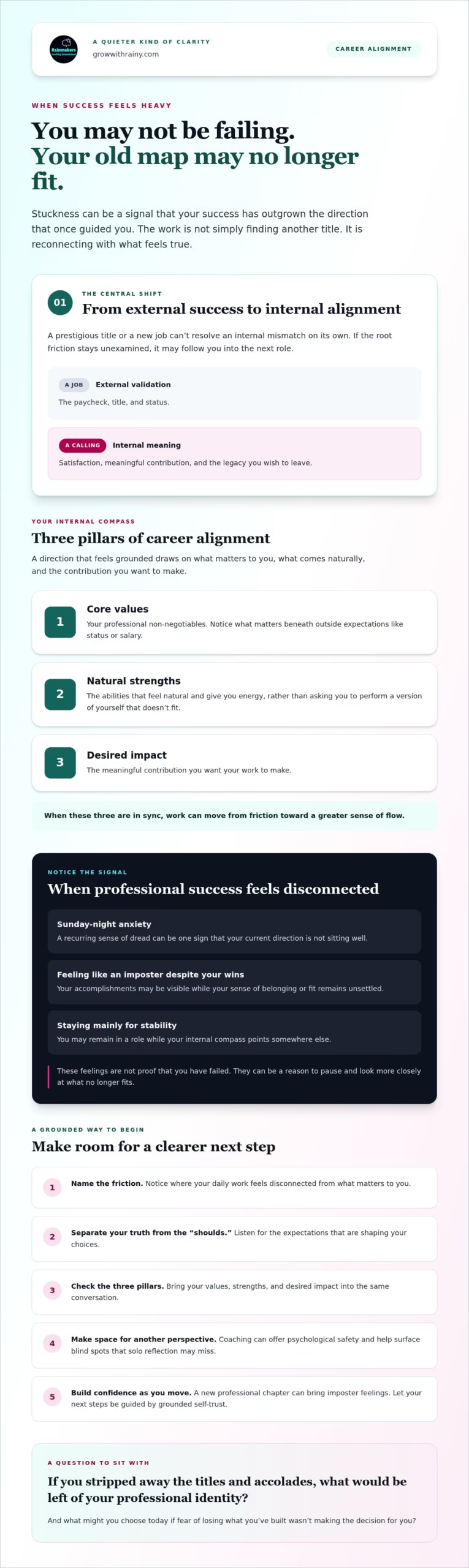
What if the heavy sense of “stuckness” you feel isn’t a sign of failure, but a signal that your success has simply outgrown your old map? It’s a quiet, persistent friction that many high-performers are facing in 2026.
You might find yourself in what researchers call “false employee retention,” where you stay in a role for the sake of stability while your internal compass points elsewhere. That says something about the weight of external expectations, doesn’t it?
It’s natural to feel a sense of paralysis when considering **how to find career direction ** at this stage of your life. The stakes feel higher, and the fear of making a costly mistake can lead to overwhelming mental clutter. You want more than just another job title; you want a sense of professional purpose that feels solid and authentic. It’s about moving from a place of hesitation to a state of quiet, decisive strength.
I promise that by the end of this guide, you’ll discover a psychological and practical framework to move from professional stagnation to a career path aligned with your true potential. We’ll explore how to clear the noise of external “shoulds” and replace your anxiety about the future with a concrete plan for alignment.
So here is my curious question: what would you choose today if you weren’t afraid of losing what you’ve already built?
Key Takeaways
- Shift your perspective from chasing external job titles to cultivating an internal state of alignment that resolves the heavy feeling of professional drift.
- Learn how to find career direction by anchoring your next move in two non-negotiable pillars: your core values and your natural, energy-giving strengths.
- Identify the hidden blind spots that solo self-reflection often misses and understand how a coaching partnership provides the psychological safety needed for deep growth.
- Apply a 5-step framework to audit your current professional state and use diagnostic tools to measure your readiness for a meaningful transition.
- Develop the quiet, rock-solid confidence required to execute your new plan and navigate the imposter syndrome that often accompanies a fresh professional chapter.
What Does It Mean to Truly Find Career Direction?
Imagine waking up on a Monday morning with a sense of anticipation rather than a heavy knot in your stomach. For many high-performers, this feels like a distant, perhaps even impossible, dream.
True career direction isn’t found in a glossy job description or a prestigious title. It’s an internal state of reconnecting with your truth where your daily actions mirror your deepest values.
You might be experiencing “Career Drift,” a phenomenon where you continue to climb the ladder, achieving every milestone, yet feel increasingly disconnected from the result. It’s success without substance.
This is why traditional job searching often fails; you’re trying to solve an internal misalignment with an external change. If you don’t address the root cause, you’ll simply carry the same friction into a new office.
Understanding What is Career Development? involves more than just skill acquisition. It requires a holistic view of your life’s trajectory and your evolving identity. At Rainmakers Coaching International, we advocate for “Heart-Centered Authority.”
This is the ability to make professional decisions from a place of grounded truth rather than reacting to external pressure or the “shoulds” of your industry. When you learn how to find career direction through this lens, the path becomes visible through the mental clutter. It’s about moving from a state of hesitation to a state of action that feels both powerful and peaceful.
The Difference Between a Job and a Calling
There is a profound psychological shift that occurs when you move from asking “What can I do?” to “What am I meant to do?” A job focuses on external validation: the paycheck, the title, and the status.
A calling, however, prioritizes internal satisfaction and the legacy you wish to leave. It’s the transition from mere survival to meaningful contribution. Career alignment is the bridge between your hard-earned skill and your deepest soul.
Symptoms of Being Professionally Unaligned
How do you know if you’re drifting? The signs are often subtle before they become overwhelming. You might experience chronic Sunday-night anxiety or a persistent sense of being an imposter despite your clear success.
This is the “High-Achiever’s Paradox,” where your accomplishments feel like a golden cage that keeps you trapped in a role that no longer fits. If your success feels heavy, it’s likely because your internal vision is obscured by the expectations of others.
You can explore more about career misalignment to see where the friction truly lies. The first step toward clarity is acknowledging that your current success isn’t enough to sustain your spirit. If you feel like an imposter despite your wins, it may be time to explore career alignment coaching to reconnect with your professional truth and move beyond the inner friction of pretending too much.
So here is my curious question: If you stripped away the titles and the accolades, what would be left of your professional identity?
The Three Pillars of Internal Career Alignment
If you’ve ever felt like your professional life was a house built on sand, you’re not alone. You can have the most impressive resume in the room, but if the internal pillars are weak, the structure eventually cracks.
When we explore **how to find career direction **, we aren’t just looking for a new office or a better title. We are looking for structural integrity. This comes from aligning three specific internal pillars: your core values, your natural strengths, and your desired impact.
Think of these pillars as your internal compass. Without them, you’re susceptible to the “Career Drift” we discussed earlier. When these three elements are in sync, your career moves from a state of friction to a state of flow. It’s the difference between pushing a boulder uphill and finally feeling the wind at your back.
Decoding Your Core Values
Your core values are the non-negotiables that define your professional integrity. Most people list “salary” or “status” when asked what they value, but these are often external pressures disguised as personal desires.
To find your true values, look back at your most fulfilling professional moments. What was happening? Were you mentoring someone, solving a complex puzzle, or creating something from scratch?
Value-conflict is one of the primary drivers of burnout. If you value “autonomy” but work in a micro-managed environment, no amount of money will stop the internal friction. You can explore these top personal value examples to begin identifying what truly anchors you. When your values are clear, decisions become simpler and much less exhausting.
From Competence to Zone of Genius
There is a dangerous trap in being “good” at things you don’t actually enjoy. This is the difference between competence and your “Zone of Genius.” Competence is what you can do well, but it leaves you drained.
Your Zone of Genius involves activities that actually give you energy. This is where “flow states” happen; those moments where time seems to disappear because you’re so deeply engaged.
I often suggest a “Strength Audit” for my clients. Look at your calendar from the last month. Which tasks felt like a heavy lift, and which ones made you feel alive? This isn’t just about skills; it’s about the psychological energy behind them. Working with a professional through career alignment coaching can help you identify these natural strengths and reconnect with the innate talents that give your work genuine meaning.
Resources like this University Career Planning Guide can offer additional frameworks for identifying these natural talents. If you find yourself consistently drained, it’s a sign that your current role is relying on your competence rather than your genius.
If you feel ready to bridge the gap between where you are and where you’re meant to be, our career direction coaching program is designed to help you solidify these pillars.
So here is my curious question: Which of your many talents are you currently using out of obligation rather than inspiration?
Self-Reflection vs. Professional Career Coaching
There is a specific kind of exhaustion that comes from circling the same three thoughts for six months. You’ve likely spent late nights staring at job boards or filling out journals, hoping that the “right” answer will suddenly appear on the page.
While self-reflection is a vital starting point, it often hits a psychological ceiling. You cannot see the back of your own head, and similarly, you cannot easily identify the deep-seated “blind spots” that keep you tethered to a path that no longer serves you. That says something about the limits of the solo journey, doesn’t it?
When you are trying to figure out how to find career direction, the difference between going it alone and working with a mentor is primarily one of speed and depth. A coach acts as an objective mirror, reflecting back the patterns you’re too close to see. This partnership provides the psychological safety required to explore “risky” paths that your internal filters might usually discard.
In a 2026 job market where hiring has cooled and employers are more cautious, having a clear, coached strategy isn’t just a luxury. It’s how you stay grounded, make wiser decisions, and keep moving towards the career that truly fits you.
The Limitations of the Inner Monologue
Our internal monologue is often dominated by an “Inner Critic” that is designed to keep us safe, not fulfilled. This critic filters out your most innovative ideas before you even have the chance to consider them.
By engaging with a “wise peer,” you allow someone else to challenge these self-imposed limits and help you navigate the internal friction of a potential pivot. This external perspective is what turns a stagnant internal debate into a decisive plan of action.
When to Seek a Career Development Coach
There are specific “pivot points” where the need for an Empathetic Catalyst becomes undeniable. If you are facing mid-career stagnation, executive burnout, or the “High-Achiever’s Paradox” mentioned earlier, solo exercises might only increase your mental clutter.
You need a deeper coaching experience that helps you clear the doubt, reconnect with your truth, and move from hesitation to authority. Learn how career coaching can clarify your next move and provide the bridge you need to cross from where you are to where you belong.
Choosing to work with a professional is an admission that your future is worth more than your current comfort. It’s about deciding that you’ve spent enough time wondering and are ready to start knowing.
For practitioners in the helping professions who want to build their business with authority, you can learn more about Martin Hogg Private Practice Success to discover specialized coaching and accredited training.
So here is my curious question: How much longer are you willing to let your Inner Critic be the sole architect of your career path?
A 5-Step Framework to Reclaim Your Career Direction
Moving from a state of professional drift to one of decisive alignment requires more than just a new resume. It requires a guided process that supports your internal truth while acknowledging the realities of the 2026 job market.
For many high-performers, discovering how to find career direction is a methodical journey of stripping away the “shoulds” to reveal what is already there. This framework moves you through the internal work before you ever look at a job board.
- Step 1: The Internal Audit. This involves clearing the mental clutter and identifying the core pillars we discussed earlier. It’s about honesty. If you don’t know what you’re auditing, you’re just rearranging the furniture in a room that doesn’t fit you anymore.
- Step 2: The Confidence Check. Assessing your readiness for change.
- Step 3: Market Mapping. Aligning your internal pillars with real-world opportunities—such as those in civil construction at Lakes Consultancy Limited—in a cooling labor market where skills are prioritized over titles.
- Step 4: Strategic Prototyping. Testing the waters.
- Step 5: Decisive Execution. Creating a transition plan with authority and self-trust.
Step 2: Assessing Your Professional Confidence
Confidence is the engine that drives your career path. Without it, even the clearest map is useless because you’ll never put the car in gear. Many professionals confuse competence with confidence.
You can be highly competent in your role yet feel a deep hesitation about stepping into something new. This internal friction is often where the fear of making a high-stakes mistake lives. That says something about the need for diagnostic clarity, doesn’t it?
I suggest watching our free training on Building Rock Solid Confidence or taking the confidence self-assessment to identify these hidden hesitations.
So here is my curious question: If you weren’t afraid of failing, which path would you choose today?
Step 4: Testing the Waters Without Quitting Your Day Job
In 2026, with private sector payroll growth averaging 88,000 jobs monthly in the first half of the year, employers are being more selective. This makes “Strategic Prototyping” essential. You don’t need to quit your job to gather data on a new direction. Instead, look for “micro-volunteering” opportunities or conduct informational interviews in your target field. This moves you from “hesitation to decisiveness” through small, low-stakes wins.
Gathering this data allows you to “test drive” the reality of a new role without compromising your current stability. It’s about replacing mental drama with concrete evidence. When you have data, your anxiety about the future begins to dissolve. You’re no longer guessing how to find career direction; you’re actively observing it.
Discover how our career direction coaching can help you execute your 5-step plan with confidence.
Building the Confidence to Execute Your New Direction
Knowing where you want to go is one thing. Taking the first step is where the internal friction truly begins. When you finally understand how to find career direction, you might expect a sudden wave of relief.
Instead, it is often accompanied by a sharp spike in self-doubt. That says something about our deep attachment to the familiar, even when that familiar path is no longer fulfilling. Execution requires a different kind of strength than reflection does.
This is where “Imposter Syndrome ” often makes its loudest appearance. As you stand at the threshold of a new professional chapter, your inner critic might whisper that you are unqualified or that your new vision is a high-stakes mistake.
It’s important to recognize that this resistance isn’t a sign to stop. It’s a sign that you are challenging the “High-Achiever’s Paradox” we discussed earlier. Building “Rock Solid Confidence” acts as the structural foundation for your pivot, ensuring that your new path is built on authenticity rather than external validation.
Overcoming the Fear of the Unknown
Think of this transition like navigating a road at night. You don’t need to see the entire highway to reach your destination. You only need to see as far as your headlights reach. You only need to see the next light.
Quieting the inner critic during a professional transition isn’t about achieving total silence. It’s about moving from a state of hesitation to one of decisive action despite the noise. My Career Direction Coaching Program helps you anchor yourself in your “Heart-Centered Authority” when the path feels uncertain.
Your Next Step Toward Clarity
Professional fulfillment is a choice, not a matter of luck. It is the result of deciding that your true potential is more important than your current comfort. If you’ve spent months or years feeling “stuck,” the most transformational thing you can do is take one immediate, concrete action.
Start with a self-assessment to clear the remaining mental clutter. When you move with authority, the world tends to get out of your way.
Take the Self-Confidence Quiz to see if you are ready for your next big move
So here is my curious question: What is the one small action you can take today that your future self will thank you for?
Stepping Into Your Next Chapter with Authority
Your professional journey isn’t a series of accidental job titles; it’s a reflection of your internal state. We’ve seen that the friction you feel is often just a signal that your old map no longer matches your current potential.
By anchoring yourself in the three pillars of alignment, with personalised coaching journey, you move from the High-Achiever’s Paradox into a space of genuine purpose. That says something about the power of intentionality, doesn’t it?
Understanding how to find career direction is ultimately about choosing clarity over comfort. It requires the courage to look at your blind spots and the grounded support to navigate the unknown.
At Rainmakers, we provide that bridge through our empathetic, heart-centered approach and transformational coaching programs . It’s about moving from a state of hesitation to one of decisive, quiet strength.
Discover your path with Rainmakers Coaching International
You can start this transition today with our Self-Confidence Quiz for instant clarity on what might be holding you back. Fulfillment isn’t a lucky break; it’s a result of the internal shifts that lead to external results. You’ve spent enough time wondering; it’s time to start knowing.
So here is my curious question: If you knew you couldn’t fail, what is the very first step you’d take toward your new direction tomorrow?
Frequently Asked Questions
How do I know if I need a career change or just a new manager?
You can distinguish between the two by looking at the source of your friction; if your values still align with the work but the environment is toxic, it’s likely a management issue. If the work itself feels heavy regardless of who leads you, it’s a structural misalignment. That says something about the difference between environment and essence, doesn’t it?
Can a career development coach help me find my passion if I have no idea what it is?
A coach helps you uncover passion by identifying the activities that naturally give you energy, even if you can’t name them yet. We look for patterns in your “flow states” rather than waiting for a bolt of lightning. This is a core part of how to find career direction when the path feels obscured by mental clutter and external “shoulds.”
Is it too late to find a new career direction if I am in a senior-level role?
It is never too late for a pivot, especially as senior-level professionals often have the most transferable “meta-skills” to leverage in new chapters. In 2026, many leaders are redefining success to prioritize work-life balance and meaningful impact over traditional metrics. Your experience is a solid foundation, not a cage that keeps you trapped in a role that no longer fits.
How long does it typically take to find a clear career direction through coaching?
While every journey is personal, most professionals begin to see a clear shift in perspective within three to six months of consistent coaching. The initial diagnostic phase provides immediate relief from mental clutter, while the execution phase takes longer to solidify. It’s a methodical transition from hesitation to decisiveness that requires both patience and a commitment to your own growth.
What is the first step I should take if I feel completely lost in my career?
The first step is to conduct an internal audit to clear away the external expectations that are drowning out your own voice. You can’t navigate a new path until you understand why the current one feels so heavy. Starting with a diagnostic tool, such as a self-assessment, offers instant clarity and helps you identify the specific areas where your internal pillars have begun to crack.
How does self-confidence affect my ability to choose a career path?
Self-confidence acts as the engine for your decision-making; without it, you’ll likely choose the “safe” path rather than the aligned one. High-performers often suffer from a hidden lack of confidence that manifests as perfectionism or procrastination. Strengthening this foundation is essential for how to find career direction with authority and structural integrity, ensuring you move toward your true potential.
What is the difference between executive coaching and career direction coaching?
Executive coaching focuses on refining leadership skills and performance within your current trajectory, whereas career direction coaching is about questioning the trajectory itself. One helps you climb the ladder faster; the other ensures the ladder is leaning against the right wall. Both require a heart-centered authority to be truly effective and lead to long-term professional fulfillment.
How can I find career direction while still working a demanding full-time job?
You can find direction by dedicating small, intentional blocks of time to “strategic prototyping” and reflection without compromising your current stability. Use your existing role as a laboratory to test which tasks energize you and which drain you. This allows you to build momentum quietly before making a visible move. So here is my curious question: What is one small shift you can make in your current workday to test a new strength?

Article by
Rainy Rainmaker
Rainy Rainmaker is the founder of Rainmakers Coaching International and a transformational coach for confidence, self-trust, and authentic leadership. Based in Singapore, she helps high-achieving professionals, managers, and leaders who appear capable on the outside but feel quietly held back by self-doubt, overthinking, imposter feelings, burnout, or a loss of direction. Through her signature Rainmaker Transformation Journey™, Rainy helps clients uncover the insights already within them and turn inner clarity into aligned action that creates lasting change in how they work, lead and live.
