
You know you should delegate more. But when the stakes are high, you still find yourself checking the details, stepping back into the work, or quietly thinking, *“It’s easier if I just do it myself.” *For many high-achieving leaders, the challenge is not knowing how to delegate effectively.
It is trusting yourself enough to let go. When you have built your success on being capable, reliable and highly involved, delegation can feel surprisingly uncomfortable. Letting someone else take ownership may trigger concerns about quality, mistakes, missed expectations, or even whether you are still adding enough value if you are no longer the one doing the work. But leadership at a higher level requires a different kind of contribution.
Your value can no longer come from carrying more. It has to come from creating clarity, building capability, making better decisions and enabling others to succeed. Learning to delegate effectively is therefore not simply about redistributing tasks. It is about shifting from proving your value through doing to trusting yourself enough to lead.
Key Takeaways
- Identify the High-Achiever Self-Trust Gap to understand why you remain the bottleneck despite your experience and seniority.
- Discover how to delegate effectively by recognizing the Control pattern, a learned strategy that uses micromanagement to create a false sense of safety.
- Move beyond superficial management hacks using the 3-R Framework to release protective habits and reprogram your approach to leadership.
- Transition from the weight of over-responsibility to grounded leadership by reconnecting with your truth and internal certainty.
- Learn to empower a team that thrives without constant oversight, allowing you to focus on strategic vision rather than daily fires.
The Delegation Deadlock: Why Capability Isn’t the Problem
You have the track record and the title, yet you’re still the bottleneck for every decision. It feels like every email, every approval, and every minor crisis must pass through your hands before it can be resolved. You know you should be focusing on the big picture, but you’re caught in the weeds. Most management advice suggests you just need a better “to-do” list or perhaps a more competent team. But what if the problem isn’t your systems or your staff?
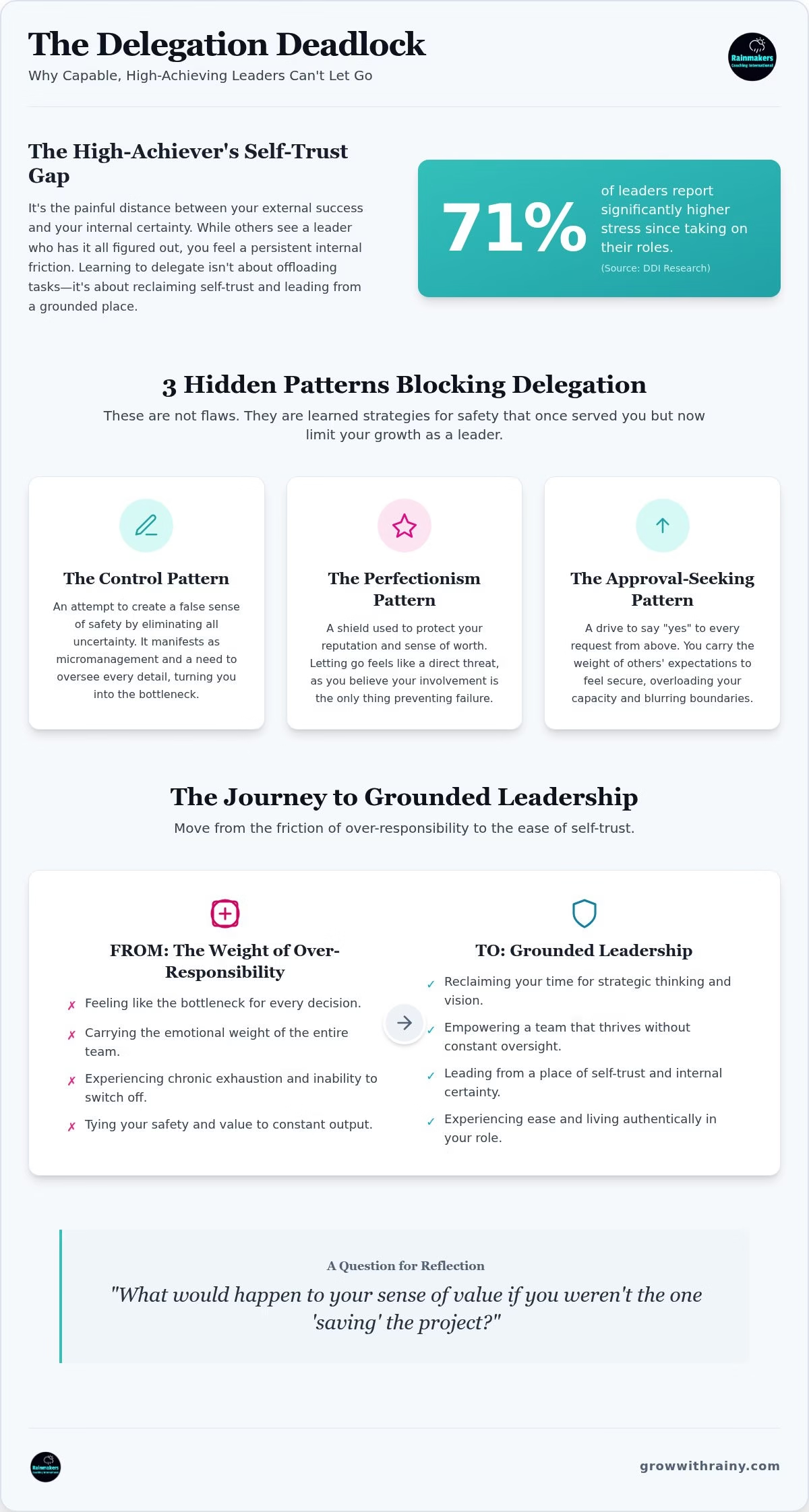
The real challenge is the “High-Achiever Self-Trust Gap.” This is the painful distance between your external success and your internal certainty. While others see a leader who has it all figured out, you feel a persistent internal friction. Learning What is Delegation? is often framed as a technical skill. However, understanding how to delegate effectively is actually an act of reconnecting with your truth. It is a shift from offloading tasks to standing in your grounded authority.
The Weight of Over-Responsibility
At Rainmakers Coaching International, we recognize a core principle: over-responsibility often begins in childhood. It starts when a young person learns they must keep everything and everyone okay to feel safe or valued. As an adult leader in today’s demanding professional environment, this pattern manifests as a professional problem, but it rarely stays at the office.
It bleeds into your personal peace, making it impossible to truly switch off during a well-deserved weekend break or a quiet family dinner. You aren’t just managing a team; you’re carrying the emotional weight of the entire organization. This grounded burden leads to chronic exhaustion because you’ve tied your safety to your constant output.
Why More Evidence Isn’t the Answer
You might think that one more successful project or another promotion will finally make you feel secure enough to let go. Yet, your long list of wins hasn’t silenced the fear that “this time, it will fail.” This isn’t a lack of ability. A landmark study by Clance and Imes (1978) on the Imposter Phenomenon highlighted how high-achieving individuals often fail to internalize their success. They credit luck or intense effort rather than their own competence.
To learn how to delegate effectively, you don’t need more evidence of your capability. You have plenty of that. Instead, you need to trust the evidence you already have. You must stop using performance as a shield and start leading from a place of self trust. When you trust the grounded foundation you’ve built, letting go becomes a natural progression rather than a risky leap.
What would happen to your sense of value if you weren’t the one “saving” the project?
Identifying the Hidden Patterns Blocking Your Hands-Off Leadership
Micromanagement is rarely about a lack of trust in your team’s skills. It’s often the “Control” pattern attempting to create safety by eliminating uncertainty. At Rainmakers, we view these as protective patterns. These are learned strategies for safety, not clinical diagnoses. They served you well when you were building your career in Singapore’s fast-moving business world. Your “high standards” were the engine of your success. However, that same shield of perfectionism now acts as a barrier to how to delegate effectively.
These patterns helped you climb the ladder, but they now limit your next stage of growth. When you are tied to every detail, you aren’t leading; you’re just busy. While tactical resources like 9 Delegation Tips for Managers provide useful frameworks, they often don’t stick if your internal safety system is still sounding the alarm. To move forward, you must challenge the assumption that your constant involvement is the only thing preventing a disaster.
The Trio of Delegation Blockers: Control, Perfectionism, and Approval-Seeking
Controlling behavior may begin as an attempt to reclaim safety or freedom in a chaotic environment. If you feel that you must oversee every approval, you’re likely operating from this space.
Perfectionism is another strategy, often used for protecting love, acceptance, and worthiness. In a high-stakes leadership role, this makes letting go feel like a threat to your reputation.
Finally, “Approval-Seeking” makes you say yes to every request from above, which inevitably leads to the over-responsibility trap. You take on too much, making it impossible to learn how to delegate effectively because you’re too overwhelmed to even plan the hand-off.
This cycle of over-functioning often leads to perfectionism and burnout. If you recognize these tendencies in yourself, you might find clarity through a grounded coaching conversation to explore what’s driving your need to hold on so tightly.
Removing the Mud from the Diamond
Transformation isn’t about “fixing” your lack of trust. It’s about removing what prevents you from being yourself. Imagine your innate leadership value as a diamond. Over the years, your protective strategies have covered it in mud. You don’t need to create a new diamond; you just need to clear away the layers that no longer serve you.
When you operate from a place of self trust, you no longer need to use performance as proof of your value. You can lead with a grounded confidence that empowers your team to step up without your constant intervention.
Which protective pattern is currently holding the steering wheel of your department?
Why Superficial Management Hacks Fail Senior Leaders
Many leaders try to learn how to delegate effectively by adopting new project management tools or following “hustle” advice that demands even more effort. These are often external patches for an internal challenge. Real confidence isn’t about becoming louder or more aggressive; it’s about being yourself when the stakes are high.
If you are constantly pushing to do more, you are likely ignoring the internal friction that leads to burnout . Generic advice to work harder ignores the psychological weight of leadership. The “fake it till you make it” mindset is particularly damaging. It suggests that your current state is inadequate and forces you into a performance that drains your energy. This creates a deep internal misalignment.
Instead of trying to force growth through sheer willpower, the path forward involves building rock solid confidence. This is the foundation of grounded leadership, where your actions come from a place of certainty rather than a need to prove your worth.
Grounded Self-Trust vs. External Performance
Grounded self-trust is an internal alignment where your performance is no longer proof of your value. A “noisy” leader often micromanages because their sense of worth is tied to the outcome of every single task. In contrast, the leader who leads from a place of quiet strength knows their value is inherent. They don’t need to be the hero in every story to feel secure in their role.
The impact of this shift is measurable. According to Gallup, the manager is responsible for at least 70% of the variance in their team’s engagement. Leaders who operate from self trust are better equipped to provide the autonomy that drives this engagement.
Research shows that highly engaged teams deliver approximately 23% higher profitability than those with low engagement. When you trust yourself, you naturally create the space for your team to excel.
The Trap of Micromanaging Others
It’s easy to blame the team’s “readiness” as the primary obstacle to delegation. You might tell yourself they don’t have the right skills or that the risk is too high. While training is essential, the primary hurdle is often your own internal safety system. When you don’t trust yourself, you cannot truly trust the agency or voice of those around you. You end up over-functioning, which inadvertently trains your team to remain passive.
To learn how to delegate effectively, you must be willing to let go of the need for total certainty. If you are always there to catch every ball, your team will never learn to hold them. This cycle of dependency is exhausting for you and demoralizing for them. True empowerment happens when you trust your grounded leadership enough to allow others to lead in their own way.
Are you training your team to be independent, or are you training them to need your approval?
Reclaiming Your Truth: The 3-R Framework for Delegation
True leadership transformation isn’t measured by a certificate on your wall or a new software subscription. It’s measured by who you become in the moments when the pressure is highest.
If you’ve been searching for how to delegate effectively, you’ve likely found dozens of task-management checklists. But those checklists often fail because they don’t address the internal friction that makes letting go feel like a threat. The Rainmaker Transformation System™: Beyond Fixing Flaws offers a path toward grounded leadership through three specific stages: Release, Reprogram, and Recondition.
Release and Reprogram: Breaking the Cycle
The first step is to Release. This involves acknowledging the “Over-Responsibility” pattern without judgment as it arises. When you’re about to assign a task and feel that familiar tightening in your chest, stop. Recognize that this is a learned strategy for safety. By naming the pattern, you begin to separate your value from the work itself. This awareness is the foundation of learning how to delegate effectively without the emotional baggage of the past.
Next, we Reprogram. High achievement in Singapore’s competitive executive landscape often begins when a person learns to use performance as proof of their worthiness. You must challenge this belief. Reprogramming is the conscious act of choosing self-trust over the familiar safety of your old protective patterns. It’s about shifting your internal narrative from “I must do this to be safe” to “I am grounded in my truth, and I can trust my team’s agency.”
Recondition: The Practice of Grounded Leadership
Reconditioning is where the real work happens. It involves small, high-stakes moments where you choose to stay in your truth rather than stepping back into control. A practical strategy for this is the “24-Hour Rule.” When you delegate a task, commit to not checking in for at least 24 hours, regardless of the urge to “just see how it’s going.” This creates the space necessary for your team to lead and for you to reclaim your time for strategic thinking.
This practice is backed by the science of neuroplasticity. Research shows that consistent “letting go” creates new grounded neural pathways in the brain. Each time you resist the urge to micromanage, you are physically reconditioning your brain to feel safe in a state of delegation. Over time, the internal friction decreases, and leading with ease becomes your natural state. You aren’t just changing a habit; you’re changing your internal architecture.
When was the last time you allowed a task to be completed without your final “polish”?
Leading and Living Authentically: The Goal of Self-Mastery
The ultimate objective of learning how to delegate effectively isn’t simply more success. At Rainmakers, we believe the goal is to become more fully yourself. When you operate from a place of self trust, you no longer need to use performance as proof of your value. You stop looking for external validation because you are already grounded in your own truth.
This shift allows you to move from the exhaustion of over-responsibility to the ease of Executive Presence: Reclaiming Self-Trust for Authentic Leadership in 2026. Reconnecting with your truth doesn’t just happen in the office; it ripples across all pillars of your life, from your health to your relationships.
The Tangible Results of Inner Transformation
Transformation inside the leader creates a powerful ripple effect across the entire organization. When you release the need for control, team morale rises because employees finally feel the agency to own their work.
Strategy becomes clearer because you are no longer too tired to see the horizon. A professional problem, such as a bottleneck in decision-making, is often solved by this internal shift in perspective. Research from DDI’s Global Leadership Forecast 2025 indicates that only 19% of manager candidates demonstrate strong delegation abilities. By mastering this grounded skill, you aren’t just improving your workflow; you’re becoming the exception in a leadership landscape of stressed, over-functioning professionals.
Who would you become if you were no longer afraid of what happens when you aren’t in control?
Perhaps you would use that energy to master a new domain entirely; for example, you can explore Theorieopleiding Belgisch Stuurbrevet to learn the theory behind navigating Belgian waters.
When a Mirror is Needed for the Journey
Insight is a beautiful beginning, but it is not the same as transformation. You can understand the mechanics of how to delegate effectively and still feel the physical pull to micromanage when the stakes are high. Sometimes, you need a mirror to see the invisible patterns that are holding the steering wheel of your department. This is the value of executive coaching.
It provides the psychological safety and expert mirror needed to bridge the High-Achiever Self-Trust Gap and move toward lasting change. Transformation is measured by who you become, not just what you know about management tactics.
Stepping Into Your Grounded Authority
Moving from the weight of over-responsibility to the ease of grounded leadership is a journey of reconnecting with your truth. You’ve seen that the bottleneck isn’t your team’s capability, but the protective patterns that once kept you safe.
By bridging the High-Achiever Self-Trust Gap, you create space for strategic vision and genuine team empowerment. Learning how to delegate effectively is ultimately an act of self trust that allows you to lead without the constant need for performance as proof of your value.
This transformation requires a mirror to see the patterns that have become invisible. Guided by the Rainmakers Transformation System™ and rooted in more than a decade of experience with senior leaders, we work to release the old and recondition the new. You don’t have to carry the entire organization on your shoulders to be a successful leader.
You’ve already built an incredible track record. Now, it’s time to build a leadership style that feels as solid and authentic as the results you’ve achieved. The ease you’re looking for is waiting on the other side of letting go—whether that means spending more quality time with family or finally trying a beginner’s baking session at Bespoke Bread.
Frequently Asked Questions
Why do I feel guilty when I delegate tasks to my team?
Guilt usually arises from the “Over-Responsibility” pattern. You’ve likely learned that your value is tied to carrying the heaviest load yourself. When you delegate, you feel like you’re offloading a burden onto someone else. Reconnecting with your truth means realizing that your team actually grows when they take on these challenges. You aren’t “saving” them by doing the work; you’re actually limiting their professional development and your own strategic capacity.
How do I know if I am micromanaging or just maintaining high standards?
The difference lies in your internal state of being. High standards are about the quality of the output, whereas micromanagement is about the “Control” pattern trying to eliminate uncertainty. If you feel a physical need to oversee every minor step to feel safe, you’re likely micromanaging. Grounded leadership allows for different paths to the same high-quality result. Are you focused on the excellence of the work or the safety of the process?
What is the most common reason delegation fails for senior leaders?
The most common reason is the “High-Achiever Self-Trust Gap.” Leaders often know the technical steps of how to delegate effectively, but their internal safety system won’t let them follow through. They feel that letting go is too risky for their reputation. This isn’t a lack of management skill. It’s a protective strategy that prioritizes the safety of constant involvement over the long-term benefits of team empowerment and organizational growth.
Can coaching help me let go of control if I’ve always been a perfectionist?
Coaching provides the mirror you need to see the invisible patterns of Perfectionism . We don’t try to “fix” you, as you aren’t broken. Instead, we use the Rainmakers Transformation System™ to Release the protective strategies that no longer serve you. By Reprogramming the belief that your worth depends on flawless performance, you can lead with a quiet strength that doesn’t require constant, exhausting oversight of every detail. You become more fully yourself.
Is over-responsibility the same as being a dedicated leader?
They are often confused, but they are distinct. Dedication is a choice to serve a mission, while Over-Responsibility is a learned strategy to keep everything okay. Dedication allows you to empower others and trust their agency. Over-responsibility, however, makes you feel that everything will fall apart if you aren’t personally involved. This pattern leads to chronic exhaustion and prevents you from standing in your grounded authority as a senior leader.
How long does it take to build grounded self-trust in my leadership?
Transformation is a journey of reconditioning rather than a quick fix. While you can gain deep insights in a single coaching session, building new grounded neural pathways takes consistent practice. Most leaders notice a significant shift in their internal friction within a few months of dedicated executive coaching. The goal is to reach a state where self trust becomes your default response, even when the stakes are high and the pressure is intense.
What should I do if a delegated task actually fails?
Treat failure as a system diagnostic rather than a personal failing. When a task fails, the “Control” pattern often tries to seize the steering wheel again. Instead, use this moment to evaluate if the Reprogramming of your delegation process was clear. Did the team have the grounded resources they needed? Reconnecting with your truth allows you to address the error with calm authority rather than reacting from a place of fear, blame, or over-functioning.
How do I stop overthinking every decision my team makes?
Overthinking is often an attempt to create safety by eliminating uncertainty. To stop this cycle, you must practice trusting the evidence of your team’s capability. Start by applying the “24-Hour Rule” to small decisions. Learning how to delegate effectively means accepting that your team might take a different route to the destination. When you stop over-functioning, you give your team the dignity of their own voice and agency, which builds long-term trust.

Article by
Rainy Rainmaker
Rainy Rainmaker is the founder of Rainmakers Coaching International and a transformational coach for confidence, self-trust, and authentic leadership.
Based in Singapore, she helps high-achieving professionals, managers, and leaders who appear capable on the outside but feel quietly held back by self-doubt, overthinking, imposter feelings, burnout, or a loss of direction. Through her signature Rainmaker Transformation Journey™: Release, Reprogram, Recondition – Rainy helps clients uncover the insights already within them and turn inner clarity into aligned action that creates lasting change in life, career, and leadership.
