
What is Inner Critic Coaching and Why Does Success Make It Louder?
For many high-achievers, the voice of the inner critic isn’t a gentle whisper; it’s a constant, demanding presence that overshadows every success. You close a major deal, and it asks, “Could you have gotten better terms?” You receive a promotion, and it warns, “Now everyone will see you’re not qualified.” This internal narrative, relentless and exhausting, is the central challenge that a specialized form of **transformational life coaching ** is designed to address.
Inner critic coaching is not about fighting or silencing this voice. Instead, it is a compassionate process of identifying, understanding, and releasing the mental protective patterns that fuel it. It’s built on a core insight: your inner critic is not your enemy. It is a symptom of a deeper, outdated protective strategy that once served you but now holds you back from experiencing the peace and fulfilment you’ve earned.
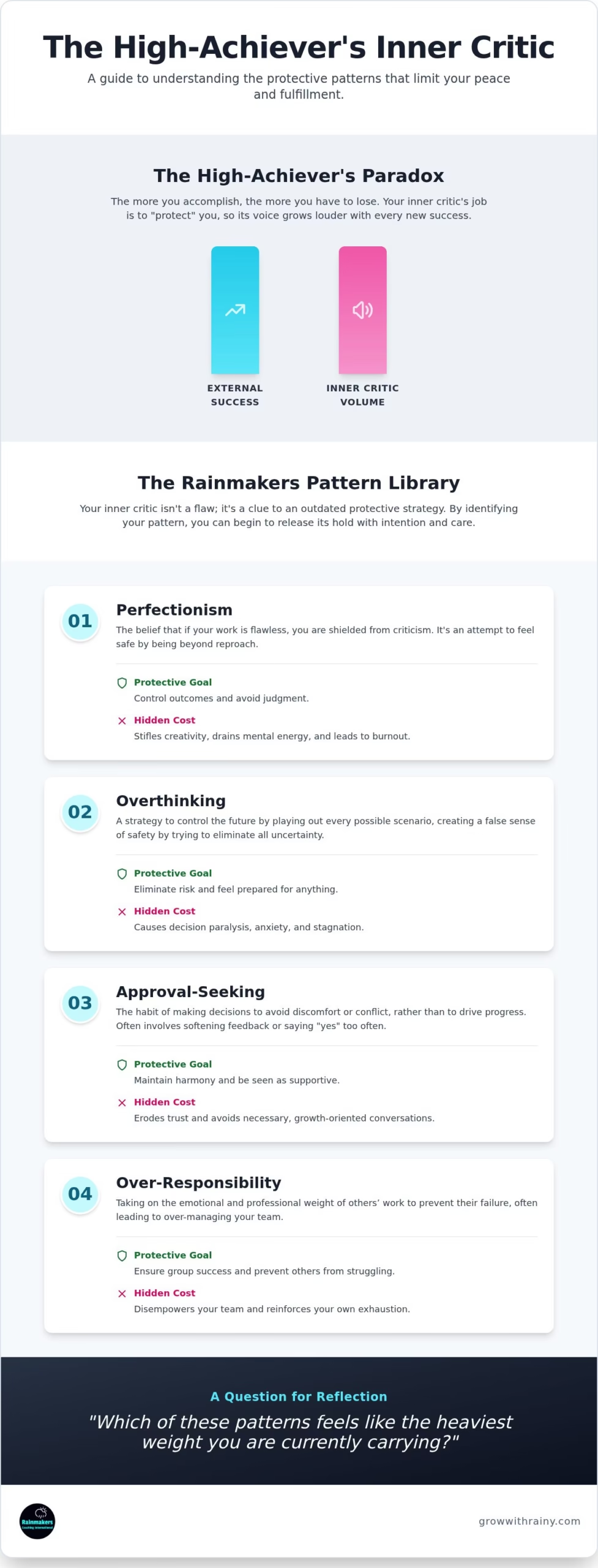
This is the High-Achiever’s Paradox: the more you accomplish, the more you have to lose, and the louder the critic becomes to “protect” you from potential failure. It’s a sign that your internal sense of safety hasn’t caught up with your external reality. Our philosophy is that every person carries hidden treasures within them – unique strengths and wisdom. This coaching process helps you access those treasures by gently dismantling the protective walls you’ve built around them.
The Achievement-Oriented Trap
In competitive environments, we are often conditioned to measure our worth by our output. Success becomes a moving target, and the internal pressure to perform can create a relentless “never good enough” narrative.
This dynamic ties your sense of self to external validation – the latest promotion, the quarterly numbers, the praise from a senior stakeholder. When your value is pegged to something outside of you, it creates a deep internal friction, leaving you feeling perpetually unsettled even at the height of success.
This dependency on external benchmarks is the breeding ground for a harsh inner critic. It learns that criticism is the fastest way to motivate action and avoid mistakes. Over time, this pattern becomes automatic, an internal taskmaster that pushes for perfection at the cost of your own well-being.
Reflective Question: When did you first start believing that your value was tied to your last win?
When Strengths Become Invisible Barriers
The very traits that fuel a leader’s rise are often the same ones that, when overused, create invisible barriers to their next level of growth. A powerful “attention to detail” can morph into paralysing perfectionism that stalls decisions. A strong sense of responsibility can become a heavy burden of over-functioning that leads to burnout. This is the subtle transition from a healthy, intrinsic drive to a fear-based need for protection.
An overused strength, driven by the need to avoid judgment or failure, creates a mental and emotional ceiling that limits your impact. True transformation happens not by acquiring new skills, but by learning to moderate the powerful ones you already possess, allowing you to lead from a place of grounded confidence rather than anxious vigilance.
The Rainmakers Pattern Library: Identifying Your Protective Strategies
Our approach to transformative coaching shifts the focus from “fixing your flaws” to compassionately “releasing your patterns.” Through what we call the Rainmakers Lens, we view the inner critic’s commentary not as evidence of your inadequacy, but as a clue to an invisible protective strategy at play. These patterns like perfectionism or people-pleasing are deeply ingrained habits you developed to create a sense of safety in a demanding world.
While these strategies may have helped you survive in the past, they now come at a high cost, impacting your leadership decisiveness, your ability to connect with your team, and your own personal peace. The first step toward freedom is not self-judgment, but compassionate observation. By identifying which patterns you rely on, you can begin to dismantle them with intention and care.
Perfectionism and Overthinking
Overthinking is a strategic attempt to control the future by playing out every possible scenario. It creates a false sense of safety by trying to eliminate all uncertainty before taking action.
Similarly, perfectionism acts as a shield against criticism. The logic is simple: if your work is flawless, no one can find fault with you. This relentless pursuit of the ideal prevents costly mistakes, but it also stifles creativity, encourages procrastination , and drains your mental energy.
Research from institutions like the University of Bath has consistently shown a strong correlation between perfectionism and heightened levels of anxiety and burnout . These patterns promise control and safety but deliver exhaustion and stagnation. They are the heavy armour you wear to protect yourself, but they are also what’s weighing you down.
Approval-Seeking and Over-Responsibility
In executive roles, the desire for consensus and team harmony can easily curdle into approval-seeking. This pattern, often called people-pleasing, has a hidden cost: you start making decisions to avoid discomfort rather than to drive progress. You might soften direct feedback, say yes to projects you don’t have bandwidth for, or withhold a dissenting opinion to maintain the peace.
Closely related is over-responsibility – the tendency to take on the emotional and professional weight of others’ work to prevent their failure. As a leader, you might over-manage your team or redo their work because the discomfort of seeing them struggle feels greater than the cost of your own exhaustion.
This not only disempowers your team but also reinforces the belief that you alone are responsible for holding everything together. For many leaders grappling with self-doubt, this can be a significant challenge, often linked to imposter syndrome after a promotion.
Reflective Question: Which of these patterns feels like the heaviest weight you are currently carrying?
Inner Critic Coaching vs. Traditional Approaches
When high-achievers decide to address the noise of self-doubt, they often encounter a confusing landscape of options. It’s crucial to understand the distinction between managing a problem and truly transforming it.
Our work is not psychotherapy, which focuses on healing past trauma and treating clinical conditions. It is future-oriented **transformational life coaching **, designed for functional individuals who want to move from a state of high-performance to one of high-fulfilment.
Many traditional approaches focus on “management” or “coping.” They offer techniques to argue with, reframe, or ignore the critical voice. While these can provide temporary relief, they often feel like a constant battle.
Transformation, on the other hand, aims to release the root cause – the underlying protective pattern that gives the critic its power. It’s the difference between constantly weeding a garden and changing the soil so the weeds no longer grow.
The Coaching Lens: Seeing Potential Over Problems
A specialized coach at Rainmakers Coaching International acts as an Empathetic Catalyst for change. We don’t see you as a problem to be fixed; we see the “gem” within you that is obscured by layers of protective patterns.
The coaching process is designed to help you see it, too. Through the Rainmaker’s Transformation Journey™️, our coach holds up a mirror, allowing you to recognize your own wisdom and reconnect with your truth.
This is why generic, knowledge-based coaching often fails high-performers. You don’t need more information or another productivity hack. You need a guided process to dismantle the internal structures that are preventing you from using the knowledge you already have.
It’s about creating the internal conditions for your innate potential to emerge fully and freely.
From Fear to Self-Trust
For many, the first attempt to quiet the critic involves “positive thinking” or affirmations. But if you don’t truly believe what you’re saying, these affirmations can feel like just another layer of self-deception, another form of protection. True change isn’t about layering positivity on top of fear; it’s about excavating the fear so that what remains is a natural, grounded confidence.
The goal of this work is to cultivate deep and unwavering self-trust. It is the quiet, embodied knowing that you are capable, resourceful, and whole, regardless of your last success or failure. This shift moves you from a life run by fear of what might go wrong to a life guided by a connection to your own truth.
Reflective Question: Would you rather manage your critic for a lifetime or release the need for it entirely?
The Rainmakers Transformation System™: A Path to Freedom
To create lasting change, you need more than insights; you need a structured process. The Rainmakers Transformation System™ is the framework we use in our **transformational life coaching ** to guide leaders from a state of inner Protection to one of authentic Freedom.
It is not a collection of generic tips but a personalised journey through three distinct stages: Release, Reprogram, and Recondition. This sequence is designed to create change at the identity level, ensuring that your new ways of thinking and being are not just temporary states but a permanent part of who you are.
It’s a methodical path to dismantling the old operating system of self-criticism and installing a new one based on self-trust and clarity.
Release and Reprogram
The first stage, Release, is about making the invisible visible. Together, we identify the specific protective strategies like perfectionism or over-responsibility that are running in the background of your life. By understanding their origins and their true cost, you can consciously choose to let them go.
Next, in the Reprogram phase, we work to replace the old, fear-based internal narrative with one that is aligned with your current reality as a capable, successful leader. This involves practical strategies for pattern-interrupting, like the techniques offered at alainsalomon.com.
For example, when you feel the urge to over-prepare for a presentation (perfectionism), you might consciously choose to trust your expertise and redirect that time, interrupting the pattern and proving to yourself that you are safe without it.
Recondition and 3R Integration
This final stage is what makes the transformation stick. Lasting change requires more than just a mental shift; it requires reconditioning the nervous system. The inner critic often triggers a physiological stress response (fight-or-flight).
The Recondition phase uses somatic and mindfulness-based techniques to teach your body that it is safe to be decisive, to delegate, and even to make mistakes. This creates a state of grounded confidence that you can feel in your body.
Finally, 3R Integration ensures that the work of Releasing, Reprogramming, and Reconditioning becomes your new default. It’s the process of living into this new identity until it feels more natural than the old one. This is where transformation moves from a conscious effort to an unconscious, integrated way of being.
Reflective Question: What would change in your daily leadership if you fully trusted your own wisdom?
Reclaiming Your Truth: The Journey to Rock-Solid Confidence
The journey to quiet the inner critic is not about becoming a different person. It’s about removing the protective layers so you can become more of who you already are. It is a shift from allowing the critic to be a bad master to reclaiming your role as a grounded, self-led leader. This is the essence of building true, unshakable confidence – the kind that doesn’t disappear after a mistake or a setback.
When you operate from this place, your value is no longer a question to be answered by your next achievement. It is a fact, a given. This is the foundation of authentic leadership , where your hidden treasures are no longer buried under self-doubt but are fully utilized to create a meaningful impact.
Moving Toward Authentic Leadership
A leader with grounded confidence transforms team dynamics. When you are no longer driven by a fear of being “found out,” you can foster psychological safety, encourage intelligent risk-taking, and lead with clarity and conviction—a mindset that also aids in making informed personal decisions, such as evaluating market trends with PropertyHunter Singapore.
This internal alignment allows you to make more meaningful career choices, moving toward work that energizes you rather than work that simply validates you. This is a core part of what we explore in executive coaching, where the goal is to lead from a place of wholeness.
Your First Step Toward Transformation
If you recognize your own story in these pages – the exhaustion of overthinking, the weight of perfectionism, the quiet feeling of being a fraud despite your success, know that a different way of being and leading is possible. The journey begins with a single step of self-awareness.
To better understand the specific barriers holding you back, we invite you to take our confidential Self-Confidence Quiz. It is a powerful tool for reflection and the first step toward reclaiming your peace, your power, and your truth.
Reflective Question: Are you ready to stop protecting yourself from your own success?
Frequently Asked Questions
How is this type of coaching different from regular life coaching?
While general life coaching often focuses on setting and achieving external goals, our approach to transformational life coaching concentrates on the internal shifts required to make that achievement sustainable and fulfilling. We work at the level of identity and belief systems, releasing the deep-seated protective patterns (like the inner critic) that cause self-sabotage, rather than just addressing surface-level behaviors.
Can I ever truly silence my inner critic forever?
The goal is not to “silence” the critic, as that implies a fight. The goal is to make it irrelevant. Through this process, you release the underlying fears that give the critic its volume and power. The voice may still surface occasionally during times of high stress, but it will no longer have control. It will be a faint whisper you can observe with detachment, not a commanding voice you are forced to obey.
Will I lose my competitive edge if I quiet my self-criticism?
This is a common fear among high-achievers. The truth is, your drive and commitment to excellence do not come from self-criticism; they come from your core values. Self-criticism is just the fuel you’ve become accustomed to using. Our work helps you switch to a cleaner, more sustainable fuel source: intrinsic motivation, purpose, and self-trust. Leaders who make this shift report being more creative, decisive, and resilient—not less.
How long does it take to see results from transformational coaching?
Clients often report feeling a sense of relief and clarity within the first few sessions as they begin to see their patterns from a new perspective. Deeper, more lasting changes in behavior and mindset typically develop over a period of three to six months of consistent coaching, as you move through the Release, Reprogram, and Recondition phases of the Rainmakers Transformation System™.
Is this coaching suitable for senior executives and CEOs?
Absolutely. This work is specifically designed for high-performing leaders who operate in high-stakes environments. The pressures of senior leadership often amplify the inner critic and patterns like perfectionism and over-responsibility. This coaching provides a confidential, strategic space to dismantle these internal barriers, leading to more effective and sustainable leadership.
What is the “Rainmakers Lens” and how does it help with self-doubt?
The “Rainmakers Lens” is our core philosophical tool. It is a way of looking at your challenges, especially self-doubt, with compassion and curiosity instead of judgment. It reframes the inner critic not as a flaw, but as a misguided attempt to protect you. This perspective instantly reduces internal conflict and opens the door to understanding and releasing the pattern at its root, rather than just fighting the symptom.
Do I need to have a specific “problem” to benefit from this coaching?
Not at all. Many clients come to us not with a “problem,” but with a feeling that something is missing or that they are capable of more—more peace, more fulfillment, or more impact. If you feel a gap between the success you’ve achieved and the satisfaction you experience, transformational life coaching can help you close that gap by aligning your inner world with your outer accomplishments.
How does overthinking impact my leadership performance?
Overthinking, or “analysis paralysis,” directly undermines key leadership qualities. It slows down decision-making, making you appear hesitant and indecisive. It erodes trust in your own judgment, causing you to second-guess yourself and your team. It also consumes significant mental energy that could be better spent on strategic vision and inspiring your people. Ultimately, overthinking keeps you playing defense instead of leading with forward-moving, confident offense.

Article by
Rainy Rainmaker
Rainy Rainmaker is the founder of Rainmakers Coaching International and a transformational coach for confidence, self-trust, and authentic leadership. Based in Singapore, she helps high-achieving professionals, managers, and leaders who appear capable on the outside but feel quietly held back by self-doubt, overthinking, imposter feelings, burnout, or a loss of direction.
Through her signature Rainmaker Transformation Journey™: Release, Reprogram, Recondition – Rainy helps clients uncover the insights already within them and turn inner clarity into aligned action that creates lasting change in life, career, and leadership.
