

The constant friction of managing a difficult team member can be one of the most draining experiences for a leader. You’ve likely tried every tactic in the book – clearer feedback, stricter boundaries, more frequent check-ins, yet the dynamic remains stuck. The emotional exhaustion builds, productivity suffers, and you find yourself asking: How do I deal with this person without it blowing up or me burning out?
The answer doesn’t lie in another management hack or a new way to deliver feedback. It lies in a fundamental shift in perspective. The behaviour you see as ‘difficult’ is not a character flaw; it’s a protective strategy. It’s a shield, not a weapon. When you learn to see the pattern behind the behaviour, you move from a state of frustration to one of compassionate authority. You stop reacting and start leading from a place of grounded confidence.
This guide will help you navigate these challenging dynamics by understanding the hidden reasons behind difficult behaviour and reconnecting with your own truth as a leader. You will learn to see the ‘hidden treasures’ in your team members and yourself, transforming friction into an opportunity for profound growth.
Reframing the ‘Difficult’ Label: The Rainmakers Lens
When you label someone ‘difficult’, you create an invisible barrier. That word, often born of frustration, unintentionally frames the situation as a fixed personality trait. It implies the person is the problem, locking both of you into a cycle of conflict. The manager’s role becomes one of containment, and the employee’s natural response is defensiveness. The high cost of this label is that it makes genuine connection and resolution almost impossible.
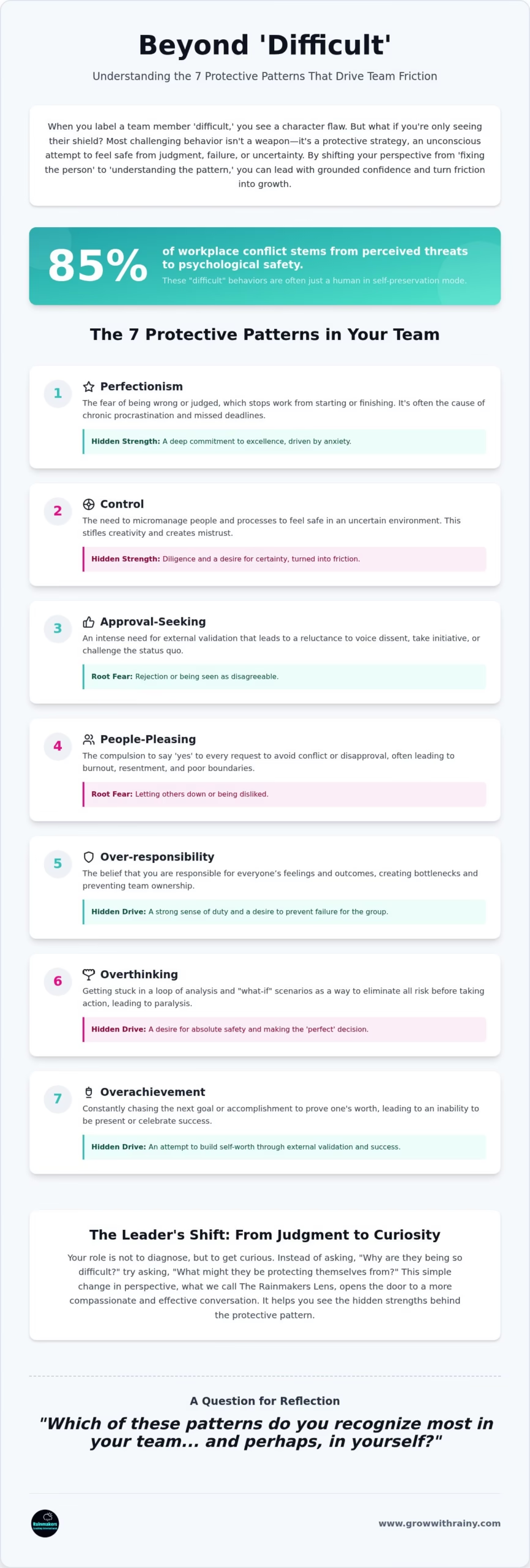
The first step toward a different outcome is to stop trying to ‘fix the person’ and start seeking to ‘understand the pattern’. This is where we introduce the concept of Protective Strategies. These are the behaviours we adopt, often unconsciously to shield ourselves from perceived threats like failure, judgment, or uncertainty. What you see as micromanagement might be a shield against a fear of losing control. What appears as aggressive pushback could be a shield against feeling incompetent.
Understanding Behaviour as a Safety Mechanism
Behaviour is rarely random; it’s a response. Research consistently shows that a vast majority of workplace conflict, some studies suggesting as high as 85%, stems from perceived threats to psychological safety. When an individual feels unsafe, their brain’s primary goal is to re-establish that safety. This can manifest as aggression (fighting the threat), withdrawal (fleeing the threat), or passive-resistance (freezing).
These are not signs of a ‘difficult’ person, but of a human in self-preservation mode. In this context, protective strategies are the mind’s automated, often inefficient, way of navigating uncertainty and protecting our sense of self-worth. This reframing is crucial. It moves the problem from an unchangeable personality trait to a changeable behavioural pattern, one that can be understood and addressed with compassion and clarity.
The Power of Compassionate Observation
To see beyond the frustrating behaviour, you need a new lens. At Rainmakers Coaching International, we call this ‘The Rainmakers Lens’. It’s a way of looking at a person and seeing the ‘hidden treasures’ – their innate strengths, wisdom, and potential that are currently being obscured by an overused protective strategy. A team member’s obsessive need for control might be their strength of ‘diligence’ in overdrive. Their stubborn perfectionism might be their ‘commitment to excellence’ distorted by fear.
Using this lens requires a conscious shift from a state of judgment to a state of grounded curiosity. Instead of asking, “Why are they being so difficult?” you start asking, “What might they be protecting themselves from?” This simple question opens the door to a more productive and empathetic conversation.
Practical exercise: Think of the team member you find challenging. Now, identify one positive quality or strength they possess that they might be over-using to the point of creating friction. Is it their attention to detail? Their passion? Their independence? Acknowledging this ‘hidden treasure’ is the first step to helping them wield it more effectively.
The 7 Protective Patterns in Your Team
While traditional management advice categorises people into unhelpful boxes like ‘The Complainer’ or ‘The Slacker’, this approach only addresses the surface-level output. To truly manage the dynamic, you must understand the underlying psychological drivers. Based on over a decade of coaching leaders, we’ve identified seven common protective patterns that show up in teams. Recognising them is the key to decoding the behaviour you find so challenging.
- Perfectionism: The fear of being wrong or judged stops work from starting or finishing. It’s ‘commitment to excellence’ driven by anxiety.
- Control: The need to micromanage people, processes, and outcomes to feel safe in an uncertain environment. It’s ‘diligence’ turned into a source of friction.
- Approval-Seeking: An intense need for external validation that leads to a reluctance to voice dissent or take initiative.
- People-Pleasing: The compulsion to say ‘yes’ to every request to avoid conflict or disapproval, often leading to burnout and resentment.
- Over-responsibility: The belief that you are responsible for everyone’s feelings and outcomes, creating bottlenecks and preventing team ownership.
- Overthinking: Getting stuck in a loop of analysis and “what-if” scenarios as a way to eliminate all risk before taking action.
- Overachievement: Constantly chasing the next goal or accomplishment to prove one’s worth, leading to an inability to be present or celebrate success.
Identifying Resistance Patterns (Control and Perfectionism)
Control and Perfectionism are often two sides of the same coin, rooted in a deep fear of failure. A team member exhibiting a ‘Control’ pattern disrupts collaboration by refusing to delegate, questioning every decision, and creating an atmosphere of mistrust. They are trying to build a fortress of certainty around themselves, but in doing so, they isolate their colleagues and stifle creativity.
The ‘Perfectionism ‘ pattern is just as disruptive, though often less confrontational. It’s the engine behind chronic procrastination and missed deadlines. The individual isn’t lazy; they are paralysed by the fear that their work won’t be flawless. Your role as a leader is not to crush their high standards but to help them redefine success. The goal is to reassure them that excellence doesn’t require flawlessness and that progress is more valuable than perfection.
Social Patterns (People-Pleasing and Approval-Seeking)
‘People-Pleasers’ and ‘Approval-Seekers’ can seem like easy team members at first – they are agreeable and avoid conflict. But these patterns are quietly corrosive. A ‘People-Pleaser’ will agree to feedback in the moment but may not implement it, as their primary goal was to make the conversation comfortable, not to commit to change. This breaks down feedback loops and erodes trust.
Similarly, the ‘Approval-Seeking’ pattern leads to a lack of initiative. Team members wait to be told exactly what to do because they are afraid of making a mistake and losing your validation. As a leader, your task is to create an environment where authentic contribution is valued more than social compliance. This means rewarding thoughtful challenges, celebrating learning from mistakes, and encouraging ownership even when the outcome isn’t perfect.
The Manager’s Mirror: Are Your Patterns Interacting?
Here is a truth that many management consultants ignore: a difficult dynamic is rarely one-sided. As a high-achieving leader, you have your own set of protective patterns, and they are likely interacting with your team member’s. The most common trap for leaders is ‘Over-responsibility’. You see a team member struggling, and your instinct is to carry their weight, fix their problems, and ensure the outcome is perfect. This feels like good leadership, but it can enable their patterns and lead to your own burnout .
Do you find yourself in an ‘Overthinking’ loop, replaying conversations and dwelling on the conflict? This mental energy doesn’t solve the problem; it magnifies it. Or perhaps your own need for ‘Control’ is triggering their ‘Perfectionism’.
Your constant check-ins, intended to be supportive, might be signalling a lack of trust, causing them to retreat further into their fear of making a mistake. The cycle of reaction can only be stopped when you reconnect with your own truth and lead from a place of self-trust.
Breaking the Over-responsibility Cycle
Your role as a leader is to guide, support, and empower. It is not to carry the emotional or performance-related weight for your team members. Distinguishing between your responsibility (providing clear expectations, resources, and feedback) and their responsibility (owning their work and behaviour) is critical.
The psychological toll of ‘carrying’ someone is immense. It depletes your energy, breeds resentment, and ultimately disempowers the very person you are trying to help.
Learning to hold people accountable with compassion is a key leadership skill. It requires you to be comfortable with the temporary discomfort of a direct conversation, trusting that it serves the long-term health of the individual, the team, and yourself. For more on this, explore these 10 key qualities of a leader to inspire and motivate teams.
Self-Trust as a Management Tool
When you are grounded in your own truth, you can set firmer, kinder boundaries. You stop over-explaining your decisions or apologising for holding a standard. You can enter a high-stakes feedback session without being emotionally hijacked by the other person’s reaction. This ‘grounded’ state is your most powerful management tool.
It allows you to listen without judgment, speak with clarity, and remain focused on the goal of the conversation. It is not about being cold or detached; it’s about being so connected to your own internal stability that you can handle external turbulence. Ultimately, self-mastery is the foundation of team mastery. Your ability to manage your own internal state directly dictates your ability to lead others effectively.
The 3-Step Conversation: Release, Reprogram, Recondition
Generic advice like “be direct” or “give clear feedback” fails because it doesn’t provide a process for lasting behavioural change. It addresses the symptom, not the source. To facilitate a real shift, you need an dynamic approach that creates psychological safety and invites collaboration rather than demanding compliance. This is where leaders who have difficulty managing difficult team members can benefit from coaching with a proven methodology.
At Rainmakers Coaching International, coach Rainy Rainmaker developed the Rainmakers Transformation System™, a signature three-stage process designed to guide this transformation. In a management context, it provides a powerful framework for your conversations:
- Release – Creating a safe space to acknowledge the current friction and lower defences.
- Reprogram – Collaboratively challenging the underlying assumptions and beliefs driving the protective behaviour.
- Recondition – Setting new, integrated habits and establishing clear accountability for practising a new way of being.
Step 1: Releasing the Friction
The ‘Release’ phase is about opening the conversation in a way that bypasses the brain’s threat response. Instead of starting with, “Your micromanagement is causing problems,” you begin with reflective questions that invite curiosity. For example: “I’ve noticed we seem to have a different approach to project updates. Can you walk me through your thought process?”
The goal is to validate the employee’s positive intent (“I can see you’re deeply committed to ensuring we deliver high-quality work”) while clearly addressing the impact of their actions (“However, when you follow up multiple times a day, it can interrupt the team’s focus and signal a lack of trust”). This approach separates the person from the behaviour, making it easier for them to hear your feedback without becoming defensive. Developing these coaching skills can transform your impact as a leader.
Step 2 & 3: Shifting the Narrative
Once the friction is acknowledged, you move to ‘Reprogramming’. This is a collaborative process of helping the team member see a more ‘grounded’ and effective way to achieve the safety they are seeking. You might ask, “What is the fear or concern that drives your need to check in so frequently?” or “What would need to be true for you to feel confident delegating this task?” You are helping them challenge the belief that their protective strategy is the only way to succeed.
Finally, ‘Reconditioning’ is about practice. Lasting change doesn’t happen in one conversation. Here, you establish clear, non-punitive checkpoints for progress. For example: “For the next two weeks, let’s agree that you’ll consolidate your questions into one email per day. We can check in at the end of each week to see how that feels.” Consistency in this phase is the key. It helps the team member build ‘self-trust’ in their ability to operate without their old shield, proving to themselves that they can be safe and successful in a new way.
Leading with Grounded Authority
Mastering the ability to manage difficult team dynamics isn’t just about fixing a problem. It’s about a fundamental evolution in your leadership style – a transition from ‘Protection’ to ‘Freedom’. When you are no longer drained by team friction, you have more energy for vision, strategy, and inspiration. You lead with a ‘Heart-Centered Authority’, a powerful blend of empathy and effectiveness that creates a truly high-performing, psychologically safe environment.
Navigating these complex human dynamics on your own can be challenging, which is why executive coaching is often the fastest path to this transformation. A coach provides an objective mirror, helping you see your own interacting patterns and equipping you with frameworks like the Rainmakers Transformation System™ to lead with more confidence and less stress.
Reflective Question: What is the one treasure, the one overused strength that might be hidden in this difficult dynamic you’re facing?
The Role of Executive Coaching in Singapore
Singapore’s high-pressure, high-excellence corporate environment can amplify the protective patterns in both leaders and their teams. The immense pressure to perform often triggers deep-seated fears of failure , leading to burnout , conflict, and disengagement. Coaching provides a confidential space to dismantle the ‘Over-responsibility’ and ‘Overthinking’ patterns that so many successful leaders fall into.
It’s an investment in your own sustainability and leadership effectiveness. By working with a coach, you learn to release the patterns that lead to burnout and reconnect with a more grounded, authentic, and impactful way of leading. Explore how executive coaching in Singapore can help you navigate these challenges.
Taking the Next Step
If you’re tired of the endless cycle of conflict and emotional exhaustion, it’s time for a new approach. Moving from fear-based management to leadership grounded in self-trust is possible. For many leaders, a single conversation is all it takes to gain immediate clarity and find a path forward.
A 90-minute coaching conversation can help you diagnose the interacting patterns at play, understand the hidden needs driving the behaviour, and map out the first steps toward a more peaceful and productive team dynamic.
Final Reflective Question: If you weren’t afraid of the conflict, how would you lead today?
Frequently Asked Questions
Is it possible to manage someone who is older or more experienced?
Absolutely. The principles of understanding protective patterns and leading with grounded authority are universal. The key is to approach the conversation with respect for their experience, framing it as a collaborative effort to improve team dynamics rather than a top-down directive. Focus on the impact of their behaviour on shared goals, not on their age or tenure.
How do I know if a team member is truly ‘difficult’ or just in the wrong role?
This is a crucial distinction. Use the Rainmakers Lens to first explore if the friction is caused by a protective pattern (e.g., fear-driven perfectionism causing missed deadlines). If, after coaching and providing support, the core issue is a fundamental mismatch of skills, interests, or values with the role’s requirements, then a conversation about role alignment may be necessary. The pattern-based approach often clarifies this quickly.
What should I do if my own manager is the one being difficult?
While you can’t manage your manager, you can manage your response. Identify their protective patterns (e.g., are they operating from a place of ‘Control’ or ‘Over-responsibility’?). Understanding their pattern helps you depersonalise their behaviour. You can then use elements of the ‘Release’ phase to set boundaries and communicate your needs clearly and calmly, focusing on shared objectives.
Can I use the Rainmakers Transformation System™ for my entire team?
Yes. While the system is powerful for one-on-one conversations, its principles can be adapted for the entire team. Introducing the language of ‘protective patterns’ and ‘psychological safety’ in a group setting can create a shared vocabulary for understanding and resolving conflict, fostering a more open and resilient team culture.
How do I handle a difficult team member who is also a high performer?
This is a common challenge. The key is to separate their performance results from their behavioural impact. Acknowledge and appreciate their contributions while being firm about the non-negotiable need for respectful collaboration. Frame the conversation around how their behaviour is limiting their own leadership potential and the team’s overall success, turning it into a development opportunity rather than a punitive one.
What happens if the ‘difficult’ behaviour doesn’t change after coaching?
The Rainmakers Transformation System™ is a powerful tool for inviting change, but it cannot force it. If you have consistently applied the framework, provided clear feedback, and offered support without seeing any shift, you may reach a point where you must make a decision based on the ongoing impact to the team. A structured performance management plan may be the necessary next step, and your documentation of these coaching conversations will be invaluable.
How can I maintain my own confidence while dealing with constant team friction?
This is where ‘The Manager’s Mirror’ is essential. Recognise your own ‘Over-responsibility’ or ‘Overthinking’ patterns. Reconnecting with your truth means focusing on what you can control: your own grounded state, the clarity of your communication, and the fairness of your process. Executive coaching can be particularly helpful here, providing the support and tools you need to stay resilient and lead effectively without burning out. Consider exploring how to rebuild and maintain self-trust as a leader.

Article by
Rainy Rainmaker
Rainy Rainmaker is the founder of Rainmakers Coaching International and a transformational coach for confidence, self-trust, and authentic leadership. Based in Singapore, she helps high-achieving professionals, managers, and leaders who appear capable on the outside but feel quietly held back by self-doubt, overthinking, imposter feelings, burnout, or a loss of direction.
Through her signature Rainmaker Transformation Journey™: Release, Reprogram, Recondition – Rainy helps clients uncover the insights already within them and turn inner clarity into aligned action that creates lasting change in life, career, and leadership.
