
As a leader, you solve complex problems every day. You can untangle a project timeline, navigate a difficult conversation, and put out tactical fires with impressive skill. Yet, when it comes to the five-year plan or the long-term vision for your department, you feel a sense of paralysis. The more you try to think strategically, the more you find yourself pulled back into the urgent, the immediate, the known.
Why does a leader who can handle any immediate crisis feel so blocked by the future? What if the barrier isn’t a lack of skill but a hidden, protective pattern at play?
This isn’t about learning another complex framework or gathering more data. It’s about understanding the internal friction – the overthinking, the over-responsibility, the deep-seated need for certainty that creates tactical noise and obscures your natural strategic vision. Improving your strategic thinking skills begins not by adding more, but by releasing what’s in the way.
Key Takeaways
- Strategic thinking is often blocked by protective patterns, not a lack of skill. High-achievers can get stuck in “tactical noise” due to patterns like Overthinking and Over-Responsibility, which feel safer than navigating the uncertainty of long-term vision.
- The solution is self-trust, not more data. While data is important, the endless pursuit of more information can be a form of perfectionism. True strategy emerges when you learn to trust your innate wisdom and the evidence you already have.
- Shift from “fixing” to “vision-holding.” Moving from a reactive problem-solver to a strategic leader requires creating mental space. This involves letting go of the need to have every answer and focusing on the “why” behind the “how.”
- A practical, four-step process can build strategic muscle. You can improve your strategic thinking skills by auditing your protective patterns, creating dedicated space for reflection, challenging tactical impulses, and practicing decisiveness with imperfect information.
Why Your Strategic Thinking Feels Blocked (The Overthinking Strategy)
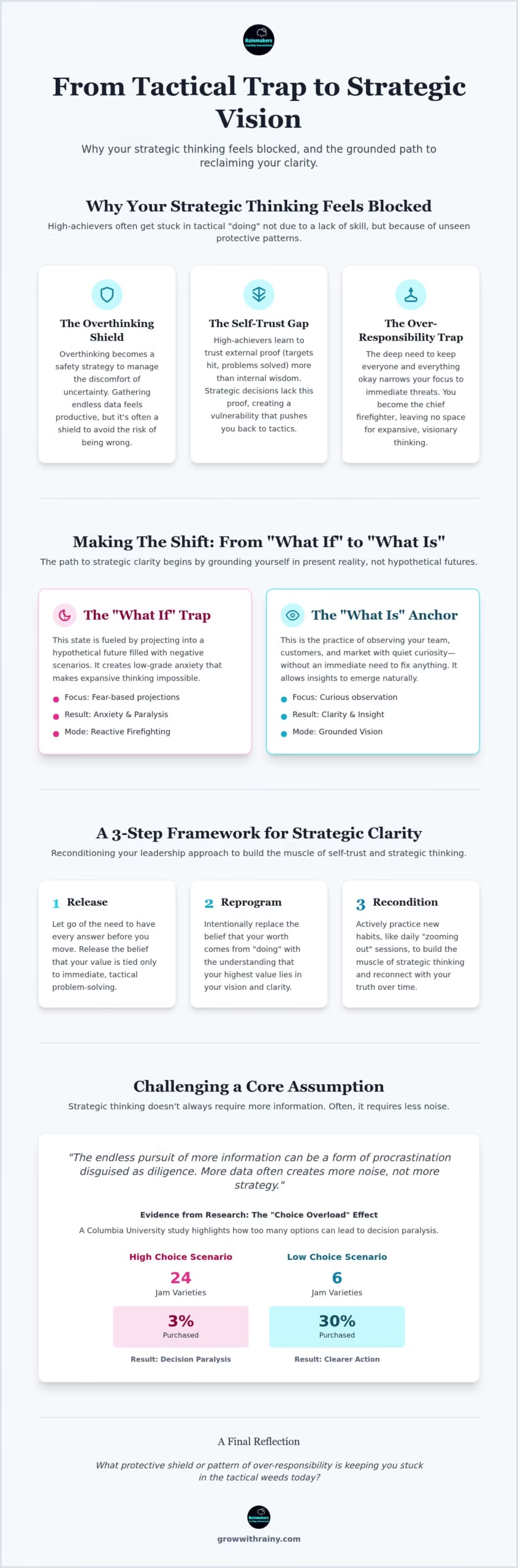
Strategic thinking is the ability to see the “whole” while others are focused on the “parts.” It’s the capacity to rise above the daily urgencies and connect your team’s work to a larger, more meaningful purpose. So, why does a leader who can solve any immediate crisis often feel paralyzed by a five-year plan?
The answer lies in a pattern many high-achievers know well: overthinking. At its core, this pattern isn’t a flaw; it’s a strategy. As a Rainmakers Principle states, “Overthinking is often an attempt to create safety by eliminating uncertainty.”
You analyze every variable, map every potential outcome, and gather endless data to be thorough, and to build a fortress against the possibility of being wrong.
Is your “detailed analysis” a genuine search for clarity, or is it a protective strategy to avoid the risk that comes with bold, visionary leadership?
The High-Achiever Self-Trust Gap
Many successful leaders build their careers on evidence. You know you’re good at your job because of the promotions, the successful projects, and the positive feedback. This reliance on external proof creates what I call the High-Achiever Self-Trust Gap – a space between what you know you can do and what you trust you can be.
When faced with the ambiguity of long-term strategy, there is no immediate proof of success. This uncertainty triggers the self-trust gap, and to close it, you retreat to the familiar ground of tactical “doing.”
In the world of tasks, checklists, and immediate problems, you feel safe, proven, and valuable. This is the moment your greatest strength – your capability becomes a shield against the vulnerability of strategic risk.
Over-Responsibility and the Tactical Trap
Another powerful pattern that keeps leaders in the weeds is Over-Responsibility. Rainmakers Principle: Over-responsibility often begins when we feel we must keep everyone okay. As a leader, you may feel an intense pressure to have all the answers, protect your team from every challenge, and personally fix every problem that arises.
This instinct, while noble, is a tactical trap. When you are carrying everyone’s burden, there is simply no mental or emotional space left for vision. Your energy is consumed by managing the present, leaving none for creating the future.
The critical shift required is moving from being the chief “problem-fixer” to becoming the primary “vision-holder.” It’s a move from carrying the work to holding the grounded vision that directs the work.
Reconnecting With Your Truth: The Shift from Tactics to Vision
If you feel exhausted from being the “chief firefighter” in your organization, you are not alone. This constant state of reaction is draining, and it disconnects you from the very reason you wanted to lead in the first place. The antidote isn’t another productivity hack; it’s reconnecting with your truth.
A “grounded vision” is a strategy that comes from a place of deep self-trust and alignment, not from corporate jargon or market trends. It’s an expression of your authentic leadership intent.
Before you can know which direction to lead your team, you must first reconnect with the internal compass that points toward what truly matters for you and the organization.
Moving from “What If” to “What Is”
Overthinking traps you in a hypothetical future filled with potential dangers. You spend hours mentally rehearsing worst-case scenarios, which feels like responsible planning but is often just a cycle of anxiety. This “what if” thinking keeps you from seeing the reality of your business and your team right now.
To break this cycle, practice returning to the present. Grounded techniques can be as simple as taking a few deep breaths before a meeting or spending five minutes observing your team’s dynamics without an immediate need to “fix” anything.
The power of observation – of seeing “what is” without judgment, provides real data, not fear-based projections. It’s from this clear, present-moment awareness that the most potent strategies emerge.
The 3-R Framework for Strategic Clarity
The Rainmakers Transformation System™ offers a simple but powerful framework for moving from tactical noise to strategic clarity. It’s a process of Release, Reprogram, and Recondition.
- Release: This could be about letting go of the need to have every answer before you speak. Releasing the belief that your strategy must be perfect from the start. Give yourself permission to have a hypothesis, a starting point, rather than a flawless, finished plan.
- Reprogram: This involves consciously changing the belief that your value is tied only to your immediate output. Your worth as a leader also comes from your ability to hold space, ask powerful questions, and inspire a vision – activities that don’t always look “busy.”
- Recondition: True change comes from practice. Recondition your mind by building in a daily habit of “zooming out.” This could be a 10-minute walk without your phone or dedicated time on your calendar to simply think about the future, no deliverables required.
Challenging the Assumption That Strategic Thinking Requires More Information
In a world of big data, it’s easy to assume that the key to better strategy is more information. We believe that with one more report, one more market analysis, or one more competitor deep-dive, the perfect path forward will reveal itself. But more data often creates more noise, not more clarity.
As the Rainmakers Point-of-View suggests: You don’t always need more evidence that you’re capable; sometimes you need to trust the evidence you already have. You have years of experience, a deep understanding of your business, and a team of capable people.
The constant search for more data can become a sophisticated form of procrastination, driven by a fear of making the wrong call. Research from Columbia University on “choice overload” demonstrates this well. In a famous study, shoppers presented with 24 varieties of jam were far less likely to make a purchase than those presented with only six.
Too many options led to decision paralysis. Similarly, for leaders, an overload of information can stall strategic movement, making it feel impossible to commit to a single direction.
The Perfectionism Pattern in Strategy
The relentless pursuit of more data is often a mask for Perfectionism . This isn’t about high standards; it’s a protective pattern. Rainmakers Principle: Perfectionism is often a strategy for protecting love, acceptance, and worthiness.
As a leader, you may believe that if your strategy is anything less than perfect, you will lose the respect of your team, your boss, and your peers. But strategy, by its nature, is not about short-term perfection. It requires the courage to be “wrong” in the small bets for the sake of being right on the big, long-term vision.
The next time you find yourself asking for “one more report,” pause and ask yourself: Is this truly necessary for the decision, or is it a stall tactic designed to protect me from the discomfort of uncertainty?
Trusting Your Innate Wisdom
Your best strategic insights are already within you. I often use the metaphor of a gem or diamond: your strategic treasures are already there, but they are hidden by the “mud” of overthinking, perfectionism, and self-doubt . The work isn’t to create the gem, but to gently clear away the mud so its brilliance can shine through.
How do you distinguish between a reactive “gut feeling” and a grounded strategic insight? A grounded insight feels calm, clear, and expansive. It aligns with your values and the organization’s core mission.
A fear-based impulse, on the other hand, often feels tight, urgent, and restrictive. Building the confidence to stand by a vision that isn’t yet fully proven is the hallmark of a truly strategic leader. It begins with trusting the wisdom you already possess.
How to Improve Strategic Thinking Skills: A Practical 4-Step Guide
Shifting from a tactical to a strategic mindset is a practice. It’s about reconditioning the self-trust muscle that may have weakened from years of relying on external validation. Here is a practical, four-step guide to help you make that shift.
Step 1: Audit Your Protective Patterns
The first step is awareness. You cannot change a pattern you cannot see. When you feel pulled into the weeds, ask yourself: Am I overthinking to create safety, or am I analyzing to create value? Notice the physical sensation that accompanies each state. Tactical urgency often feels like a tightness in your chest or shoulders, while strategic thinking feels more open and centered. During your next team meeting, simply notice when a protective pattern arises and name it silently to yourself. This act of naming begins to separate you from the pattern’s automatic pull.
2. ### Step 2: Create a “Grounded Space”
Strategic thinking cannot happen in the slivers of time between back-to-back meetings. You must intentionally create space for it. Block 15-30 minutes on your calendar each day for “Grounded Space” or a “10-Minute Zoom Out.” This is protected time with no devices and no agenda other than to reflect on your vision and reconnect with your truth regarding the organization’s core mission. This is not about solving problems; it’s about reconnecting with the purpose that fuels your work. For a deeper dive into building this inner foundation, our Rock Solid Confidence: Guide for High-Achieving Leaders can be a valuable resource.
3. ### Step 3: Challenge the Tactical Impulse
Your brain is wired to solve problems quickly. To think more strategically, you must interrupt this impulse. The next time a problem arises, try this: wait a full 60 seconds before offering a solution. This small pause creates a space for deeper thinking. In that space, ask a different kind of question: “If I weren’t worried about being the one to fix this, what would the long-term move be?” Research published in sources like the Harvard Business Review has highlighted the power of the “pause” in leadership, noting that deliberate reflection leads to more effective and thoughtful decision-making.
4. ### Step 4: Practice Decisiveness with Imperfect Data
Self-trust is like a muscle; it grows stronger with use. To recondition it, you must practice making decisions without 100% certainty. Start with small, low-risk decisions. Choose a path forward for a minor project based on the 70% of information you have, rather than waiting weeks for the final 30%. Announce your decision with grounded confidence. Each time you act with imperfect data and realize that things turn out okay, you are sending a powerful signal to your nervous system that it is safe to trust yourself.
Cultivating Grounded Leadership Through Executive Coaching
Reading an article can provide powerful insights, but as we say at Rainmakers, “Insight is not the same as transformation.” You may now understand the patterns that block your strategic thinking, but reconditioning your deep-seated responses requires consistent practice and support.
This is where executive coaching can be a powerful catalyst. A coach doesn’t give you the answers; they help you see the patterns you cannot see in yourself. They provide a safe, confidential space to challenge the protective strategies that have helped you succeed in the past but may now be limiting your future growth.
The goal is to lead and live authentically, without the immense weight of having to be perfect, right, and responsible for everything.
As you reflect on your own leadership, ask yourself this question: If you trusted your vision completely today, what is the first thing you would stop doing?
The Rainmakers Transformation System™ in Action
Our work with leaders is grounded in the Rainmakers Transformation System™. We guide you through the three core stages: Release, Reprogram, and Recondition – to help you move beyond the tactical noise.
You learn to release the need for certainty, reprogram the belief that your worth is in your “doing,” and recondition the habit of trusting your own grounded vision. This inside-out approach leads to tangible external results, whether it’s earning a promotion, growing a business, or simply leading your team with more clarity and less stress.
If you feel ready to move from being a manager of tasks to a leader of vision, exploring Executive Coaching in Singapore could be your next step.
Becoming More Fully Yourself as a Leader
Ultimately, learning how to improve strategic thinking skills isn’t about adding a new technique. It’s about becoming more fully yourself. The goal isn’t simply more success; it’s to lead from a place of authenticity and self-trust. When you are no longer hiding behind the protective shields of Overthinking or Perfectionism, your innate strategic wisdom – your “hidden treasures” can finally emerge.
Strategy becomes natural when you are no longer afraid of being wrong. It becomes clear when you are no longer burdened by the need to fix everything. It becomes powerful when it is a true reflection of you.

Article by
Rainy Rainmaker
Rainy Rainmaker is the founder of Rainmakers Coaching International and a transformational coach for confidence, self-trust, and authentic leadership.
Based in Singapore, she helps high-achieving professionals, managers, and leaders who appear capable on the outside but feel quietly held back by self-doubt, overthinking, imposter feelings, burnout, or a loss of direction. Through her signature Rainmaker Transformation Journey™: Release, Reprogram, Recondition – Rainy helps clients uncover the insights already within them and turn inner clarity into aligned action that creates lasting change in life, career, and leadership.
