
You know what you think. You know what you need. Yet when you disagree with someone more senior, need to push back, or have to set a boundary, you still find yourself holding back. You stay quiet when you disagree. You soften your opinion so much that your message gets lost. You say yes when you want to say no. Or you leave a meeting thinking of all the things you wish you had said.
Learning how to be more assertive at work is not about becoming louder, more forceful or more confrontational. It is about being able to express what you think, need and believe clearly – while respecting both yourself and the people around you. And often, the hardest part is not knowing what words to use. It is trusting yourself enough to use them.
When you constantly second-guess your judgement, worry about disappointing others or fear being seen as difficult, even a simple boundary or disagreement can feel uncomfortable. You may know exactly what you want to say and still hesitate when the moment arrives. Over time, that hesitation can have a cost. Your ideas may go unheard. Your boundaries become easier to cross. Others may underestimate your confidence or readiness for greater responsibility.
Becoming more assertive therefore begins with something deeper than communication technique: developing enough self-trust to stand behind your own voice. In this guide, we’ll explore how to communicate more assertively, set clearer boundaries and express your perspective with greater confidence, without becoming someone you’re not.
Key Takeaways
- Understand that your silence is often a protective strategy for safety rather than a lack of leadership capability.
- Discover how to be more assertive at work by identifying and releasing patterns like people-pleasing that hold you back.
- Learn to distinguish grounded confidence from aggression by building executive presence through deep self trust.
- Master the 3R method; Release, Reprogram, and Recondition; to navigate high-stakes meetings with calm authority.
- Shift your focus toward reconnecting with your truth so that clear communication becomes a natural extension of who you are.
Understanding the Assertiveness Gap: Why Capability Isn’t Enough
Imagine sitting in a high-stakes meeting where the air is thick with tension. You have the solution. You see the path forward with perfect clarity. But you hesitate. Ten minutes later, a colleague says exactly what you were thinking, and the room erupts in nods of agreement.
You’re the silent leader. You have the capability, the experience, and the vision, but you’re watching someone else take the credit for ideas you already held. This isn’t a lack of intelligence; it’s a gap in how you occupy your space.
That tightening in your chest or the sudden dry throat isn’t a sign that you’re unqualified. It’s internal friction. It happens when your system looks for external validation to give you permission to speak.
We often assume we need more confidence training to learn how to be more assertive at work. I want to challenge that. You don’t need to be fixed. Your silence is actually a protective strategy your mind uses to keep you safe from perceived conflict or rejection. It’s a survival mechanism, not a skill deficit.
Defining Assertiveness in a Grounded Way
True assertiveness isn’t about being the loudest person in the room or dominating the conversation. In fact, volume often masks a lack of psychology of assertiveness. Being grounded means you aren’t fighting for space; you’re simply occupying it with calm presence. It’s about reconnecting with your truth rather than memorizing a set of clever corporate scripts. Assertiveness is the alignment of your internal values with your external expression.
The High-Achiever Self-Trust Gap
At Rainmakers Coaching International, we often talk about the High-Achiever Self-Trust Gap. You likely have the degrees, the track record, and the data to back up your expertise. You don’t need more evidence of your capability. You need to trust the evidence you already have.
This gap is the invisible barrier between knowing what to say and actually saying it. Bridging it is the secret to how to be more assertive at work without feeling like you’re playing a character. When you bridge this through self trust, speaking up stops feeling like a risk and starts feeling like an obligation to your own integrity.
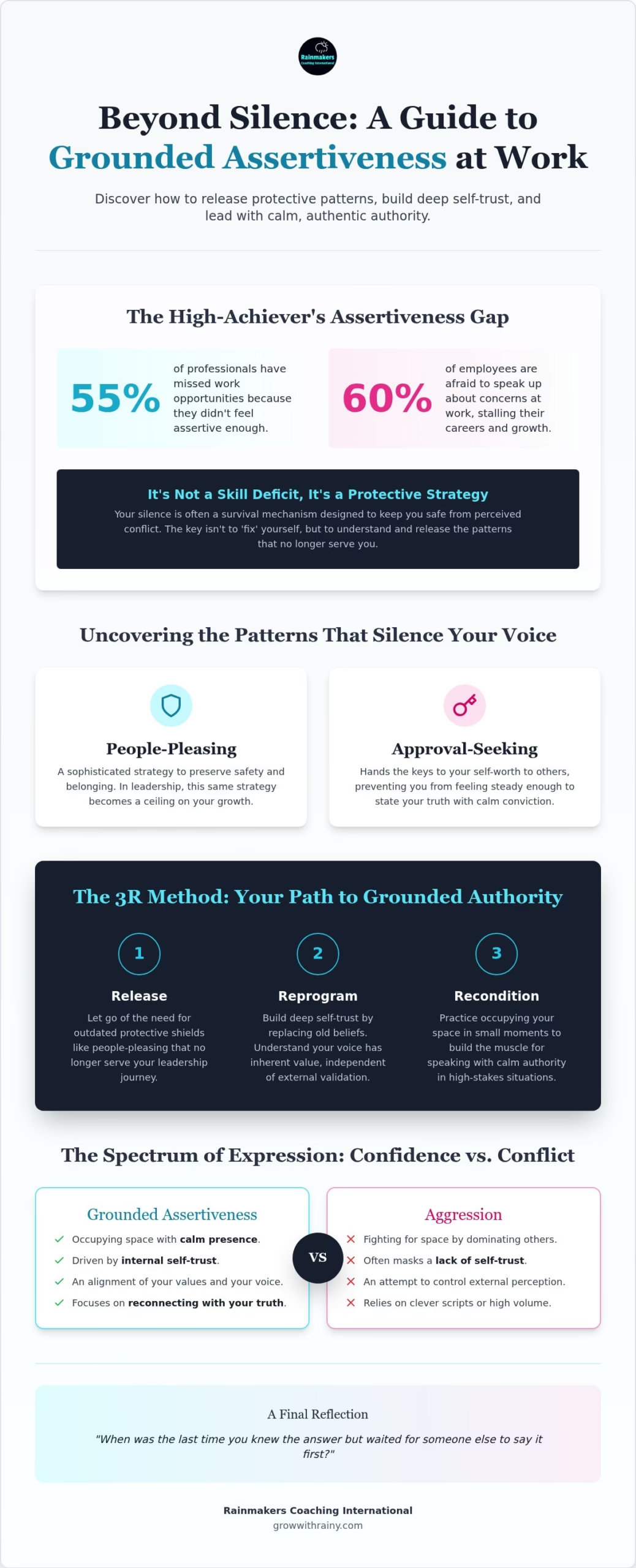
This struggle is more common than you might think. A 2026 report found that 6 in 10 employees are afraid to speak up about concerns at work. This silence erodes culture and stalls careers, yet only 8% of people seek professional help to change these patterns. Reclaiming your voice starts with a simple moment of honesty.
Reflection: When was the last time you knew the answer but waited for someone else to say it first?
Releasing the Protective Patterns That Silence Your Voice
Silence isn’t a void; it’s a choice made by a part of you that values safety above all else. At Rainmakers, we view People-Pleasing not as a personality flaw, but as a sophisticated strategy for preserving love, safety, and belonging.
If you grew up learning that being "easy" or "agreeable" was the only way to stay in good standing, it’s natural that you’ve carried that into your career. These patterns served a purpose once. They kept you safe. But in a leadership role, these same strategies now act as a ceiling on your growth.
The first step in learning how to be more assertive at work is recognizing that these behaviors are just protective layers. They aren’t who you are. When you stop trying to "fix" yourself and instead start releasing the need for these outdated shields, your natural authority begins to surface. This process is about reconnecting with your truth so you can speak without the internal static of fear.
The Role of People-Pleasing and Approval-Seeking
Approval-Seeking is particularly dangerous because it hands the keys to your self-worth to everyone else in the room. If you let a manager’s mood or a colleague’s passing comment determine your value, you’ll never feel steady enough to be more assertive.
Think of your natural voice as a diamond. Over the years, the mud of social expectations and the need for external validation has covered it up. You don’t need to build a new voice from scratch; you just need to clear the mud.
Ask yourself: whose approval am I actually hunting for in this meeting?
Often, we are performing for a ghost of a past authority figure rather than the people currently in front of us. If you feel stuck in this cycle, a 90-minute coaching conversation can help you identify exactly which pattern is currently blocking your path.
Over-Responsibility: Why You Say Yes to Everything
Another primary block is Over-Responsibility. This pattern begins when we learn that we are responsible for keeping everyone around us "okay." In a professional setting, this manifests as saying yes to every request because you fear the discomfort of others.
Research from the Yale Center for Emotional Intelligence highlights a strong correlation between high empathy and over-responsibility, suggesting that empathetic leaders often struggle to set boundaries because they over-identify with their team’s stress. This weight eventually makes it impossible to figure out how to be more assertive at work because you’re too exhausted from carrying everyone else’s load.
Reflection: What is the one thing you’re afraid will happen if you stop being "agreeable" for a single day?
Assertiveness vs. Aggression: Navigating the Spectrum
The fear of "being a jerk" is often what keeps the most empathetic leaders silent. You might worry that speaking up will make you seem difficult, bossy, or even hostile. Because you value your professional reputation, you default to a passive stance, hoping your hard work will eventually be noticed.
But there is a massive difference between being loud and being firm. Understanding how to be more assertive at work requires you to see that aggression is rarely a sign of strength. It’s usually a mask for a lack of self trust.
When you are aggressive, you’re trying to force a result because you don’t feel steady inside. When you are passive, you’re letting others dictate the result because you’re afraid of conflict.
Assertiveness is the middle path. It allows you to reduce stress and communicate better by honoring your needs while still respecting the needs of those around you. It’s about being yourself when the stakes are high, not becoming a version of yourself that feels forced or fake.
It’s helpful to see where your current communication falls on the spectrum. Most high-achievers oscillate between being passive to avoid conflict and being aggressive when they finally reach a breaking point. Grounded assertiveness is the steady anchor that prevents these swings:
- Passive: You stay silent in meetings, say yes to extra tasks you can’t handle, and feel resentful later.
- Aggressive: You interrupt others, use "you" statements to blame, and prioritize winning over connection.
- Assertive: You state your perspective clearly, use "I" statements, and maintain a calm, steady presence.
The Grounded Communication Framework
By reconnecting with your truth, you can set firm boundaries without a hint of hostility. This is the essence of reclaiming self-trust for authentic leadership . Instead of using "defensive" scripts that try to justify your position, you make "grounded" declarations. You aren’t asking for permission to have an opinion; you’re simply sharing it. This shift in perspective moves you from a state of internal friction to one of grounded authority.
This isn’t about memorizing scripts. If you’re just repeating words, people will sense the lack of alignment. Instead, it’s about reconnecting with your truth so that your body language, tone, and words all tell the same story. When you speak from this place, you don’t need to be loud to be heard.
The Fear of Judgment at Work
The Approval-Seeking pattern often convinces us that being assertive will damage our relationships. For many, especially those navigating complex gender-based expectations of politeness, this fear is deeply ingrained. However, standing your ground in a human way often increases respect.
Psychological research into the "Pratfall Effect" suggests that high-performing individuals who show vulnerability actually become more relatable. When you learn how to be more assertive at work, you’re actually building trust. People know where you stand, which creates a sense of psychological safety for the entire team.
Reflection: What is the cost of your silence to the team’s success?
The 3R Method for Grounded Assertiveness at Work
Most advice on how to be more assertive at work tells you to "fake it till you make it." But if your nervous system feels unsafe, your body will eventually betray your words. Surface-level scripts don’t work because they don’t address the internal friction of your protective patterns.
The Rainmakers Transformation System™ uses a specific sequence; Release, Reprogram, and Recondition; to ensure your external voice is a natural extension of your internal self trust. This isn’t about learning to be loud; it’s about learning to be steady.
Release: Identifying the Root of the Silence
The "Release" stage is about identifying the fear of conflict that keeps you quiet. When you feel that familiar pull to stay silent in a meeting, use the "Pause and Observe" technique. Instead of reacting to the urge to please, just notice the physical sensation in your body.
A 2023 study published in the Journal of Occupational Health Psychology found that mindfulness practices significantly improve emotional regulation in the workplace. By observing your impulse to seek approval without acting on it, you begin to release the grip that People-Pleasing has on your voice. You create a grounded space where you can choose your response rather than falling into an old habit.
Reprogram and Recondition: Building New Pathways
Once you’ve identified the pattern, you must Reprogram the internal script. You move from the belief that "I must keep everyone happy" to the understanding that "I must be clear." Clarity is a form of leadership. If your team doesn’t know where you truly stand, they can’t align with your vision. This shift is the foundation of reconnecting with your truth.
Reconditioning your nervous system is the final piece. You have to teach your body how to handle the "friction" of a boundary. When you speak up, you might feel a surge of adrenaline. That’s not a sign to stop; it’s the feeling of a new pathway being built. Start small by using these grounded sentence starters in your next meeting:
- "I have a different perspective on this project that I’d like to share."
- "I’m not able to commit to that additional task right now given my current priorities."
- "Let’s pause and look at this from another angle before we finalize the decision."
By staying with the discomfort for just a few seconds longer each time, you recondition your response. You prove to yourself that you are safe even when you are being direct. This is how to be more assertive at work in a way that feels authentic rather than forced.
Reflection: What is one small "no" you can say today to practice this?
Sustaining Assertiveness through Reconnecting with Your Truth
Assertiveness is not a goal you check off a list. It’s a byproduct of deep self trust. When you focus solely on the mechanics of how to be more assertive at work, you’re often just trying to manage symptoms. The real shift happens when you stop trying to perform confidence and start reconnecting with your truth.
In our Rainmaker POV, the ultimate objective isn’t just a bigger title or a higher salary. It is the freedom to become more fully yourself in every professional interaction. This becomes especially critical during career transitions.
A promotion often brings the Approval-Seeking pattern back to the surface with renewed intensity. You might feel like you need to prove you belong in the new seat by being extra agreeable. But grounded leadership requires the opposite. It requires you to hold your space even when you feel the internal friction of being "new."
Data shows that 45% of workers have actually rejected a promotion or avoided applying for a job just to evade the pressure of public speaking and assertive duties. Don’t let a protective pattern dictate the ceiling of your career.
From Fixing Flaws to Reclaiming Treasures
Coaching at Rainmakers isn’t about "fixing" you because you aren’t broken. It’s about removing the People-Pleasing "mud" that prevents your natural voice from emerging. When you release the need to keep everyone happy, a hidden treasure of courage naturally takes its place.
This courage doesn’t feel like aggression; it feels like a grounded solidity. If you’re ready to move beyond surface-level tips, the Building Rock Solid Confidence program offers a dedicated path to this internal alignment.
The Next Step in Your Transformation
Transformation is a journey of layers. While understanding the 3R method provides a map, deeper support through Executive Coaching can help you navigate the specific nuances of your leadership environment. This is where you move from theory to lived experience. You begin to see that your voice is your most valuable asset, not a risk to be managed.
The Rainmakers Transformation System™ is designed to support this evolution, helping you move from hesitation to a state of decisive clarity. By reconnecting with your truth, you ensure that your assertiveness is sustainable because it is no longer a performance.
Your voice has always been there. It’s just been waiting for you to trust it. When you speak from a place of self trust, you don’t just change the conversation; you change the culture around you.
Final Reflection: If you trusted yourself completely, what would you say in your next meeting?
Stepping into Your Authentic Authority
Reclaiming your voice is a journey of internal alignment. You’ve seen that the struggle isn’t a lack of skill, but the presence of protective patterns like People-Pleasing and Approval-Seeking. By going through the Rainmakers Transformation System™, you can release these blocks and find the courage that has always been there. Learning how to be more assertive at work isn’t about becoming someone else; it’s about finally having the self trust to be yourself.
With over a decade of leadership coaching experience, I’ve seen high-achievers move from silent frustration to calm, grounded authority. This compassionate approach to executive development focuses on the internal shifts that lead to lasting external results. You don’t have to carry the weight of everyone else’s expectations anymore. When you prioritize reconnecting with your truth, your presence becomes an anchor for your team.
Your perspective is valuable. The world is waiting for you to share it with clarity and purpose. Trust that your natural voice is enough.
Frequently Asked Questions
Is assertiveness at work the same as being aggressive?
Assertiveness is fundamentally different from aggression. While aggression often stems from a lack of self trust and a need to dominate, assertiveness is about being grounded in your own values. It involves expressing your needs clearly and respectfully without infringing on others. When you learn how to be more assertive at work, you’re actually building psychological safety for your team because they know exactly where you stand. It’s about clarity, not volume.
How can I be more assertive if I am naturally an introvert?
Being an introvert is often a hidden strength in communication. You don’t need to become an extrovert to reclaim your voice. Grounded assertiveness for introverts often involves using your natural observation skills to provide well-timed, thoughtful input. You can practice by preparing one key point before a meeting. This allows you to speak from a place of reconnecting with your truth rather than feeling pressured to perform.
What should I do if my boss reacts poorly to my new assertiveness?
If your boss reacts with surprise or resistance, stay steady. People often react poorly when a long-standing dynamic shifts. This response is usually about their own discomfort with change rather than a flaw in your communication. Continue to speak with calm authority and focus on the facts of the situation. If the friction persists, it may be a sign to explore deeper support through Career Coaching to navigate these relationships.
Can assertiveness be learned, or is it a personality trait?
Assertiveness is absolutely a skill that can be developed. At Rainmakers, we believe it’s often a natural state that has been buried under protective patterns like People-Pleasing or Approval-Seeking. By going through the Rainmaker Transformation System™, you can release these old strategies. Once you clear away the internal friction, your natural voice begins to emerge. It’s not about changing your personality; it’s about becoming more fully yourself in high-stakes environments.
How do I stop overthinking before I speak in a meeting?
Rainmakers Principle: Overthinking is often an attempt to create safety by eliminating uncertainty. To stop this cycle, use the "Pause and Observe" technique mentioned earlier. Notice the physical sensation of the urge to over-prepare or stay silent. Instead of trying to find the "perfect" sentence, focus on your primary intent. Speaking with 70% certainty is often more effective and grounded than staying silent while you wait for total clarity.
How do I say no to extra work without sounding like I am not a team player?
Saying no is actually a service to your team because it preserves the quality of your work. Frame your refusal around your current priorities. You might say, "I can’t take that on right now without compromising the deadline for project X." This shows you are deeply committed to the team’s success. Learning how to be more assertive at work means recognizing that a "no" to one task is a "yes" to your most important goals.
What are the first signs that I am successfully becoming more assertive?
The first sign is often a reduction in the mental load of overthinking every interaction. You might notice that you feel steadier in your body during difficult conversations. Another sign is leaving a meeting without that lingering sense of frustration from staying silent. As you continue reconnecting with your truth, you’ll find that you spend less time hunting for external validation and more time trusting your own internal compass and self trust.

Article by
Rainy Rainmaker
Rainy Rainmaker is the founder of Rainmakers Coaching International and a transformational coach for confidence, self-trust, and authentic leadership.
Based in Singapore, she helps high-achieving professionals, managers, and leaders who appear capable on the outside but feel quietly held back by self-doubt, overthinking, imposter feelings, burnout, or a loss of direction. Through her signature Rainmaker Transformation Journey™: Release, Reprogram, Recondition – Rainy helps clients uncover the insights already within them and turn inner clarity into aligned action that creates lasting change in life, career, and leadership.
