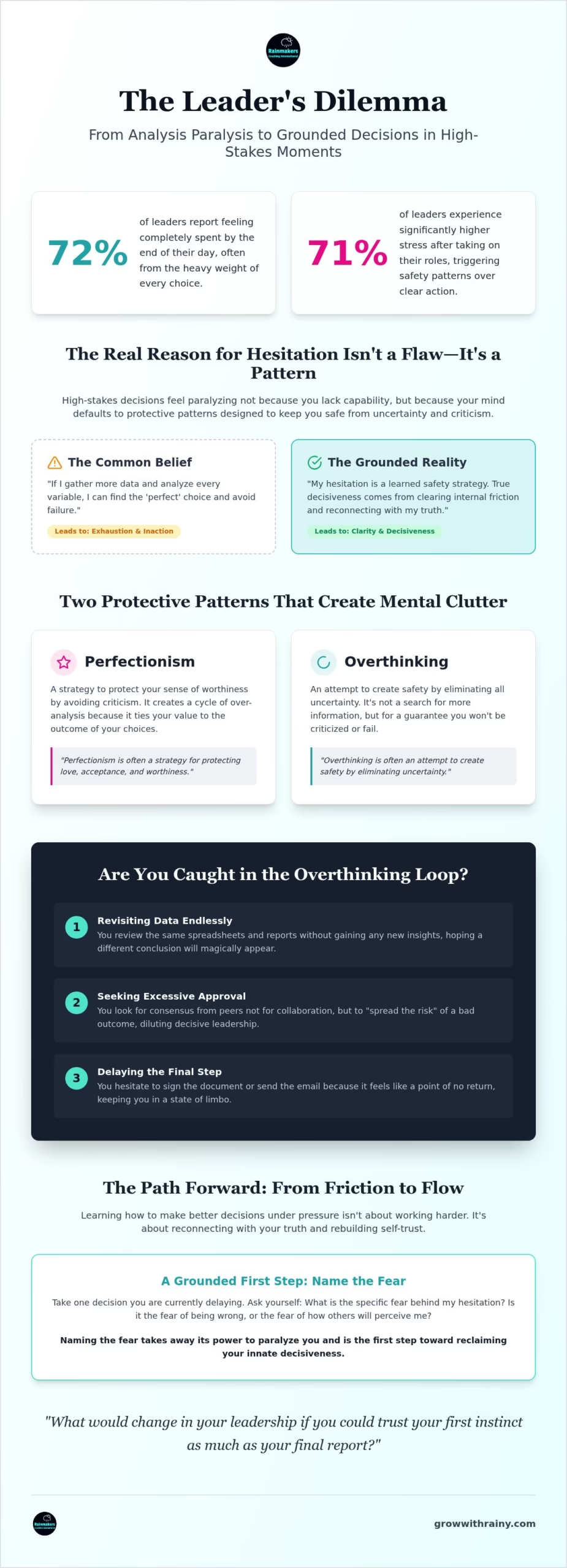
Did you know that 72% of leaders report feeling completely spent by the end of their day? This exhaustion often stems from the heavy weight of every choice you make. If you find yourself caught in a loop of overthinking, you’re likely searching for more data to feel safe. But learning how to make better decisions under pressure isn’t about gathering more information. It’s about recognizing the internal friction that keeps you stuck.
It’s exhausting to carry the fear of making the wrong choice while your mental clutter grows. You might believe that more analysis will eventually lead to clarity, but often, it just leads to more fatigue. We’re going to explore how to move past these protective patterns by reclaiming your self trust. When you stop trying to solve for every possible variable, you create space for your innate decisiveness to return.
In this article, we’ll look at the patterns that trigger hesitation and how to build a more grounded approach to leadership. Recent data shows that 71% of leaders experience significantly higher stress after taking on their roles. We’ll show you how to navigate high-stakes choices by understanding the hidden patterns that trigger hesitation and reconnecting with your truth.
What would change in your leadership if you could trust your first instinct as much as your final report?
Key Takeaways
- Understand why hesitation in the boardroom isn’t a sign of weakness; it’s a protective pattern trying to keep you safe.
- Discover how to make better decisions under pressure by identifying when your mind is using overthinking to avoid uncertainty.
- Access a grounded framework to pause and name the patterns, like Perfectionism or Overthinking, that create mental clutter in high-stakes moments.
- Learn how executive coaching closes the self-trust gap by moving you from performance-based value to authentic leadership.
- Transition from gathering endless data to reconnecting with your truth, allowing your natural decisiveness to lead the way.
Why High-Stakes Decisions Feel Paralyzing for Capable Leaders
Imagine the heavy silence in the boardroom when all eyes turn to you. You’ve spent years building your career, yet in this high-stakes moment, your mind feels like it’s wading through thick mud. You’re searching for the "right" answer, but all you find is hesitation. This paralysis isn’t a flaw in your expertise. It’s an indicator of how your brain handles the cognitive process of decision-making when the stakes are high.
When you’re trying to figure out how to make better decisions under pressure, it’s easy to blame the external environment. However, Ihe Global Leadership Forecast 2025 by Development Dimensions International (DDI) indicates that 71% of leaders report significantly higher stress levels after taking on a leadership role. This pressure triggers learned strategies for safety rather than clear-headed action. Your capability is not the problem. The protective pattern underneath is what’s creating the friction.
The High-Achiever Self-Trust Gap
There is often a wide gap between your proven capability and your current hesitation. High achievers often fall into the trap of believing that more evidence of success will eventually fix the feeling of being "not good enough." You might think that once you hit the next revenue target or secure the next promotion, your doubt will vanish. It won’t. Success is a result, not a foundation. True decisiveness requires a grounded sense of self that doesn’t depend on your last win.
If you’re currently delaying a choice, try this. Identify one decision you are sitting on and name the specific fear behind it. Is it a fear of being wrong, or a fear of how others will perceive you? Naming the fear takes away its power to paralyze you.
The Myth of the Perfect Choice
Perfectionism is one of the most common protective patterns. It acts as a strategy for protecting your sense of worthiness. A core Rainmakers Principle is that "Perfectionism is often a strategy for protecting love, acceptance, and worthiness." If you believe that a perfect choice will keep you safe from criticism, you’ll never feel ready to move.
This pattern creates a cycle of over-analysis that drains your energy. Learning how to make better decisions under pressure requires you to separate your value from the outcome of your choices. You can explore this further in our Rock Solid Confidence Guide.
When was the last time you felt your internal friction was louder than the external problem?
The Overthinking Pattern: Trying to Buy Safety with Analysis
Many leaders believe that if they just had one more spreadsheet or one more expert opinion, the "right" choice would become obvious. At Rainmakers Coaching International, we operate on a core principle: "Overthinking is often an attempt to create safety by eliminating uncertainty."
You aren’t actually looking for more data. You’re looking for a guarantee that you won’t be criticized or fail. This is a common trap for high achievers who have spent years using their performance as proof of their value. When your worth is tied to being right, every choice feels like a threat to your identity.
This "Overachievement" pattern forces you into a loop of constant analysis. While it feels like due diligence, it’s actually diminishing your ability to lead. Psychological research on cognitive load shows that when your mental "RAM" is filled with "what-if" scenarios and fear-based calculations, your executive function effectively shuts down.
You cannot access your innate wisdom when your mind is cluttered with the noise of survival strategies. Learning how to make better decisions under pressure requires clearing this mental fog so you can see the path forward clearly.
Recognizing the Strategy for Safety
How do you know if you’re performing a grounded analysis or simply stuck in a protective pattern? Look for these signs of the Overthinking strategy:
- Revisiting the same data sets without finding new insights.
- Seeking excessive approval from peers to "spread the risk" of a bad outcome.
- Delaying the final click or signature because it feels like a point of no return.
Approval-seeking is particularly dangerous in high-stakes environments. It creates a consensus-driven culture that lacks the sharp edge of decisive leadership. While a framework for improving decision-making is helpful for technical accuracy, it cannot replace your internal sense of self trust.
Is your current overthinking protecting your project, or is it protecting your sense of safety?
Moving from Insight to Grounded Action
Knowing you are overthinking is only the first step. Insight alone doesn’t change behavior; it just makes you a more self-aware overthinker. Real transformation happens when you move from mental noise to reconnecting with your truth. This shift allows you to bypass the protective patterns and act from a place of quiet strength.
Try the "5-Minute Pattern Check" before finalizing your next high-pressure choice. Stop and ask yourself: "If I knew I would be safe regardless of the outcome, what would I do right now?" This simple prompt helps you strip away the "mud" of overthinking to reveal the "diamond" of your innate decisiveness.
If you’re ready to explore these patterns more deeply, consider a coaching conversation to help navigate the transition from hesitation to authentic leadership.
Grounded Strategies for Decisiveness Under Pressure
Breaking the cycle of overthinking requires more than just a new productivity hack. It requires a grounded framework that allows you to step out of the mental noise and back into your own authority.
Learning how to make better decisions under pressure is a practice of returning to your center when the environment feels chaotic. If you can change your internal state, the external complexity becomes much easier to manage.
You can begin reclaiming your self trust in the moment by following these three steps:
- Step 1: Pause and acknowledge the pattern. Simply saying, "I see my Perfectionism at work," or "I recognize this is my Overthinking pattern," creates immediate distance. You are no longer the pattern; you are the leader observing it.
- Step 2: Triage your data. Ask yourself if you are looking for "useful data" that changes the outcome, or "safety-seeking data" that only serves to soothe your anxiety. If you already have the core facts, stop digging.
- Step 3: Reconnect with your values. Shift your focus from the fear of being wrong to the intention of being aligned. This moves the choice from a defensive posture to a proactive one.
Reconnecting with Your Truth
In high-pressure moments, your values act as a compass in a storm. When you are reconnecting with your truth, you aren’t just making a business choice; you’re making a choice that reflects who you are. If you haven’t defined what matters most to you, every decision will feel equally heavy because there is no filter to prioritize them. You might find it helpful to review these Top Personal Value Examples to Guide Your Choices to help sharpen your focus.
Try using a "Values Filter" for your top three options. If one of your core values is "Integrity," which choice feels the most honest? If it’s "Innovation," which choice pushes the boundaries? When you align a decision with a value, the "wrongness" of a potential failure loses its sting because you know you acted with purpose.
The Power of the Grounded Choice
There’s a significant difference between a "forced" decision and a grounded decision. A forced decision feels heavy, rushed, and driven by the need to escape discomfort. A grounded decision feels solid. It’s built on self trust rather than a guarantee of success. At Rainmakers, we believe that confidence isn’t about becoming louder or more aggressive; it’s about having the quiet strength to be yourself when the stakes are high.
Psychological research on the "Affective Forecasting Error" shows that we consistently overestimate the intensity and duration of the pain we’ll feel if we make a "wrong" choice. We imagine a mistake will be catastrophic, yet we are far more resilient than we realize. By acknowledging this bias, you can lower the perceived stakes and move forward with more clarity.
Which personal value are you currently compromising just to feel "safe"?
How Executive Coaching Closes the Self-Trust Gap
Leaders often come to me with a shelf full of management books and frameworks. They know the theory of leadership, yet they still struggle with how to make better decisions under pressure. This is because transformation is measured by who we become, not just what we know.
If you are operating from a place of internal friction, no amount of external consulting can fix the hesitation you feel. This is where the Rainmakers Transformation System™ comes in, focusing on closing the High-Achiever Self-Trust Gap.
Our system is designed to help you move from protective patterns to a state of deep self trust. While traditional consulting might focus on organizational alignment, coaching does the deep inner work required to reveal your innate decisiveness.
This process is about removing the "mud" of old habits to reveal the "diamond" of your own authority. You can learn more about this process in our guide to Executive Coaching Singapore: A Guide to Reclaiming Your Hidden Leadership Treasures.
The 3-R Methodology in Action
The journey toward grounded leadership follows a specific path that transforms how you show up in the boardroom:
- Release: We begin by letting go of the protective patterns that no longer serve you. This means identifying the Overthinking or Perfectionism that has become your default safety strategy.
- Reprogram: Once you are reconnecting with your truth, we build new neural pathways based on self trust. You learn to recognize your own wisdom without needing excessive external validation.
- Recondition: Finally, we sustain these habits in high-pressure environments. It is about maintaining your center when the stakes are highest and the noise is loudest.
When to Seek Deeper Support
You might be able to manage minor choices on your own, but some signs indicate that self-help is no longer enough. If you are experiencing chronic burnout , recurring imposter syndrome , or a persistent sense of "Career Confusion," it’s time for a different approach.
A professional problem rarely stays at work; it eventually leaks into your health, your relationships, and your overall well-being. Leadership burnout rates increased from 52% in 2023 to 56% in 2024, proving that the weight of these roles is becoming heavier for those without a grounded foundation.
What would change in your leadership if you trusted your first instinct 20% more?
Your Next Step: From Hesitation to Authentic Leadership
You’ve spent this time exploring why high-stakes choices feel so heavy. We’ve looked at the patterns of overthinking and the gap that forms when we lose our self trust. The journey isn’t about learning a new set of rules for how to make better decisions under pressure. It’s about stripping away the "mud" of your protective strategies. When you stop trying to buy safety with endless analysis, you allow the "diamond" of your innate decisiveness to emerge.
Transformation is often misunderstood as a process of adding more skills or becoming someone else. At Rainmakers, we see it differently. Our mission is to help you allow your hidden leadership treasures to surface.
The goal isn’t just more success or a cleaner inbox. It’s to become more fully yourself in every moment. When you lead from a place of reconnecting with your truth, the pressure of the boardroom doesn’t disappear, but it no longer defines you.
Realizing how to make better decisions under pressure starts with the understanding that your capability was never the issue. It’s the internal friction that slows you down. By choosing to step out of the Overthinking pattern, you reclaim the mental energy needed to lead with clarity and impact.
Practical Reflection Question
Take a moment to step away from the spreadsheets and the mental noise.
Ask yourself: "If I knew I were already capable enough, what would my next move be?"
This question bypasses the Perfectionism pattern. It forces you to look at the choice through the lens of your own authority rather than the lens of fear. Pick one small, grounded action step you can take in the next ten minutes. Don’t wait for the perfect moment. Just move.
Connecting with Rainmakers Coaching International
With more than a decade of experience coaching leaders, I’ve seen how the High-Achiever Self-Trust Gap can derail even the most brilliant careers. You don’t have to navigate this transition alone. If you’re ready to move from constant hesitation to grounded leadership, I invite you to explore our Building Rock Solid Confidence Program.
This is where we do the deep work of releasing the patterns that hold you back so your authentic leadership can shine.
What is the one decision you will make today, not for safety, but for your truth?
Stepping into Your Authority
Decisiveness is a natural state that often becomes buried under layers of protective patterns. We have explored how overthinking is usually a search for safety rather than a search for truth; real leadership requires a return to self trust. By naming these patterns in the moment, you can clear the mental noise and act with a grounded sense of purpose. It’s about moving from a defensive posture to a proactive one.
If you’re ready to bridge the gap between your proven capability and your current hesitation, I’m here to support that shift. With more than a decade of leadership coaching experience, I use the proprietary Rainmakers Transformation System™ to help you move from performance-based value to authentic leadership .
Learning how to make better decisions under pressure isn’t about adding more techniques. It is about reconnecting with your truth so you can lead with quiet strength.
The wisdom you’ve been seeking is already within you. It is simply time to clear away the friction and let your innate decisiveness lead the way.
Frequently Asked Questions
What is decision fatigue and how does it affect leaders?
Decision fatigue is the mental exhaustion that occurs after a long session of decision-making, leading to poorer choices. For leaders, it often manifests as a "crisis management" mindset where they begin to prioritize short-term safety over long-term alignment. When your mental energy is spent, your ability to think clearly declines. This makes it harder to understand how to make better decisions under pressure because the brain defaults to the easiest, least risky path.
How can I stop overthinking every small detail at work?
You can stop overthinking by recognizing it as a learned strategy for safety. Overthinking is often an attempt to eliminate uncertainty to protect your worthiness. Instead of looking for more data, practice a grounded pause. Name the pattern, such as Perfectionism or Approval-Seeking, and ask if the analysis actually changes the outcome. Shifting focus to reconnecting with your truth helps bypass the mental noise and allows your innate decisiveness to return.
Why do I feel like an imposter even after a major promotion?
Feeling like an imposter often happens because high achievers use performance as proof of their value. When you step into a higher role, your old performance metrics no longer apply, creating a High-Achiever Self-Trust Gap. This isn’t a lack of capability; it’s a protective pattern. You don’t need more evidence of success; you need to trust the evidence you already have. Transformation is measured by who you become, not just what you achieve.
Can executive coaching really improve my decision-making speed?
Yes, executive coaching improves speed by removing the internal friction that causes hesitation. By identifying your specific protective patterns, coaching helps you clear the mental clutter that leads to paralysis by analysis. When you build a foundation of self trust, you no longer spend hours seeking excessive approval or revisiting the same data. This clarity allows you to make faster, more grounded choices because you aren’t fighting against your own internal safety mechanisms.
What is the difference between perfectionism and high standards?
High standards are about the quality of the work, while Perfectionism is a strategy for protecting love, acceptance, and worthiness. This is a core Rainmakers Principle. High standards allow for learning and iteration. Perfectionism, however, is often driven by a fear of criticism. It creates a rigid environment where you feel you must be flawless to be safe. Reclaiming self trust means moving toward excellence without the weight of needing to be perfect.
How do I know if I am making a decision based on fear or intuition?
Fear-based decisions usually feel heavy, rushed, or loud. They are often driven by a need to avoid a negative outcome or to seek approval. Intuition, or what we call reconnecting with your truth, feels solid, and grounded. If your choice is based on "what if" scenarios and anxiety, it is likely a protective pattern. If the choice feels aligned with your core values, even if it’s difficult, it’s likely your intuition.
What should I do when I make a wrong decision under pressure?
Start by acknowledging that a "wrong" choice is not a reflection of your worth. High achievers often overestimate the pain of a mistake due to affective forecasting errors. Use the Rainmaker approach to release the self-judgment and reprogram your perspective. View the outcome as data for your next choice rather than proof of failure. Staying grounded in your self trust allows you to pivot quickly and effectively without spiraling into a cycle of over-responsibility.
How does the Rainmakers Transformation System™ work for leadership?
The system follows a three-stage process: Release, Reprogram, and Recondition. We help leaders release protective patterns like Overthinking or Control that limit growth. Then, we reprogram the mind to build new neural pathways based on self trust. Finally, we recondition these habits so they remain solid in high-pressure environments. This "inside-out" approach ensures that transformation is deep and sustainable, helping you learn how to make better decisions under pressure.

Article by
Rainy Rainmaker
Rainy Rainmaker is the founder of Rainmakers Coaching International and a transformational coach for confidence, self-trust, and authentic leadership.
Based in Singapore, she helps high-achieving professionals, managers, and leaders who appear capable on the outside but feel quietly held back by self-doubt, overthinking, imposter feelings, burnout, or a loss of direction. Through her signature Rainmaker Transformation Journey™: Release, Reprogram, Recondition – Rainy helps clients uncover the insights already within them and turn inner clarity into aligned action that creates lasting change in life, career, and leadership.
