
You can be successful, capable and highly respected, and still struggle with self-confidence. You may lead teams, make important decisions and carry significant responsibility, yet still second-guess yourself, replay conversations or quietly wonder whether you are really as capable as others believe.
For high achievers, this can be confusing. You have plenty of evidence that you are competent, but achievement alone does not always create lasting confidence. When your confidence depends mainly on performing well, it can become fragile. A mistake, criticism or unfamiliar situation can quickly shake it. Grounded self-confidence is different. It is not believing you will always get things right. It is trusting that you can handle yourself even when you don’t.
In this guide, we’ll explore how to build self-confidence that is less dependent on proving and performing, and more rooted in knowing and trusting yourself.
Key Takeaways
- Redefine self-confidence as the quiet capacity to remain your authentic self when the stakes are highest, moving away from the performance of “loud” confidence.
- Recognize the 7 Protective Patterns that act as learned safety mechanisms but ultimately create internal friction and hide your true capabilities.
- Bridge the self-trust gap by shifting your focus from external performance metrics to a sense of grounded self trust.
- Explore the 3-R methodology—Release, Reprogram, Recondition—to systematically move beyond hidden patterns and reclaim your internal clarity.
- Learn how to navigate high-stakes decisions and critical feedback without losing your connection to your truth.
What is Self-Confidence? Moving Beyond the "Louder is Better" Myth
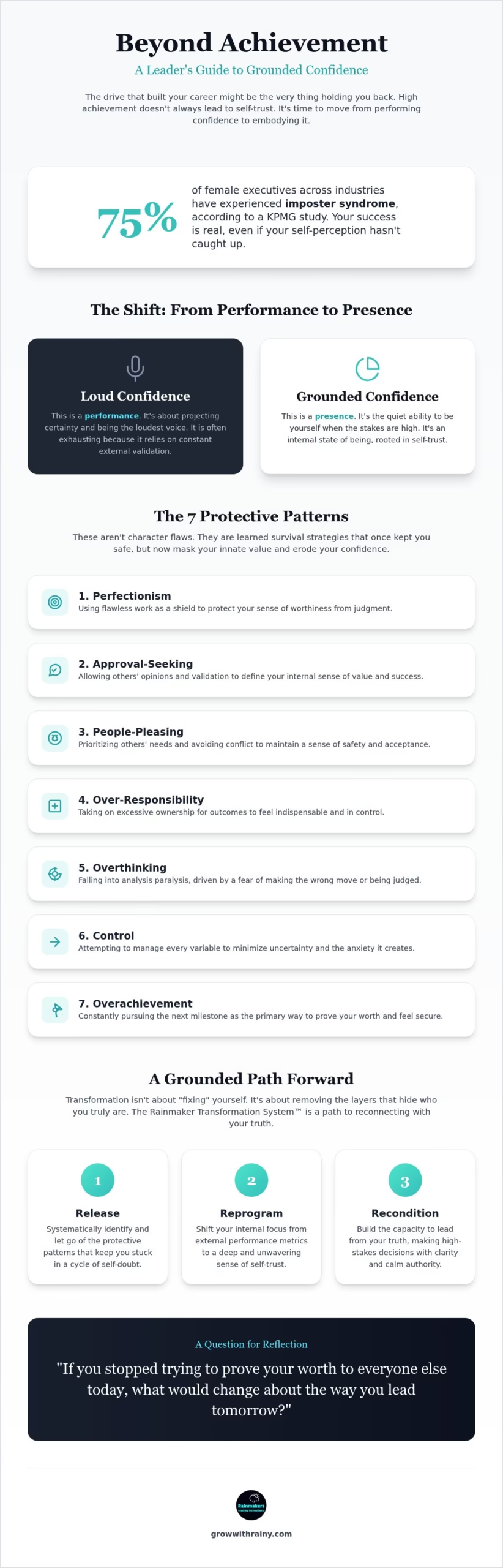
Many leaders believe that self-confidence is something you have to project, like a voice you throw across a boardroom. They think it’s about being the loudest or the most certain person in the room. It isn’t. Real self-confidence is the quiet ability to be yourself when the stakes are high. It’s a presence that doesn’t need to perform or convince.
While the psychological definition of self-confidence often centers on a belief in one’s own abilities, I see it as something deeper. It’s the difference between "loud confidence," which is a performance, and "grounded confidence," which is an internal state of being.
The High-Achiever Paradox: Success Without Self-Trust
It’s a strange reality that moving into a senior role often triggers more doubt than pride. If you’ve recently stepped into a larger position and felt like a fraud, you’re experiencing the "Self-Trust Gap." This happens when your external achievements outpace your internal sense of safety.
I define self-trust as a grounded state of reconnecting with your truth. It’s about who you become when the pressure is on, not just what you’ve listed on your CV. You don’t need more skills; you need to bridge the gap between what you can do and how you feel about it. This is why imposter syndrome in senior leaders is so common after a major win.
Why "Fixing Yourself" Never Works
We’re often told that self-doubt is a flaw we must "fix." This approach is exhausting because it keeps you in a cycle of constant self-improvement that never reaches a finish line. At Rainmakers Coaching International, we use the metaphor of a diamond covered in mud. The mud represents the protective layers, like perfectionism or people-pleasing, that you’ve used to stay safe. The diamond is your innate value.
Transformation isn’t about polishing the mud; it’s about removing it. You need to remove what prevents you from being a better version of yourself. Research from 2026 shows that prevalence estimates for imposter syndrome range from 9% to 82%, depending on the tools used. This means most of the people you admire are likely navigating the same internal friction.
You don’t need more evidence of your success. You need to start learning how to trust yourself again. Real growth isn’t about adding facets to the mask; it’s about finding the courage to take it off.
If you stopped trying to prove your worth to everyone else today, what would change about the way you lead tomorrow?
The 7 Protective Patterns Masking Your Innate Value
If you’ve ever wondered why you still feel like a fraud despite your track record, the answer usually lies in what I call "protective patterns." These aren’t character flaws or clinical diagnoses. They are learned strategies you developed to stay safe, gain approval, or avoid criticism as you climbed the corporate ladder. While these behaviors might have helped you survive earlier stages of your career, they eventually become the very things that erode your self-confidence. They create a layer of internal friction that keeps your true capabilities hidden behind a mask of high performance.
In the Rainmakers Transformation System™, we focus on seven specific coaching constructs: Perfectionism, Approval-Seeking, People-Pleasing, Over-Responsibility, Overthinking, Control, and Overachievement.
Each of these patterns serves as a way to manage the anxiety of leadership. However, they also prevent you from reconnecting with your truth. When you rely on these patterns, you aren’t leading from a place of grounded strength. You’re leading from a place of defense.
Perfectionism and Approval-Seeking: The Worthiness Shield
Perfectionism is rarely about excellence. It’s actually a strategy for protecting your sense of worthiness. If everything is perfect, you believe you are safe from judgment. Similarly, Approval-Seeking allows other people to hold the remote control to your internal value. If they are happy, you feel successful. If they aren’t, your sense of safety collapses.
This creates a constant state of anxiety that makes building self-confidence almost impossible. You spend so much energy maintaining the shield that you have no room left for authentic presence. This is a primary driver behind high-achiever burnout.
Overthinking and Overachievement: Creating a False Sense of Safety
Overthinking is an attempt to create safety by eliminating every possible uncertainty. You believe if you can just predict every outcome, you won’t be blindsided. Overachievement works in a similar way, using performance as proof of your right to be in the room. You stop using achievement as a tool for growth and start using it as a life-support system for your ego.
A 2025 study found that 63% of working Americans frequently compare themselves to others, which only fuels the need to over-perform. If you recognize these patterns in your own life, a coaching conversation can help you see what’s actually underneath the drive to constantly do more.
According to the University of South Florida, building self-confidence requires a shift away from these external dependencies toward a more internal focus. You have to move from a performance-based identity to one rooted in grounded self trust. When you release the need to be perfect, you finally have the space to be effective.
Which of these seven patterns is currently costing you the most energy in your daily work?
Bridging the High-Achiever Self-Trust Gap
Why can you list your accomplishments on a CV but still feel like a beginner in the boardroom? This is the gap between insight and transformation. You logically know you are capable, but you don’t yet feel it in your bones. Understanding the psychology of confidence helps us see that intellectual knowledge is only half the battle.
If your internal state hasn’t caught up to your external reality, you’ll continue to operate from a place of friction rather than flow. Real self-confidence isn’t about gathering more data; it’s about changing how you process the data you already have.
Over the years, I’ve observed that a professional problem rarely stays at work. If you don’t trust yourself in high-stakes meetings, that hesitation often leaks into your personal life and health. To move forward, we have to distinguish between two very different types of internal foundations.
| Performance-Based Confidence | Grounded Self-Trust |
|---|---|
| Tied to your most recent win. | Rooted in your innate value. |
| Requires constant external validation. | Relies on internal clarity. |
| Fragile when facing criticism. | Resilient and reflective. |
| Driven by the "mask" of perfection. | Driven by authenticity. |
Trusting the Evidence You Already Have
Most high achievers are experts at dismissing their own success. You might call it luck or timing, but this habit actively erodes your self-confidence. To bridge the gap, you must begin separating your identity from your output. You are the one who produced the results, not the results themselves.
Grounded confidence is a state of reconnecting with your truth. It involves looking at your history and seeing "Grounded Evidence" – not just what you did, but the character traits that allowed you to do it.
Reclaiming Self-Trust After a Career Transition
A confidence dip is almost guaranteed when you move from manager to director or take on a new senior mandate. This "messy middle" is where your old protective patterns, like overthinking, tend to flare up. You’re no longer the expert on the tools; you’re now the leader of the people.
If you find yourself stuck in analysis paralysis during this shift, our Career Transition Coaching Services can help you navigate the transition without losing your sense of self. We use the 3R Integration – Release, Reprogram, and Recondition, to ensure your internal foundation is as solid as your new title.
What is one piece of evidence from your career that you’ve been dismissing as "just part of the job" lately?
The Rainmaker Transformation System™: A Grounded Path Forward
Building self-confidence isn’t like adding floors to a skyscraper. It is more like clearing the clutter from a room so you can finally move around freely. Most high achievers try to solve their internal friction by doing more. They think another degree or a bigger title will finally make them feel secure. It won’t.
The Rainmakers Transformation System™ offers a different way. It is a three-stage journey designed to help you become more fully yourself. We don’t measure success by your output. We measure it by who you become when the pressure is on. This philosophy is the heart of the Building Rock Solid Confidence Program.
Stage 1: Releasing the Protective Patterns
You can’t build a new foundation until you see what is currently holding the weight. We start by identifying which of the 7 protective patterns is in the driver’s seat. Is it Perfectionism? Is it Over-Responsibility? These patterns were originally meant to keep you safe. They were your survival strategies in high-stakes environments.
The "Release" process involves acknowledging that these patterns had a positive intent. You don’t have to fight them. You just have to realize they no longer serve your leadership. Letting go of these invisible strategies is the first step toward reclaiming your truth.
Stage 2 & 3: Reprogramming and Reconditioning
After releasing the old weight, we move to Reprogramming. This is where we rewrite the internal narrative that says your value is tied to your perfection. We focus on self trust as your new internal compass. The final stage is Reconditioning. This involves practical strategies for daily self-governance. It is about staying grounded when the boardroom gets heated. This process is supported by the science of neuroplasticity.
Research by Carol Dweck on mindset shows that our brains are not fixed. We can physically re-wire our neural pathways through consistent behavioral change. By choosing new responses, you are literally building a more resilient brain.
Book your 90-minute coaching conversation
If you knew that your value was already solid, which of your current "survival strategies" would you be most willing to let go of today?
Cultivating Lasting Confidence Through Self-Discovery
If professional success was the antidote to insecurity, you’d already feel invincible. But for many high-performers, the higher the climb, the louder the inner critic becomes. The Rainmakers perspective is simple: the goal isn’t just more success; it’s to become more fully yourself.
When you stop performing for others, you reclaim the energy you’ve been using to maintain a mask. This is how you build a version of self-confidence that doesn’t crumble when the stakes are high. It’s not about adding new skills; it’s about trusting the ones you already have.
One of the most challenging parts of leadership is handling critical feedback without losing your self-confidence. If you view feedback as an attack on your character, you’ll always be in a state of defense. Instead, try to see feedback as data for your role, not a verdict on your soul.
Reconnecting with your truth allows you to listen without collapsing. You can begin identifying which of your protective patterns are currently active by taking our Self-Confidence Quiz. Understanding your patterns is the first step toward releasing them.
Daily Habits for Reconnecting with Your Truth
Transformation happens in the small moments of your workday. Start with the power of the pause. When you feel the Overthinking loop starting during a high-stakes decision, stop for ten seconds. This simple break interrupts the neural pathway of anxiety.
Then, practice "Grounded Visibility." This means showing up in meetings as your authentic self, even if you don’t have every answer polished. It’s about being seen in your truth rather than your perfectionism.
For more ways to build this internal foundation, explore Daily Habits to Love Yourself.
When Deeper Support is the Next Logical Step
There’s a limit to how much you can change by just reading about it. You can’t see your own blind spots, no matter how high your IQ is. Transformational coaching acts as a mirror, helping you see the hidden treasures you’ve buried under years of Overachievement.
A 2025 study found that 62% of working Americans feel they are "not enough." If you’re tired of that feeling, Life Coaching with Rainy provides the grounded support needed to move from self-doubt to self-mastery. You don’t have to navigate the transition from hesitation to decisiveness alone.
If you knew you were already "enough" for the role you hold, what is the first thing you would stop doing tomorrow morning?
Reclaiming Your Grounded Authority
Real self-confidence isn’t a performance you put on for a boardroom. It’s the quiet capacity to remain yourself when the pressure rises. After more than a decade of coaching senior leaders, I’ve seen that the drive to achieve often hides a deep need for safety.
By identifying patterns like Perfectionism or Approval-Seeking through the proprietary Rainmakers Transformation System™, you can finally stop performing and start leading from a place of self trust. Reconnecting with your truth is the only way to move from the exhaustion of high-stakes decisions to a state of calm decisiveness.
You don’t need another title to feel secure. You need to release the invisible strategies that are currently in the driver’s seat. When you stop trying to fix your flaws and start trusting your innate value, your leadership becomes effortless.
It’s time to put down the mask and lead from your grounded center. You have already done the hard work of building your career; now it’s time to enjoy the view from a place of internal safety.
What would be possible for your career if you no longer had to prove your worth to everyone in the room?
Frequently Asked Questions
Is self-confidence the same as self-esteem?
No. Self-confidence is distinct from self-esteem because it focuses on your ability to be yourself when the stakes are high. While self-esteem is an overall sense of your worth, confidence is about the trust you have in your capacity to navigate specific challenges. High achievers often have high self-esteem regarding their skills but struggle with grounded self trust when stepping into unfamiliar senior roles. Reclaiming this internal safety allows you to act with clarity.
Can I build self-confidence if I have always been shy?
Yes, because confidence is not the same as being loud or extroverted. You can build your capacity for authentic presence by focusing on internal alignment rather than trying to change your personality. Shyness is often just a preference for reflection. Real transformation happens when you release the protective patterns that keep your capabilities hidden. Once you begin reconnecting with your truth, you’ll lead effectively without needing to be the loudest person.
How do I stop overthinking and trust my decisions at work?
Stopping the loop of overthinking requires you to recognize it as a learned strategy for safety. Rainmakers Principle: Overthinking is often an attempt to create safety by eliminating uncertainty. To trust your decisions, you must move from seeking perfect certainty to building grounded self trust. Practice interrupting the cycle with a brief pause and focus on the evidence of your past successes. This shift helps you move from hesitation to decisiveness.
What are the 7 protective patterns of high achievers?
The seven protective patterns are learned strategies that high achievers use to manage anxiety and maintain a sense of worthiness. They are coaching constructs, not clinical diagnoses. They include:
- Perfectionism
- Approval-Seeking
- People-Pleasing
- Over-Responsibility
- Overthinking
- Control
- Overachievement
Each pattern originally helped you succeed but eventually creates internal friction and limits your next stage of growth.
How long does it take to see results from confidence coaching?
While every journey is unique, many clients experience a shift in perspective after their first few sessions. The Rainmakers Transformation System™ is designed to move you from insight to actual change through the three stages of Release, Reprogram, and Recondition. Real transformation is measured by who you become, not just what you know. Consistent practice of new daily habits usually leads to a noticeable sense of grounded self trust within a few months.
Why do I feel like an imposter even after a major promotion?
Feeling like an imposter after a promotion is often a calibration problem. Your external achievements have outpaced your internal self-perception, leaving you in a "Self-Trust Gap." It happens because you’re still using old protective patterns to navigate a new level of leadership. Reclaiming your truth involves updating your internal narrative to match the reality of your current capabilities and senior role so you can lead authentically without the mask of perfectionism.
Can self-confidence be learned, or is it an innate trait?
Self-confidence is not an innate trait that you’re either born with or without. It’s a state of being that can be reclaimed through intentional practice and self-discovery. Current coaching literature views it as a skill that high achievers can systematically develop by removing the "mud" of protective patterns. By focusing on reconnecting with your truth, you can build a grounded foundation that allows your innate value and hidden treasures to shine through.
How does the Rainmaker Transformation System™ differ from traditional life coaching?
The Rainmakers Transformation System™ differs from traditional coaching by focusing on the hidden patterns beneath high achievement rather than just setting external goals. We use a proprietary 3-R methodology: Release, Reprogram, and Recondition. This process isn’t about fixing flaws; it’s about removing the invisible strategies that keep your true self hidden. We prioritize the internal shifts that lead to lasting external results, ensuring your leadership is built on a foundation of grounded self trust.

Article by
Rainy Rainmaker
Rainy Rainmaker is the founder of Rainmakers Coaching International and a transformational coach for confidence, self-trust, and authentic leadership.
Based in Singapore, she helps high-achieving professionals, managers, and leaders who appear capable on the outside but feel quietly held back by self-doubt, overthinking, imposter feelings, burnout, or a loss of direction. Through her signature Rainmaker Transformation Journey™: Release, Reprogram, Recondition – Rainy helps clients uncover the insights already within them and turn inner clarity into aligned action that creates lasting change in life, career, and leadership.
