
A missed promotion or critical feedback can raise questions about your performance. But what happens when “What could I do differently?” becomes “Am I good enough?” Building self-esteem for career success involves developing a sense of personal worth that gives you steadier ground through professional achievements and setbacks.
When your worth feels closely tied to results or recognition, everyday career challenges may carry greater emotional weight. Strengthening self-esteem can help you acknowledge your contribution, recognise areas for growth and pursue opportunities without needing each outcome to confirm your value.
In this guide , you’ll find practical ways to recognise your strengths, question harsh self-judgements and separate performance from personal worth. You’ll also consider how a healthier relationship with yourself can support speaking up, making career decisions and pursuing ambitions that matter to you.
Key Takeaways
- Career self-esteem is a steadier sense of worth that isn’t decided by your latest result or milestone.
- Notice when hesitation, under-claiming your contributions, or dismissing positive feedback may be shaping your choices. These are invitations to reflect, not proof of a flaw.
- When building self-esteem for career success, separate observable evidence from others’ responses and the meaning you attach to them.
- Use a simple reflection practice to recognise your strengths and choose one grounded action, without relying on forced affirmations.
- If self-doubt keeps influencing important career decisions, coaching can help you explore the patterns beneath it and reconnect with your strengths.
What Does Building Self-Esteem for Career Success Really Mean?
You can deliver a demanding project, earn a promotion, or become the person colleagues turn to for guidance, and still wonder whether you truly belong. A milestone may confirm that you’re capable, but it doesn’t always settle the deeper question: “Am I good enough to be here?”
Career self-esteem is a steadier sense of personal worth across changing work outcomes. It lets you recognise your abilities and take feedback seriously without treating a missed target, difficult conversation, or uncertain decision as a final judgement on who you are. The wider concept of self-esteem includes how people evaluate and relate to themselves, not only how well they perform in one area of life.
This is the heart of building self-esteem for career success: allowing your work to matter without asking it to prove your value. Self-esteem can support you as you make choices and respond to challenges. It cannot guarantee a promotion, recognition, or any particular career result. Those outcomes depend on more than your self-belief alone.
How Is Self-Esteem Different from Confidence at Work?
Confidence is often specific to a task or situation. You might feel prepared to present a proposal but less certain when negotiating a deadline. Self-esteem is about how you relate to your worth beyond either moment. These experiences can shift: confidence can grow with practice, while a difficult day doesn’t have to define your view of yourself. For a broader look at personal development and self-trust, explore this personal development coaching guide.
Why Career Achievements Do Not Always Create Self-Worth
A new title or successful project can bring reassurance. But if the relief depends on the next achievement, it may fade when another challenge appears. The accomplishment is real evidence of what you did; it cannot settle every belief about what you must keep doing to deserve respect.
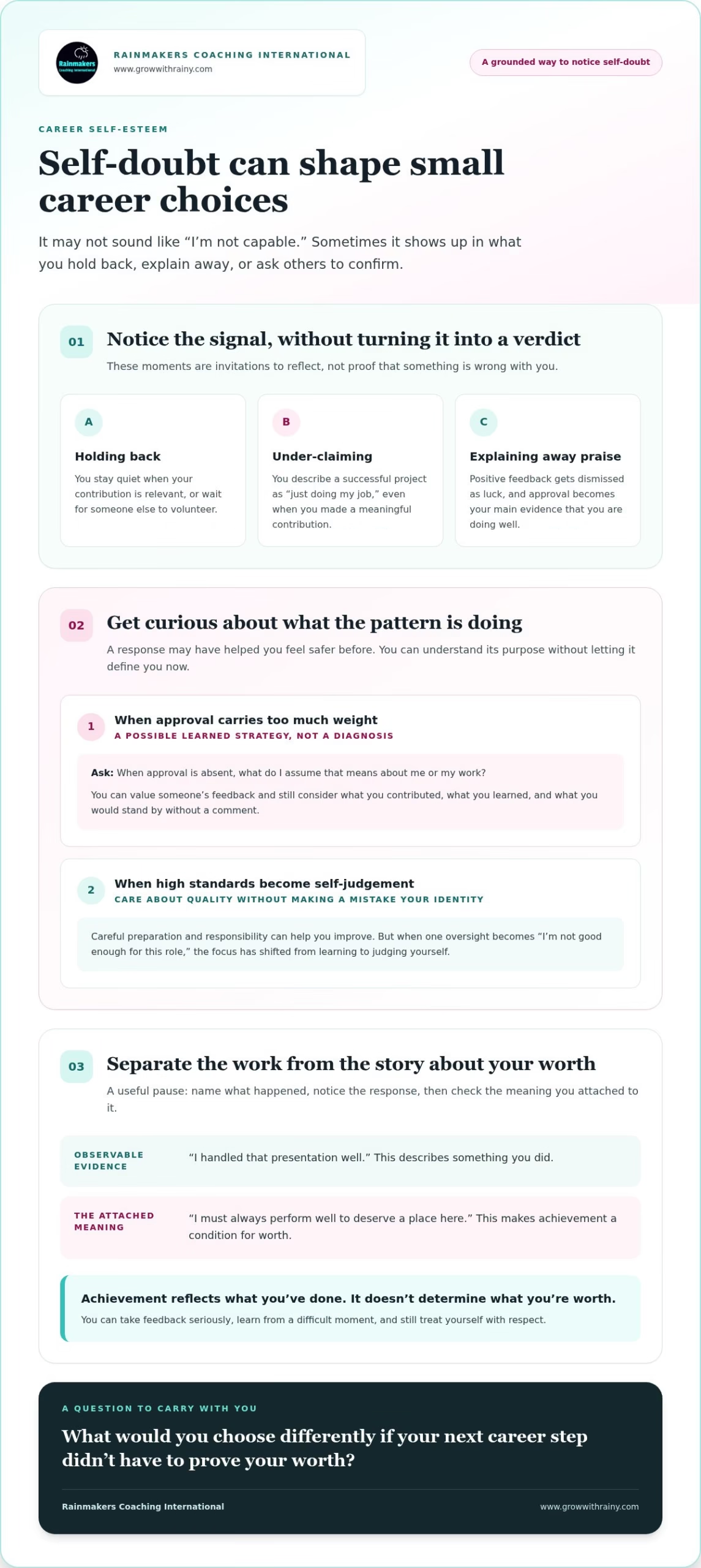
Separate these two ideas: “I handled that presentation well” describes evidence of competence. “I must always perform well to deserve a place here” makes achievement a condition for worth. The first can help you learn and take pride in your contribution. The second can make every new responsibility feel like another test.
Achievement reflects what you’ve done; it doesn’t determine what you’re worth. This distinction isn’t a reason to dismiss ambition or stop caring about your work. It’s a way to pursue meaningful goals with more self-trust, rather than making each result carry the weight of proving you belong. What would you choose differently if your next career step didn’t have to prove your worth?
How Self-Doubt Can Shape Career Behaviour Without Defining You
Self-doubt doesn’t always announce itself as “I’m not capable.” It may show up in smaller choices: staying quiet when your contribution is relevant, waiting for someone else to volunteer, or explaining away positive feedback as luck. These are possibilities to reflect on, not proof that something is wrong with you.
Notice what happens in your own work. Do you share an idea only after someone more senior has voiced a similar one? Do you describe a successful project as “just doing my job,” even when you made a meaningful contribution? If these moments feel familiar, explore them with curiosity rather than criticism.
Some responses begin as learned protective strategies. Perhaps keeping your head down once helped you avoid unwanted attention, or being especially agreeable helped you feel safer in a team. A strategy may have served a purpose then, yet feel limiting now. Instead of judging the response, look at what it helps you avoid and what it may be costing you in your current role.
When External Approval Starts Carrying Too Much Weight
Positive feedback can be encouraging. The strain begins when praise, agreement, or recognition becomes your main evidence that you’re doing well. Without it, you might replay a conversation, question a sound decision, or assume that silence means disappointment.
Approval-Seeking is one name for a possible learned strategy, not a diagnosis or a fixed identity. You don’t need to reject feedback to build self-trust. Notice whether you can value someone’s response while also considering the work itself: what did you contribute, what did you learn, and what would you stand by even if no one commented?
Ask yourself: When approval is absent, what do I assume that means about me or my work? The answer can help you distinguish a real need for useful feedback from a deeper urge to be reassured that you belong.
When High Standards Turn into a Verdict on Your Worth
Caring about quality can help you prepare carefully, take responsibility, and improve your work. But if one oversight becomes “I’m not good enough for this role,” the focus has shifted from learning to self-judgement. Perfectionism may be a useful name for a learned strategy of trying to prevent mistakes by meeting exceptionally high standards. It doesn’t define you.
After a difficult moment, separate the event from the conclusion: What happened, and what am I telling myself it means about who I am? Perhaps a report needed revisions. That calls for a practical response, not a sweeping verdict on your capability. Building self-esteem for career success includes making room for honest feedback without letting every shortfall carry the weight of your whole identity.
If these reactions keep influencing your choices, a conversation can help you explore them with care. You can talk through what you’re noticing and consider what a more grounded response might look like.
Build Career Self-Esteem by Weighing Evidence, Not Just Approval
It’s natural to notice how others respond to your work. But praise is only one part of the picture. If you use it as your main measure of capability, a quiet response can outweigh weeks of thoughtful effort. A more grounded view comes from separating what you can observe from how others react and what you conclude about yourself.
After a piece of feedback, try sorting the experience into three parts. The example below shows how one work moment can include facts, an outside response, and a personal interpretation at the same time.
| Observable evidence | Outside response | Personal meaning assigned |
|---|---|---|
| You prepared a meeting brief, summarised the key decisions, and recorded the follow-up actions. | Your manager says the summary was clear and suggests adding delivery dates and accountability next time. | “I missed a detail, how can I be so careless.” |
The first column describes what happened. The second records someone else’s response, including appreciation and a suggestion. The third is an interpretation, not a fact. It may feel convincing, especially if you’re disappointed, but it isn’t the only fair reading. Your manager acknowledged the clarity and identified a specific improvement. Both pieces of information can be true.
A Practical Reflection for Seeing Your Contribution Clearly
Choose one recent contribution, such as coordinating a handover or clarifying a decision. Write down what you did, the skills or effort involved, and what mattered to you in doing it. Then separate those details from assumptions about how others judge your value. Ask: “What would a fair, compassionate interpretation include?” Be honest, not inflated. The aim is to see the whole picture.
This practice can help you notice strengths that don’t always attract praise. Perhaps you made a complex issue easier for others to understand, followed through when priorities shifted, or asked a useful question before a decision was made. These are observable contributions. Their value doesn’t depend on someone naming them first.
How to Receive Feedback Without Turning It into a Measure of Worth
When feedback stings, pause before deciding what it means. Identify the specific information first: is there an action to adjust, a skill to develop, or a point that needs clarification? Then notice the conclusion your mind has added. “Add delivery dates next time” is input about a task. “I’m not capable” is a much broader judgement about yourself.
You don’t have to dismiss feedback or accept every interpretation of it. Consider whether the comment is specific and relevant, and what practical next step, if any, would help. Then let the information inform your work without making it the whole story of your ability.
Feedback can guide your next action; it doesn’t deliver a final verdict on your worth or potential. Building self-esteem for career success means weighing your skills, effort, values, and learning alongside other people’s responses. What evidence of your contribution would you include if you looked at your work with fairness today?
Practical Ways to Strengthen Self-Esteem in Your Career
Self-esteem at work grows through repeated moments of seeing yourself clearly and acting in line with what matters to you. You don’t have to force a positive thought or wait until doubt disappears. Start with one real situation, then choose a response that reflects your values rather than a need to prove your worth.
Try this sequence the next time you hesitate to speak, share an idea, or acknowledge your contribution:
- Name the moment. What happened? Be specific, such as “I had a suggestion during the project meeting.”
- Notice the thought. What did you tell yourself? Perhaps, “It’s probably obvious,” or “They might think it’s a bad idea.”
- Identify the pull. Did you feel like staying quiet, overexplaining, or waiting for someone else to speak first?
- Choose one grounded action. Share the idea, ask a clarifying question, or name the part of the work you contributed.
- Reflect afterwards. What did you learn about your strengths, choices, or values, regardless of how others responded?
This isn’t a test you need to pass. It’s a way to build a more honest record of how you meet work situations, including the care, skill, and judgement you bring. For another perspective on confidence and high achievement, this guide to rock-solid confidence for high-achieving leaders explores why visible success doesn’t always quiet self-doubt.
Notice the Moment Self-Doubt Takes Over
Pause long enough to separate the situation from your reaction. Ask: “What happened? What am I saying to myself? What do I feel pulled to do?” Your response may be trying to protect you from criticism, conflict, or uncertainty, but you don’t need to assume a single cause. Consider whether the thought is a fact, an interpretation, or a fear. That pause creates room to choose.
Then look for strengths in action, not only in outcomes. Did you listen carefully before responding? Prepare thoughtfully? Speak up because fairness mattered? These choices can reveal qualities you value, even if the conversation didn’t go exactly as hoped. Specific evidence is more useful than a sweeping label such as “I’m good at everything” or “I’m not capable.”
Choose One Grounded Career Action
Self-trust develops through practice, not pressure. If you want to explore ways to rebuild that trust in your decisions, this guide to trusting yourself again offers a related perspective. What is one action you could take this week because it reflects your values, not because you need to prove your worth?
When Career Coaching Can Support Lasting Self-Esteem
Reflection can help you notice self-doubt. But what if you understand the thought and still find it steering your choices? You might keep postponing a conversation about your next step, avoid taking on visible work, or repeatedly question decisions you’re equipped to make. If this pattern persists and begins narrowing your career choices, exploring it with support may be useful.
Career coaching offers space to look beneath the immediate work situation and understand what may be influencing your response. That doesn’t mean assuming there’s a single cause or treating self-doubt as a diagnosis. It means getting curious about the strategies you’ve learned, the strengths you may be overlooking, and the choices you want to make now. The aim isn’t louder self-promotion. It’s greater self-trust in how you meet your work and decide what matters.
What Self-Trust-Centred Coaching Can Help You Explore
Rainmakers Transformation System™ is organised around three stages: Release, Reprogram, and Recondition. It offers a framework for exploring what may be holding you back, considering a different way of relating to yourself, and practising that change in everyday choices. The focus is on becoming more fully yourself, not collecting advice or forcing confidence. For dedicated support with confidence, explore the Building Rock Solid Confidence Program.
A Gentle Next Step for Your Career
You don’t need to wait until self-doubt has disappeared before deciding what support might help. Begin with a quieter question: What do I want to trust myself to do next? Perhaps it’s sharing your perspective, asking for a stretch assignment, or making space to consider what you want from your current role. Your answer doesn’t have to be ambitious or impressive. It only needs to feel honest.
Career coaching can offer a supported place to explore that question and the patterns around it. You might start by considering what feels useful to you and what you want to work towards. What would a more self-trusting next step look like in your working life?
Schedule a conversation about career coaching
Let Your Next Career Step Begin with Self-Trust
You don’t have to wait until you feel completely certain to act. A small choice made with care can help you reconnect with what matters: sharing a perspective, asking for support, or considering a direction that feels more like you. Building self-esteem for career success is not about proving you deserve to be where you are. It’s about meeting your work with a steadier sense of self, even when the next outcome is uncertain.
Rainmakers Coaching International provides coaching for leaders , professionals, and individuals who want to explore self-doubt and reconnect with their strengths. The Building Rock Solid Confidence Program offers dedicated support for confidence.
If you’re ready to consider what could help you move forward, start with a conversation about career coaching.
You can move forward without having every answer. Let your next step be honest, grounded, and yours.
Frequently Asked Questions
Can I build self-esteem without changing jobs?
Yes, you can work on self-esteem while staying in your current role. Start by noticing where you already have room to exercise choice, such as setting a reasonable boundary, contributing to a discussion, or asking for clarity on priorities. Building self-esteem for career success doesn’t require a new title or workplace. If your environment repeatedly undermines your wellbeing, consider what support or changes you need.
How do I rebuild self-esteem after a career setback?
Give yourself time to take in what happened, then identify what the setback does and doesn’t tell you. If a project was cancelled, for example, separate the decision from the skills you used and the circumstances involved. Ask what you can learn, what support would help, and what small step is available now. A difficult outcome deserves attention, but it needn’t erase your experience or define your future.
Is low self-esteem the same as imposter syndrome?
How can I stop comparing my career progress with colleagues?
You may not be able to stop comparisons appearing, but you can choose how much authority to give them. When a colleague’s promotion stirs discomfort, ask what you’re actually longing for: more responsibility, recognition, learning, or a different balance. Then define a next step around that need. Remember that you’re seeing one part of another person’s career, not the full context or the trade-offs behind it.
Does praise from a manager improve self-esteem?
Praise can feel encouraging, especially when it names something specific you did well. It may also help you understand what to continue doing. But its effect can be temporary if you rely on it as your only source of reassurance. When a manager recognises your contribution, take in the feedback and note what action or skill it reflects. You can appreciate praise without making your sense of worth depend on receiving it.
How long does it take to build self-esteem?
There isn’t one timeline that applies to everyone. Your experience may depend on the situations you’re facing, how long familiar self-doubt has been present, and the support or practice available to you. Rather than waiting to feel completely confident, look for small signs of change: recovering sooner after criticism, voicing a considered opinion, or making a decision with less reassurance. Progress can be uneven, and that doesn’t mean you’ve failed. What small change would you like to notice in yourself?

Article by
Rainy Rainmaker
Rainy Rainmaker is the founder of Rainmakers Coaching International and a transformational coach for confidence, self-trust, and authentic leadership. Based in Singapore, she helps high-achieving professionals, managers, and leaders who appear capable on the outside but feel quietly held back by self-doubt, overthinking, imposter feelings, burnout, or a loss of direction. Through her signature Rainmaker Transformation Journey™, Rainy helps clients uncover the insights already within them and turn inner clarity into aligned action that creates lasting change in how they work, lead and live.
