Beyond the Boardroom: Why Senior Executives Seek Coaching
You’ve reached the top of your field. The title, the team, the track record—by every external measure, you are a success. Yet, in the quiet moments after a high-stakes presentation or late at night reviewing quarterly reports, a different feeling emerges. It’s a subtle but persistent gap between your proven capability and your internal certainty. Why does the view from the top so often feel like a void?
This is the paradox many senior leaders face. We assume they need more data, more strategies, or more skills. But often, what they truly need is permission to trust the wisdom they already possess. The relentless pressure to perform can create what we call the “High-Achiever Self-Trust Gap,” where your confidence is tied to the next win, the next target, the next validation.
From our perspective at Rainmakers, your capability is rarely the problem. The issue is the invisible pattern running underneath, a protective strategy that once helped you survive but now limits how you lead. Leadership Coaching for senior executives isn’t about adding another layer of performance; it’s about reconnecting with the truth of who you are beneath the pressure.
The High-Achiever Self-Trust Gap
The Self-Trust Gap is the space between your professional competence and your internal sense of certainty. It’s why a CEO with a flawless record can feel a jolt of imposter syndrome before a board meeting, or a newly appointed director obsesses over a minor mistake, convinced it proves she’s not ready for the role.
For many, Overachievement becomes a strategy. It starts as a way to prove your value but slowly becomes the only way you know how to feel worthy. You’re no longer expressing your talent; you’re performing to secure your place. This pattern is particularly common during major transitions, like moving from a senior manager to a director. The new scope of responsibility can trigger a profound sense of being an imposter, making you feel like you have to work twice as hard just to keep from being found out.
The Cost of Carrying the Burden Alone
Another common pattern is Over-Responsibility, the deep-seated belief that you must keep everyone and everything okay. You absorb the team’s stress, shield them from corporate pressure, and carry the emotional weight of every decision. This isn’t delegation or empowerment; it’s a form of self-sacrifice that inevitably leads to executive burnout and decision fatigue.
You find yourself re-reading emails to check the tone, staying late to perfect a colleague’s presentation, and lying awake at night running through worst-case scenarios. This isn’t leadership; it’s a performance driven by a need to manage how others feel. Over time, it erodes your energy and disconnects you from your own instincts.
Reflection Question: Which part of your leadership feels like a performance rather than a choice?
Decoding the Patterns: The Rainmaker Transformation System™ vs. Skill-Based Coaching
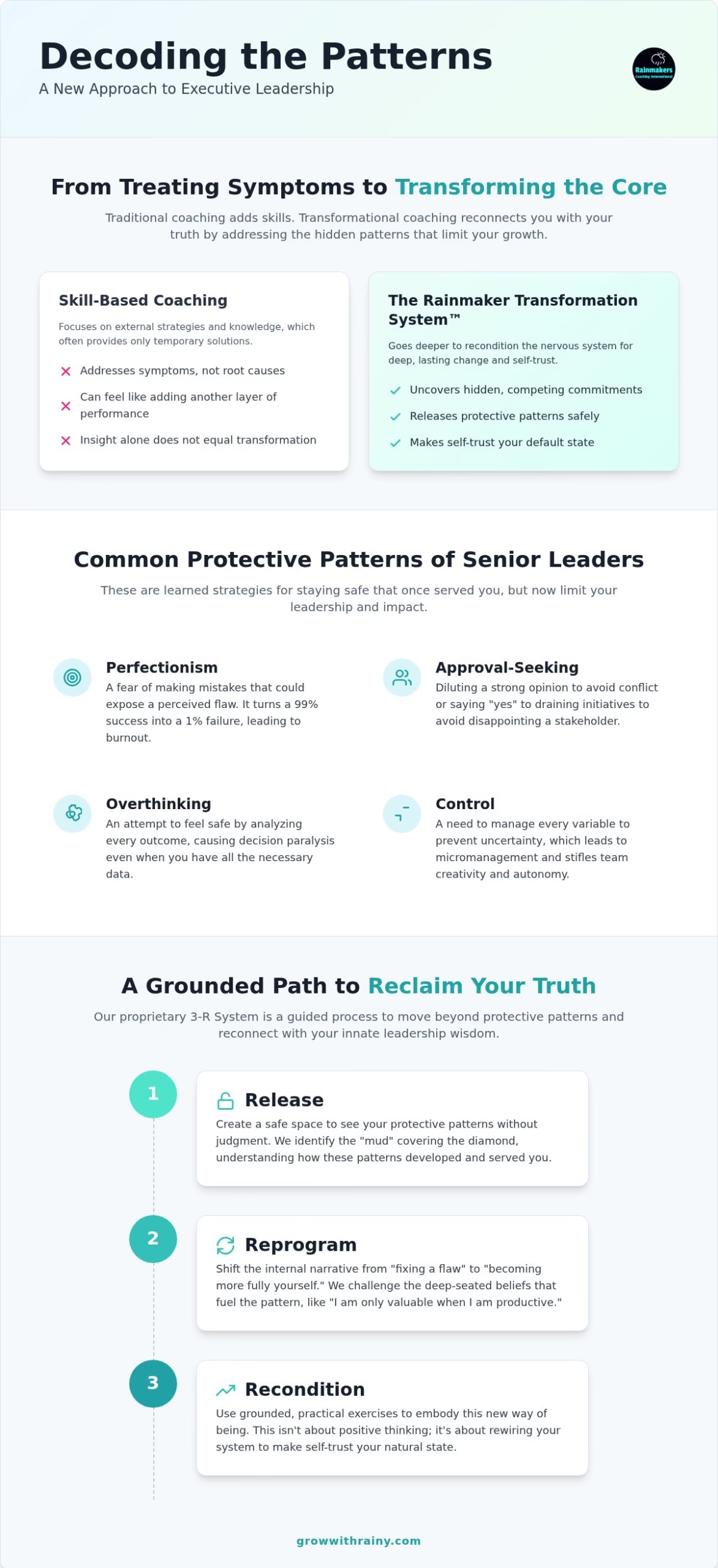
Many approach leadership coaching with the expectation of acquiring new skills—better negotiation tactics, more effective communication frameworks, or strategic planning tools. While these are valuable, they often fail to create lasting change because they only address the symptoms. Insight alone is not transformation.
The pattern that helped you succeed at one stage can become the very thing that limits your next stage of growth. True transformation requires more than new knowledge; it requires reconditioning the nervous system to feel safe without the old protective strategies. This is the core of our Rainmaker Transformation System™, a three-stage methodology designed for deep, lasting change: Release, Reprogram, and Recondition.
Research from developmental psychologists like Robert Kegan and Lisa Lahey, detailed in their book Immunity to Change, supports this view. They show how our progress is often stalled by hidden, competing commitments and subconscious assumptions that work against our stated goals. Effective coaching helps bring these hidden dynamics to the surface.
The 7 Protective Patterns of Senior Leaders
At Rainmakers, we see leadership challenges through the lens of seven common Protective Patterns. These are not clinical diagnoses but coaching constructs that describe learned strategies for staying safe. For senior executives, they often manifest in specific ways:
- Perfectionism: Not just high standards, but a debilitating fear of making a mistake that could expose a perceived flaw in your capability. It turns a 99% success into a 1% failure.
- Approval-Seeking & People-Pleasing: In the C-suite, this looks like diluting a strong strategic opinion to avoid conflict in a meeting or saying “yes” to initiatives that drain your energy and focus because you don’t want to disappoint a stakeholder.
- Overthinking: An attempt to create a feeling of safety by analyzing every possible outcome. It’s the cause of decision paralysis, where you have all the data but still can’t trust yourself to make the call.
- Control: This isn’t about authentic authority but a need to manage every variable to prevent uncertainty. It can lead to micromanagement and stifle the creativity and autonomy of a capable team.
Reconnecting with Your Truth through the 3-R System
Our proprietary Rainmaker Transformation System™ is a grounded path to move beyond these patterns and reconnect with your innate leadership wisdom. We use the metaphor of a diamond covered in mud: you don’t need to fix the diamond, you just need to gently wash away the mud.
- Stage 1: Release — The first step is identifying the “mud.” We create a safe space to see your protective patterns without judgment, understanding how they developed and how they’ve served you. This is about acknowledging the pattern, not shaming yourself for it.
- Stage 2: Reprogram — Next, we work to shift the internal narrative. Instead of a story focused on “fixing” a flaw, we create a new one centered on “becoming” more fully yourself. This involves challenging the deep-seated beliefs that fuel the pattern, such as “I am only valuable when I am productive.”
- Stage 3: Recondition — Finally, we use grounded practices to make self-trust your default state. This isn’t about affirmations; it’s about embodied change. Through consistent, small actions, you recondition your nervous system to tolerate uncertainty, navigate conflict, and lead from a place of inner authority, not fear.
Evaluating Fit: 5 Essential Criteria for Hiring a Leadership Coach
Finding the right leadership coaching for senior executives is less about a coach’s credentials and more about their ability to hold a mirror to your internal world. Don’t hire a coach who will give you another to-do list; hire one who creates the space for you to simply “be.”
To help you navigate your search, here is a checklist of essential criteria to use during discovery calls. It’s designed to help you find a partner for transformation, not just an advisor for performance.
For a deeper dive, consider reading our guide on how to find the right coach that suits your needs.
Beyond Credentials: The “Pattern” Lens
While certifications like those from the ICF are a good baseline, they don’t tell the whole story. The most impactful coaching goes beyond frameworks and into the heart of what drives you.
- Does the coach recognize the patterns of high achievers? Do they talk about imposter syndrome, perfectionism, or over-responsibility? A coach who understands these dynamics can help you see your challenges as patterns to be released, not flaws to be fixed.
- Is the approach focused on skills or on reconnecting with your truth? Ask about their philosophy. Are they offering to teach you new skills to manage your external world, or are they equipped to help you transform your internal one?
- Does the coach provide a safe, non-judgmental space for high-stakes reflection? A great coach for senior leaders creates a container of trust where you can be completely honest about your fears and uncertainties without worrying about perception or politics.
Sector Experience vs. Human Insight
It’s a common assumption that you need a coach with direct experience in your industry. While sector knowledge can be helpful, it can also be a blind spot. A coach who was a CEO in your field might unintentionally project their own experiences and solutions onto you.
- Does the coach see the human beneath the executive title? The most profound coaching happens at the human level. A coach with deep human insight can see the universal patterns of fear, ambition, and purpose that transcend any single industry.
- Does their approach feel expansive or prescriptive? A prescriptive coach tells you what to do. A transformational coach helps you access your own wisdom, empowering you to find the answers that are true for you.
Reflection Question: During your conversations with potential coaches, do you feel like a problem to be “fixed” or a person to be “seen”?
The Grounded Path to Executive Presence: Preparing for Transformation
True executive presence isn’t a rehearsed posture or a louder voice in the boardroom. It’s the natural result of deep self-trust. It’s the calm, grounded authority you radiate when you are fully yourself, especially when the stakes are high. Confidence is not about being the loudest person in the room; it’s about being yourself without apology.
This quality, often referred to as “embodied leadership,” has a measurable physiological impact. Research has shown that leaders who operate from a place of authenticity and self-trust are better able to regulate their own nervous systems, which in turn helps create psychological safety for their teams. They co-regulate rather than command.
To learn more about this, explore our article on reclaiming self-trust for authentic leadership.
Reclaiming Self-Trust as a Leadership Tool
Moving from “looking the part” to “living your truth” is a fundamental shift. When you trust yourself, you no longer need external validation to make a tough call. You can listen to your team’s input, analyze the data, and then connect with your own grounded intuition to decide the way forward. This is the essence of wise and decisive leadership.
Practical Tip: The “Grounded Pause” Technique
When you feel pressure mounting in a high-stakes moment, take a brief, intentional pause. Instead of reacting immediately, bring your attention to your feet on the floor. Feel the solidness of the ground beneath you. Take one conscious breath. This simple act can interrupt the fight-or-flight response, reconnect you to your body, and allow you to respond from a place of clarity rather than anxiety.
Setting Intentions for Your Coaching Journey
Effective leadership coaching for senior executives begins before the first session. It starts with setting a clear intention for your own transformation. This isn’t about KPIs or organizational goals. It’s about who you want to become through the process.
Before you begin, take some time to reflect:
- Define your success: How will you measure the success of this coaching engagement? Move beyond business metrics. Perhaps success is feeling calm before a board presentation, or being fully present with your family at the end of the day.
- Identify the pattern: Of the patterns discussed—Perfectionism, Over-Responsibility, Overthinking, etc.—which one feels most active in your life right now? Naming the pattern you are ready to release creates a powerful focus for your work.
Reflection Question: If you weren’t trying to prove your worth, how would you lead today?
Reclaiming Your Leadership Treasure: The Rainmakers Executive Coaching Experience
Our core philosophy at Rainmakers is simple: transformation is not about becoming someone else. It’s about removing what prevents you from being fully yourself. Every person carries hidden treasures within them—a deep well of wisdom, courage, and purpose. Our work together is to gently clear away the protective patterns that keep those treasures hidden.
The journey of leadership coaching is one of rediscovery. It’s about finding your way back to the leader you were meant to be before the world told you who you should be. This is the path to leading with grounded, authentic, and sustainable impact.
The Rainmaker Philosophy in Action
We see every senior leader as a “Diamond in the Mud.” Your innate value, brilliance, and strength are already there. Our process is not about chipping away at you to create a new shape. It’s about co-creating the conditions—safety, trust, and insightful reflection—that allow the mud of old patterns and limiting beliefs to fall away.
We focus on uncovering your innate strengths rather than just analyzing your perceived flaws. This compassionate, non-judgmental framework is what allows for deep and lasting internal shifts. You can read about the impact of this approach in our collection of Confident Leadership breakthrough stories.
Your Next Step Toward Grounded Leadership
If you are a senior leader in Singapore or beyond who feels a gap between your external success and your internal state, you are not alone. This is not a sign of weakness; it’s a call toward a more authentic way of leading and living.
The first step is a conversation. The discovery process is a no-pressure opportunity for us to understand your world and for you to experience our approach. It’s a chance to see if you feel truly seen.
Begin your journey by learning more about our Executive Coaching in Singapore.
Final Reflection: What treasure are you ready to uncover?
Frequently Asked Questions About Leadership Coaching for Senior Executives
What is the difference between executive coaching and traditional business consulting?
Business consulting focuses on solving external business problems by providing expert advice, strategies, and solutions. A consultant is hired for their expertise in a specific area, like finance or operations. Executive coaching, in contrast, focuses on the leader’s internal world. A coach doesn’t give you the answers; they help you uncover your own wisdom, challenge your assumptions, and release the patterns that limit your effectiveness. Consulting is about doing; coaching is about becoming.
How long does a typical senior executive coaching engagement last?
While every engagement is tailored, a typical journey for a senior executive lasts between six to twelve months. This timeframe allows for more than just surface-level problem-solving. It provides the space needed to identify deep-seated patterns, practice new ways of being, and integrate the changes in a sustainable way across various high-stakes situations.
Can leadership coaching help with imposter syndrome after a major promotion?
Absolutely. Imposter syndrome is rarely about a lack of competence; it’s often a symptom of underlying protective patterns like Perfectionism or Overachievement. Coaching provides a safe space to deconstruct these feelings, understand their origins, and build a grounded sense of self-trust that isn’t dependent on external validation. It helps you learn to own your success and lead from a place of authentic confidence.
Is executive coaching in Singapore different from global standards?
The core principles of powerful coaching are universal. However, the best leadership coaching in Singapore is culturally attuned to the specific pressures and nuances of the regional business environment. This includes understanding the high-context communication styles, the intense focus on excellence, and the unique challenges leaders face in a dynamic global hub.
How do I know if I am ready for the Rainmaker Transformation System™?
You are likely ready if you recognize that your challenges are not just about skills or strategy. If you feel stuck in patterns of overthinking, burnout, or self-doubt despite your success, and you’re more interested in deep, internal change than a quick fix, then our approach may be a powerful fit. It’s for leaders who are ready to do the inner work required to lead with greater freedom and authenticity.
What are the 7 Protective Patterns and how do they affect leadership?
The 7 Protective Patterns are coaching constructs we use to describe learned survival strategies: Perfectionism, Approval-Seeking, People-Pleasing, Over-Responsibility, Overthinking, Control, and Overachievement. In leadership, they can cause burnout (Over-Responsibility), decision paralysis (Overthinking), micromanagement (Control), and an inability to build trust because you’re too focused on proving yourself (Overachievement). Coaching helps you lead from your true self, not from these patterns.
Will coaching help me with my work-life balance as a senior leader?
Yes, but not by giving you time-management tips. Poor work-life balance is often a symptom of patterns like Over-Responsibility or a belief that your worth is tied to your work (Overachievement). By addressing the root cause—the pattern driving the behavior—coaching helps you set healthier boundaries, delegate more effectively, and reclaim your personal time because your sense of self is no longer dependent on being “always on.”
How is transformation measured in a leadership coaching context?
Transformation isn’t measured by how much new knowledge you’ve acquired, but by who you have become. We look for tangible shifts in your way of being. It might be how you handle a crisis—with calm instead of anxiety. It could be your ability to have a difficult conversation with clarity and compassion. Or it might be the simple feeling of ending your workday feeling fulfilled instead of drained. These internal shifts create powerful external results.

Article by
Rainy Rainmaker
Rainy Rainmaker is the founder of Rainmakers Coaching International and a transformational coach for confidence, self-trust, and authentic leadership.
Based in Singapore, she helps high-achieving professionals, managers, and leaders who appear capable on the outside but feel quietly held back by self-doubt, overthinking, imposter feelings, burnout, or a loss of direction. Through her signature Rainmaker Transformation Journey™: Release, Reprogram, Recondition – Rainy helps clients uncover the insights already within them and turn inner clarity into aligned action that creates lasting change in life, career, and leadership.
