
Table of Contents

Introduction: When the Life You Worked So Hard For No Longer Feels Like Enough
Have you ever reached a point in your life where everything looks fine on the outside…
But deep inside, something feels missing?
You have the career.
You have the achievements.
You have the responsibilities.
People may even look at you and think, “You’re doing so well.”
But when you are alone with yourself, you can’t help but wonder,
“Why don’t I feel happier?”
“Why do I feel so tired?”
“Why does my success no longer feel meaningful?”
“Is this really the life I want to keep living?”
If this sounds familiar, know that you are not alone.
Many high-achieving professionals feel this way, especially after years of working hard, proving themselves, and doing what they thought they were supposed to do. They became the capable one. The responsible one. The strong one. The one people can count on.
But somewhere along the way, they stopped asking themselves one very important question:
“Is the success I am building still aligned with who I am becoming?”
You see, success is a beautiful thing.
But success without meaning can feel very empty.
You can be promoted and still feel lost.
You can be respected and still feel invisible.
You can be financially comfortable and still feel emotionally tired.
You can be very good at what you do, and still feel like your heart is no longer in it.
This is why many people start searching for life coaching, career fulfilment coaching, or a life coach for career clarity. Simply because something inside them is asking for more truth, more alignment, and more meaning.
In psychology, Self-Determination Theory suggests that people tend to experience stronger motivation, wellbeing, and performance when three basic psychological needs are met: autonomy, competence, and relatedness.
In simple words, we need to feel that we have a sense of choice, that we are growing and capable, and that we are connected to something or someone meaningful. When these needs are not met, even external success may not feel fulfilling.
And perhaps this is why success can suddenly feel meaningless.
Not because the success is wrong. But because your soul is asking for a deeper kind of success now.
The kind of success that does not just look good on paper.
The kind that feels right in your body.
The kind that gives you peace when you wake up in the morning.
The kind that allows you to say,
“This is not just what I do. This is who I am becoming.”
At Rainmakers Coaching International, many of the people I work with are high-achieving, ambitious, and hardworking professionals. They are strong, capable and successful. And at some point in their lives, they struggle with self-doubt, loss of motivation, loss of passion, or feel stuck despite their success. What they truly desire is not just another achievement. They want clarity, confidence, purpose, and a meaningful life direction again.
So if you have been asking yourself, “Why do I feel unfulfilled despite success?” or “Is life coaching right for me?”, this article is a thoughtful place to begin.
This article is meant to help you slow down, listen inward, and understand what your dissatisfaction may be trying to tell you.
Because sometimes, the emptiness you feel is not a sign that your life has gone wrong.
Sometimes, it is a sign that you have outgrown an old version of success.
And now, it may be time to create a new one.
Reflection before we continue:
What part of your current success still feels meaningful to you, and what part feels heavy, outdated, or no longer true?
Why Success Can Stop Feeling Meaningful
For many high achievers, success did not happen by accident.
You worked for it. You showed up when it was difficult. You carried responsibilities even when you were tired. You learned how to be strong, reliable, capable, and resourceful.
And for a season, that version of success may have served you well.
It gave you confidence. It gave you recognition. It gave you proof that you could do hard things. But here is what many people do not realise.
The version of success that once gave you meaning may not be the same version of success that will continue to fulfil you.
As you grow, your values may change. Your emotional needs may change. Your life season may change. Your definition of fulfilment may change.
What used to excite you may now feel heavy. What used to motivate you may now feel empty. What used to make you feel proud may now make you wonder, “Why am I still doing this?”
And this can feel very confusing, especially when nothing is obviously “wrong”.
You may have a good job. A stable income. A good team. You may even have the title, the house, the family, or the lifestyle you once prayed for.
So when you start feeling restless, unmotivated, or emotionally disconnected, you may begin judging yourself.
“Why am I not grateful?”
“Why can’t I just be content?”
“Why do I keep feeling that there must be something more?”
But what if the question is not, “Why am I so ungrateful?”
What if the better question is:
“What part of me have outgrown this version of success?”
Because sometimes, the loss of meaning is not a sign that you are failing. Sometimes, it is a sign that you are waking up. You are waking up to the truth that success is not just about how much you achieve.
It is also about how honestly you are living. It is about whether your work reflects your values. It is about whether your life gives you space to breathe. It is about whether you still recognise yourself in the life you are building.
And for many high-achieving professionals, this is where the deeper discomfort begins. They are not lazy. They are not lost because they lack ability or confused because they are incapable.
They are often feeling stuck despite success because they have been living from responsibility for so long that they have lost touch with desire. They know what they should do and what they must do. They know what others expect them to do. But they are no longer sure what they truly want.
This is why life coaching for successful professionals can be so powerful. Not because a coach gives you all the answers, but because coaching gives you a safe and guided space to hear yourself again.
To pause. To reflect. To separate your own truth from other people’s expectations.
To ask, “What do I want now?” without guilt.
And maybe this is where meaningful success begins. Not by chasing another goal immediately. But by telling yourself the truth.
“This used to matter to me. But maybe it does not matter in the same way anymore.”
“This role used to stretch me. But now it may be shrinking me.”
“This achievement used to define me. But now I am ready to discover who I am beyond it.”
That honesty can feel uncomfortable. But it can also be the beginning of freedom. Because when success no longer feels meaningful, the answer is not always to throw your life away and start from zero.
Sometimes, the answer is to come home to yourself. To remember what lights you up. To reconnect with your values. To rebuild a life and career that does not just look successful, but feels deeply aligned.
So before you ask, “Should I quit my job?” or “Should I change everything?”, pause and ask yourself something gentler:
“What is my dissatisfaction trying to tell me?”
Because your restlessness may not be your enemy. It may be your inner wisdom asking you to stop living on autopilot. It may be the part of you that still believes your life can be more honest, more meaningful, and more fully yours.
Reflection:
Where in your life have you been successful on the outside, but quietly misaligned on the inside?

Signs Your Success May No Longer Feel Aligned
Sometimes misalignment does not arrive loudly. It does not always come as a crisis. It does not always look like a breakdown, resignation letter, or dramatic life change.
Sometimes, it shows up quietly.
- You wake up in the morning and feel heavy before the day has even started.
- You sit in another meeting and realise you are physically there, but emotionally far away.
- You receive praise, but you don’t feel happy.
- You achieve another milestone, but instead of feeling proud, you feel strangely empty.
- You look at your life and think, “Technically, everything is fine. So why don’t I feel fine?”
- If that sounds familiar, you may not be lazy, ungrateful, or difficult to please. You may simply be out of alignment.
Here are some signs that your current version of success may no longer feel meaningful.
1. You are achieving, but not feeling fulfilled
You still know how to perform.
You still deliver.
You still meet expectations.
From the outside, it may look like you are doing well. But internally, there is no deep sense of satisfaction. You may complete a big project, receive positive feedback, or hit another goal, but the joy does not last very long. Instead of thinking, “I’m proud of myself,” you may think,
“Okay, what’s next?” And then you keep moving.
This is very common among high achievers. They are often excellent at accomplishing, but not always practiced at receiving, celebrating, or asking whether the goal still matters to them.
Over time, achievement without fulfilment becomes tiring. It feels like climbing a staircase without knowing where it is leading.
2. You have lost motivation for work you used to care about
Maybe you used to feel excited about your work.
You had ideas.
You had energy.
You wanted to contribute.
You wanted to grow.
But now, even meaningful work feels like another task on your list. You may still care intellectually, but emotionally, something feels switched off. This can be very unsettling, especially if you once identified strongly with your career.
You may ask yourself,
“What happened to me?”
“Why did I lose my spark?”
“Why do I feel so disconnected from something I used to enjoy?”
Sometimes, the loss of motivation is not because you have become less capable. It may be because your values, strengths, or deeper desires are no longer being expressed in the way you work.
This is where life coaching for high achievers can be helpful, because coaching creates space to explore not just what you do, but why it matters to you now.
3. You keep asking, “Is this all there is?”
This is one of the simplest but most powerful questions a successful person can ask.
“Is this all there is?”
It usually does not come from failure. It often comes after success.
After the promotion. After the recognition.
After the salary increase.
After the title.
After reaching the thing you once thought would finally make you feel secure, proud, or enough.
And then you arrive there and realise…
You are still you. The same doubts may still be there. The same emptiness may still be there. The same longing may still be there.
This does not mean your success was meaningless. It may simply mean success was never meant to be the final destination. It was a chapter. And now another part of you is asking to be heard.
4. You feel guilty for wanting something different
This is a big one.
Many professionals feel guilty for wanting more meaning when their life already looks “good enough”. You may tell yourself:
“Other people would be grateful to have what I have.”
“I shouldn’t complain.”
“Maybe I’m asking for too much.”
“Maybe I should just be content.”
Gratitude is beautiful. Contentment is beautiful. But using gratitude to silence your truth is not alignment. You can be grateful for what you have built and still be honest that something needs to change.
You can appreciate your current role and still admit that it no longer fully fits. You can honour your past choices and still allow yourself to grow beyond them. Wanting a more meaningful life does not make you ungrateful. It makes you human.
5. You feel disconnected from your own desires
When you have spent years meeting expectations, solving problems, supporting others, and being responsible, it is easy to lose touch with what you actually want.
You may know what your boss wants.
You may know what your team needs.
You may know what your family expects.
You may know what looks impressive on paper.
But when someone asks,
“What do you truly want?”
You may go blank. Because you have not given yourself permission to listen to them for a long time. This is often where people begin searching for a life coach for career clarity, because the issue is not simply about finding a new job.
It is about finding yourself again. It is about reconnecting with the part of them that has been buried under responsibility, pressure, and years of being “the strong one”.
6. You are afraid that changing direction means wasting everything you have built
This fear keeps many people stuck.
You may think,
“I’ve spent so many years building this career.”
“What if changing direction means I wasted my time?”
“What if people judge me?”
“What if I make the wrong move?”
But growth does not always mean abandoning everything. Sometimes, it means integrating everything. Your past experience is not wasted. Your skills are not wasted. Your leadership, resilience, wisdom, and relationships are not wasted.
They may become the foundation for a more aligned next chapter. A meaningful life does not always require a dramatic reinvention. Sometimes, it begins with a more honest conversation with yourself.
7. You look successful, but feel emotionally tired
This is perhaps the most common sign.
You are functioning. You are coping. You are still doing what needs to be done. But deep inside, you are tired. Both physically and emotionally tired.
Tired of holding everything together. Tired of performing confidence. Tired of being the dependable one. Tired of pretending that you are fine when you are questioning so much inside. And because you are high-functioning, people may not notice.
They may still come to you for answers. They may still assume you are okay. They may still see your strength. But you know the truth. You are ready to exhale. You are ready for clarity. You are ready for a version of success that does not require you to abandon yourself.
Because meaningful success is not just the recognition, fame or money. It is about becoming more honest with yourself. And sometimes, the first honest sentence is:
“I am grateful for what I have. And I know there is a greater part of me – waiting to be unleashed.”
Reflection:
Which of these signs feels most familiar to you right now, and what might it be inviting you to pay attention to?
The Hidden Assumption: “If I Am Successful, I Should Feel Happy”
One of the hardest things about feeling unfulfilled despite success is the shame that comes with it. Because on paper, you may have nothing to complain about.
You may have a respectable career. A stable income. And people who trust you, depend on you, and admire you. You may have achieved things your younger self once dreamed about. So when you feel empty, restless, or quietly lost, you may begin to judge yourself.
“What is wrong with me?”
“Why can’t I just be happy?”
“Why am I still searching for something more?”
But perhaps the real problem is not that you are ungrateful. Perhaps the real problem is that we have been taught to confuse success with fulfilment. Success is often external.
It is the title. The promotion. The salary. The recognition. The milestones. The visible evidence that you are doing well.
Fulfilment is different. Fulfilment is internal. It is the inner sense that your life is connected to something meaningful. It is the peace of knowing that your work reflects your values. It is the energy you feel when your gifts are being used in the right place.
It is the deep alignment between who you are, what you do, and why it matters. And this is why you can have success and still feel unfulfilled. Because the outside may be growing, while the inside is starving.
You may be advancing in your career, but abandoning your values.
You may be gaining recognition, but losing your sense of self.
You may be achieving more, but feeling less alive.
And no amount of external success can fully compensate for internal misalignment.
I have seen this many times in coaching.
High-achieving professionals often come to coaching thinking they need another strategy. Another goal. Another plan. Another way to push themselves harder. But as we go deeper, they often realise what they truly need is not more pressure.
They need permission to be honest. Honest about what no longer excites them. What they have outgrown. What they have been tolerating. Honest about the life they secretly want but have been too afraid to express.
This is why life coaching for successful professionals is not about telling someone to throw away everything they have built. It is about helping them listen to the truth beneath their success.
Because sometimes, the question is not:
“How do I achieve more?”
Sometimes, the deeper question is:
“Who am I becoming, and does my current life still support that person?”
That question can be uncomfortable. But it can also be liberating. Because when you stop forcing yourself to feel fulfilled by a life that no longer fits, you can begin creating a life that feels more honest, more purposeful, and more aligned.
And here is something I often remind my clients.
You do not need to reject your success in order to redefine it. You do not need to feel guilty for wanting a more meaningful life. You do not need to choose between achievement and alignment.
You can be ambitious and peaceful. You can be successful and soulful. You can be grateful and still desire growth. You can honour what you have built and still choose to build differently from here.
The problem is not success. The problem is success without self-connection. Because when success is disconnected from your values, it becomes performance. When success is disconnected from your purpose, it becomes pressure. When success is disconnected from your truth, it becomes exhausting.
So maybe the invitation is not to walk away from success. Maybe the invitation is to redefine success in a way that finally includes you. Not just your achievements, your responsibilities, your image. But your peace, joy, values, gifts, relationships, wellbeing, faith, sense of aliveness.
Your inner knowing that says,
“This is the life I am choosing, not just the life I accidentally kept building.”
That is where meaningful success begins – when your inner world finally feels at home.
Reflection:
What definition of success have you been living by, and is it still true for the person you are becoming?
What Life Coaching Can Help With When Success No Longer Feels Meaningful
When people hear the word life coaching, they may imagine someone giving advice, telling them what to do, or pushing them to set bigger goals. But meaningful life coaching is not about pushing you harder.
Most high achievers already know how to push. You know how to work hard, how to be responsible, how to keep going, even when you are tired, how to meet expectations. So when success no longer feels meaningful, the answer is often not to add more pressure.
The answer is to create space for clarity. Because sometimes, you do not need another achievement. You need to understand yourself more deeply. You need to hear the part of you that has been buried under responsibility, performance, and years of being strong.
You need to ask better questions. Questions like:
“What do I truly want now?”
“What kind of life feels meaningful to me in this season?”
“What am I still doing because it is expected of me?”
“What part of me have I abandoned in order to be successful?”
“What would success look like if it was built from alignment, not pressure?”
This is where life coaching for successful professionals can be powerful. Not because a coach has a magic answer. But because coaching gives you a safe, guided, and honest space to find your own answer.
A 2014 meta-analysis published in The Journal of Positive Psychology found that coaching had significant positive effects across several individual outcomes, including performance, wellbeing, coping, work attitudes, and goal-directed self-regulation. The effect sizes ranged from 0.43 for coping to 0.74 for goal-directed self-regulation.
In simple words, coaching can help people not only think differently, but also move differently. With more clarity, more self-trust, more aligned action. And perhaps that is what many high achievers need most when they feel stuck despite success.
Not someone to tell them to be grateful or to quit everything. And definitely not another motivational quote. But a space where they can slow down enough to tell the truth.
This work often comes back to three movements.
1. Reconnect with clarity
When you are lost, the first instinct is often to search outside.
You may search for a new job.
A new title.
A new country.
A new business idea.
A new project.
A new escape.
And sometimes, an external change may be needed. But before you change everything outside, you need clarity inside. Because without clarity, even a new opportunity can become another form of confusion.
Life coaching can help you ask:
“What is truly important to me now?”
“What kind of work gives me energy?”
“What are my strengths, values, and gifts?”
“What am I no longer willing to tolerate?”
“What would a meaningful life look like for me, not for everyone else?”
This is not fluffy work. This is foundational work. Because when you are clear, your decisions become lighter. You stop chasing every shiny object. You stop saying yes out of fear. You stop staying stuck simply because the next step feels uncertain.
Clarity does not always give you the whole staircase. But it gives you the next honest step.
2. Rebuild self-trust
Many high achievers do not lack intelligence. They lack self-trust. They can analyse every option. They can support everyone else’s decisions. They can create strategies, presentations, and business plans.
But when it comes to their own life, they second-guess themselves.
“What if I make the wrong choice?”
“What if I regret it?”
“What if people judge me?”
“What if I am not good enough for the next chapter?”
This is especially common when you are standing at a life or career crossroads.
A part of you wants change. Another part of you wants safety.
A part of you wants meaning. Another part of you fears losing what you have built.
A part of you wants to rise. Another part of you is afraid of being seen.
This is why coaching is not only about strategy. It is also about aligning the inner conflicts, so that you can act confidently and not half-heartedly. Because clarity without self-trust can still lead to paralysis.
You may know what you want, but not feel safe enough to choose it. In coaching, self-trust is built through reflection, emotional awareness, belief work, courageous decision-making, and consistent aligned action.
Change doesn’t happen overnight. It doesn’t happen by force. Change happens by taking one honest step at a time.

3. Create aligned action
A meaningful life is not created only by thinking. It is created by choosing.
By experimenting.
By having honest conversations.
By setting boundaries.
By exploring new possibilities.
By taking small actions that reflect the person you are becoming.
This is where coaching becomes practical. You do not stay in reflection forever. You begin to translate insight into movement.
That may look like:
Creating a clearer career direction.
Having a conversation you have been avoiding.
Exploring a new role or industry.
Redesigning your current role around your strengths.
Rebuilding confidence after a setback.
Learning to say no without guilt.
Creating a personal vision for the next season of life.
Making space for joy, faith, health, relationships, or creativity again.
Because meaningful success is not just something you think about. It is something you practise. A 2023 review of workplace coaching research also noted that coaching has been associated with improvements in individual effectiveness, managing psychological states, overcoming obstacles, and sustaining behavioural changes
And this makes sense. Because when you are supported to reflect clearly, regulate emotionally, and take aligned action, you are no longer just surviving your success. You are learning how to lead your life from the inside out. That is the difference.
Success from pressure says:
“I must keep proving myself.”
Success from alignment says:
“I can grow in a way that honours who I am.”
Success from fear says:
“I cannot disappoint people.”
Success from self-trust says:
“I can make choices that are honest and responsible.”
Success from autopilot says:
“This is just how life is.”
Success from clarity says:
“I have the power to create a life that feels more meaningful.”
And this is why life coaching can be right for someone who is already successful. Because coaching is not only for people who are broken. It is for people who are ready to become more whole.
More honest. More aligned. More connected to their own power. More willing to stop living beneath their true potential.
Not by becoming louder or by becoming harder. Not by chasing success for the sake of success. But by returning to the truth of who they are.
Reflection:
What do you need most in this season of your life – clarity, self-trust, or aligned action?

A Coaching Case Study: When Achievement Becomes a Cage
I once worked with a client whom I will call Danny. Danny was a senior leader in a regional corporate role. On paper, he was doing well. He had the title, the income, and the respect of his peers.
He had built a stable career over many years, and people trusted him because he was calm, capable, and dependable. But when he came for coaching, he said something I hear more often than people realise.
“Rainy, I should be grateful. But I don’t feel excited about my life anymore.”
He was not in crisis.
He was not failing.
He was not about to lose everything.
In fact, that was part of the confusion. Because everything looked fine. But inside, he felt flat. He told me he used to be passionate about his work. He used to enjoy leading people, solving problems, and contributing to something bigger. But over time, his days started to feel repetitive.
Meeting after meeting.
Deadline after deadline.
Decision after decision.
Responsibility after responsibility.
He was still performing, but he was no longer feeling alive. And because he was a high achiever, his first instinct was to blame himself.
“Maybe I’m just tired.”
“Maybe I need to be more disciplined.”
“Maybe I should stop complaining.”
“Maybe this is just what success feels like at this stage.”
But as we explored deeper, we realised the issue was not laziness or a lack of discipline. The real issue was that he had outgrown the version of success he was still trying to maintain. For years, success meant stability.
It meant being respected, providing well for his family, proving that he was capable. And there was nothing wrong with that. That version of success had served him beautifully for a season. But now, in this chapter of his life, where money is no longer a concern, Danny wanted something more.
He wanted meaning, impact, purpose. He wanted to use his experience in a way that felt more purposeful. To feel proud not only of what he achieved, but of who he was becoming. At first, he felt guilty admitting this. He said,
“Is it selfish to want more meaning when I already have so much?”
And I asked him gently,
“What if wanting meaning is not selfish? What if it is purposeful? Because when you are aligned, you do not just live better. You lead better too.”
That question caused him to pause. Because for the first time, he saw that his dissatisfaction was not a problem to suppress. It was a signal to understand.
So we began the work. We looked at his values, his strengths. We looked at what gave him energy and what drained him. We looked at the beliefs that kept him stuck, especially the belief that he must remain loyal to an old path simply because he had invested many years in it.
We also explored what he truly wanted his next chapter to represent. Not just in career terms. But in life terms.
What kind of father did he want to be?
What kind of leader did he want to become?
What kind of legacy did he want to build?
What kind of life would allow him to feel deeply alive again?
Slowly, Danny began to see possibilities that were not visible before.
He did not resign impulsively.
He did not throw everything away.
He did not make a dramatic decision just to escape discomfort.
Instead, he started creating small but meaningful shifts.
He initiated conversations about taking on more strategic and people-focused work.
He began mentoring younger leaders, which reminded him how much he loved developing people.
He set clearer boundaries around his time and energy.
He reconnected with a personal project he had been delaying for years.
Most importantly, he stopped asking, “What will people think?” and started asking, “What feels honest and meaningful for this season of my life?”
A few months later, he told me,
“I realised I was not lost. I was just living from an outdated definition of success.”
That sentence warmed my heart. Because many successful professionals are not truly lost. They are simply trying to navigate their future using an old map. And this is where life coaching for high achievers can make a difference.
It gives you the space to update the map. To stop forcing yourself to continue a path just because it once made sense. To honour what you have built, while giving yourself permission to create what is next.
Danny’s coaching story is not about leaving everything behind. It is about returning to himself. It is about realising that success is not meant to become a cage. It is meant to become a platform.
A platform for greater clarity.
Greater contribution.
Greater courage.
Greater alignment.
And maybe that is the invitation for you too.
If you are feeling stuck despite success, perhaps the question is not:
“What is wrong with me?”
Perhaps the deeper question is:
“What version of success am I ready to create?”
Because your next chapter may not require you to start from nothing. It may simply require you to stop living as someone you are no longer meant to be.
Reflection:
What old definition of success have you been loyal to, and what new definition is quietly asking to be created?
Is Life Coaching Right for You?
If you are reading this article, a part of you may already be wondering.
“Is life coaching right for me?”
Maybe you are not in a crisis.
Maybe your life is not falling apart.
Maybe you are still showing up at work, still fulfilling your responsibilities, still doing what needs to be done.
But deep inside, you know something feels different.
You feel restless.
You feel disconnected.
You feel tired of going through the motions.
You feel like your life is successful, but somehow not fully yours.
This is often the season when people begin searching for life coaching, career fulfilment coaching, or a life coach for career clarity. Not because they are broken. But because they are ready to understand themselves at a deeper level.
Life coaching may be right for you if you are no longer satisfied with simply asking,
“How do I achieve more?”
And you are ready to ask,
“What kind of life do I truly want to create?”
Life coaching may be right for you if you feel stuck, but cannot clearly explain why
Sometimes, you know something is off, but you cannot put it into words.
You may say,
“I don’t know what’s wrong. I just don’t feel like myself.”
Or,
“I should be happy, but I feel strangely empty.”
Or,
“I know I want something different, but I don’t know what that is.”
This is where coaching can help you slow down and make sense of what is happening inside you. Because feeling stuck is not always a lack of options. Sometimes, it is a lack of inner clarity. You may have many possible paths, but no grounded sense of which one feels true.
A life coach can help you explore your values, strengths, desires, fears, and patterns so that your next step is not driven by pressure or panic, but by alignment.
Life coaching may be right for you if you have lost motivation or purpose at work
You may still be good at your job.
You may still deliver results.
But the passion is no longer there.
The motivation feels forced.
The work that once energised you now feels heavy or meaningless.
If you have been searching online for answers like “lost motivation at work” or “why do I feel unfulfilled despite success”, you are not alone. Many high achievers experience this when their work no longer reflects their current values, strengths, or season of life.
Life coaching can help you explore whether you need to redesign your current role, rebuild your sense of purpose, set healthier boundaries, reconnect with the impact of your work, explore a new direction, or simply understand what has changed within you.
The goal is not always to leave. Sometimes, the goal is to see clearly.
Life coaching may be right for you if you want more meaning, not just more goals
High achievers are often good at setting goals. But sometimes, goals become a way to avoid deeper questions.
Another certification.
Another promotion.
Another business idea.
Another performance milestone.
Another box to tick.
There is nothing wrong with goals. But if your goals are not connected to meaning, they can become another form of pressure.
Life coaching helps you ask:
“Why does this goal matter?”
“Who am I becoming through this?”
“Is this goal aligned with my values?”
“Am I choosing this from desire, fear, or expectation?”
Because a meaningful life is not created by chasing goals blindly. It is created by choosing goals that are connected to who you truly are.
Life coaching may be right for you if you are tired of figuring everything out alone
Many successful professionals are very private about their struggles. They are used to being the strong one.
The one who solves problems.
The one who supports others.
The one who stays composed.
The one who knows what to do.
So when they feel lost, they often hide it.
They think,
“I should be able to fix this myself.”
But there is a difference between being capable and being unsupported.
You can be intelligent and still need a safe space.
You can be strong and still need to be heard.
You can be successful and still need guidance.
You do not have to carry your questions alone just because you are capable of carrying many things.
Sometimes, the most powerful decision a high achiever can make is to stop performing strength and start receiving support.
Life coaching may be right for you if you want both emotional depth and practical direction
Some people do not only want strategy. They also want to understand what is happening beneath the surface.
Why do I keep doubting myself?
Why do I keep staying in situations that drain me?
Why do I feel guilty choosing myself?
Why do I keep needing approval?
Why do I know what I want, but still struggle to act?
This is where deeper coaching work becomes important. Because sometimes, the issue is not only the decision in front of you.
It is the belief underneath it.
The fear underneath it.
The emotional pattern underneath it.
The old identity underneath it.
This is why life coaching for successful professionals can feel different from reading another self-help book.
A book can give you insight.
A course can give you information.
A life coach can help you see the blind spots that are hard to see on your own.
Life coaching may not be right for you if you only want someone to rescue you
This is important to say honestly. Coaching is powerful, but it is not magic.
A coach does not live your life for you.
A coach does not make decisions on your behalf.
A coach does not remove every discomfort from growth.
A coach walks with you, reflects with you, challenges you, supports you, and helps you access the wisdom and courage already within you.
But you still have to show up.
You still have to be honest.
You still have to take responsibility.
You still have to practise new choices.
You still have to become the person who can hold the life you say you want.
This is why coaching works best for people who are not necessarily “ready” in a perfect way, but are willing.
Willing to reflect.
Willing to be challenged.
Willing to take action.
Willing to stop betraying themselves.
Willing to create a more meaningful version of success.
The real question is not “Do I need a coach?”
Perhaps the deeper question is:
“Am I willing to keep living the same way?”
Because if you still want to tolerate life, nothing changes. And if your current life already feels heavy, disconnected, or misaligned, then waiting for things to magically change may only prolong the exhaustion.
You do not need to have all the answers before you begin.
You do not need to know exactly what your next chapter looks like.
You do not need to be falling apart before you deserve support.
Sometimes, coaching begins with one honest sentence:
“I know I am meant for more than this, but I need help finding my way back to myself.”
And that is a beautiful place to begin.
Reflection:
If you were deeply honest with yourself, are you looking for another achievement or are you looking for a more meaningful way to live?
Life Coaching vs Therapy vs Mentoring: Which Support Do You Need?
When you are feeling stuck, lost, or unfulfilled despite success, it can be confusing to know what kind of support you need.
Do you need therapy?
Do you need mentoring?
Do you need career coaching?
Do you need life coaching?
There is no shame in needing support. The more important question is:
“What kind of support matches the season I am in?”
Because different forms of support serve different purposes.
Therapy helps you heal
Therapy is especially helpful when you are dealing with emotional distress, trauma, anxiety, depression, grief, or mental health challenges that need clinical support.
A therapist may help you process the past, understand emotional wounds, and support your mental wellbeing in a deeper therapeutic context.
If you feel emotionally overwhelmed, unable to function, or unsafe with yourself, therapy may be the more appropriate place to begin. And there is nothing wrong with that. Healing is powerful work.
Mentoring helps you learn from someone’s experience
Mentoring is useful when you want guidance from someone who has walked a similar path. A mentor may share advice, lessons, industry knowledge, career wisdom, or practical perspectives based on their own experience.
This can be valuable when you want to grow in a specific role, industry, or professional direction. A mentor may say,
“This is what worked for me.” And that can be helpful. But mentoring may not always help you uncover what is uniquely true for you.
Life coaching helps you create clarity, alignment, and action
Life coaching is different. A life coach does not simply tell you what to do. A life coach helps you listen to yourself more clearly. Coaching helps you explore your values, beliefs, desires, strengths, identity, emotional patterns, and next steps.
It helps you move from confusion to clarity.
From self-doubt to self-trust.
From autopilot to intentional living.
From success that looks good to success that feels meaningful.
This is why many successful professionals seek life coaching when they are not necessarily falling apart, but they know they are ready for a more aligned life.
They may ask:
“What do I truly want now?”
“Why do I feel stuck despite success?”
“How do I reconnect with purpose and meaning in life?”
“How do I build confidence to make a change?”
“How do I stop living according to everyone else’s expectations?”
Here is a simple way to understand the difference:
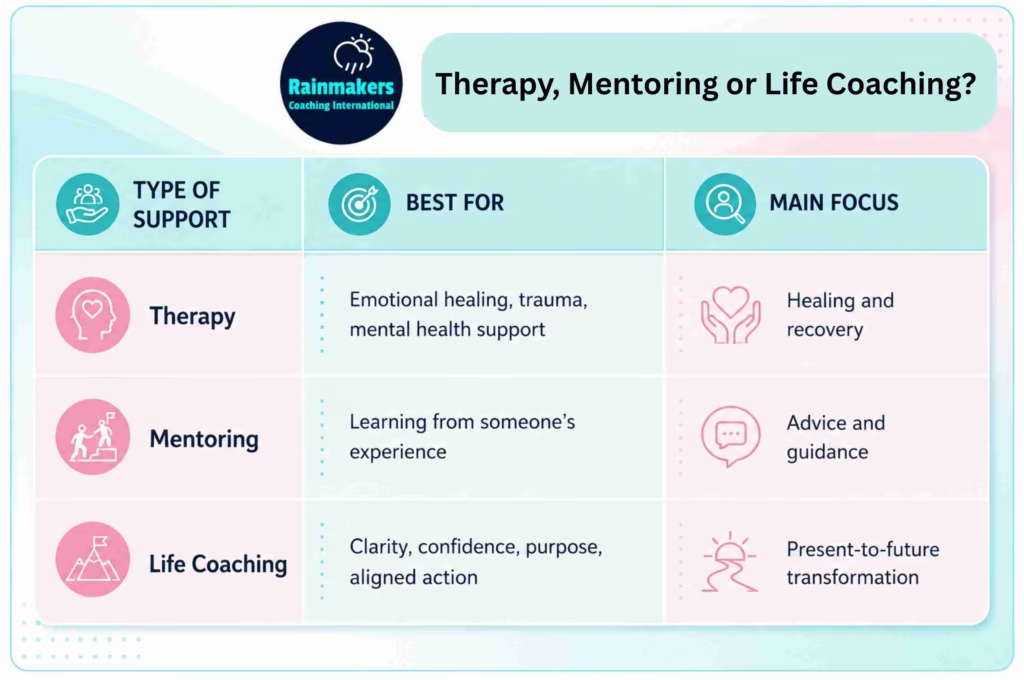
Of course, these approaches are not always separate. Some people work with a therapist and a coach at different seasons of life. Some people need mentoring for career wisdom and coaching for inner clarity.
Some people come to life coaching after years of personal development because they are ready to turn insight into transformation.
The key is not to ask, “Which one is better?”
The better question is:
“What do I need most right now?”
If you need clinical support, therapy may be right.
If you need industry advice, mentoring may be right.
If you need a space to reconnect with yourself, clarify your next chapter, rebuild confidence, and create aligned action, life coaching may be right for you.
And if you are still unsure, that is okay too. Clarity begins not by knowing the perfect answer, but by being honest enough to say,
“I know I do not want to keep doing life the same way.”
Reflection:
What kind of support would feel most nourishing and useful for you in this season – healing, guidance, clarity, or courageous action?

A Practical Exercise: The Meaningful Success Audit
Before you make any big decision, I’d like to invite you to pause.
Do not rush to resign.
Do not rush to change everything.
Do not rush to blame yourself.
Do not rush to silence the discomfort either.
Instead, give yourself a quiet moment to listen. Because sometimes, the part of you that feels lost is not asking for an immediate solution. It is asking for your attention.
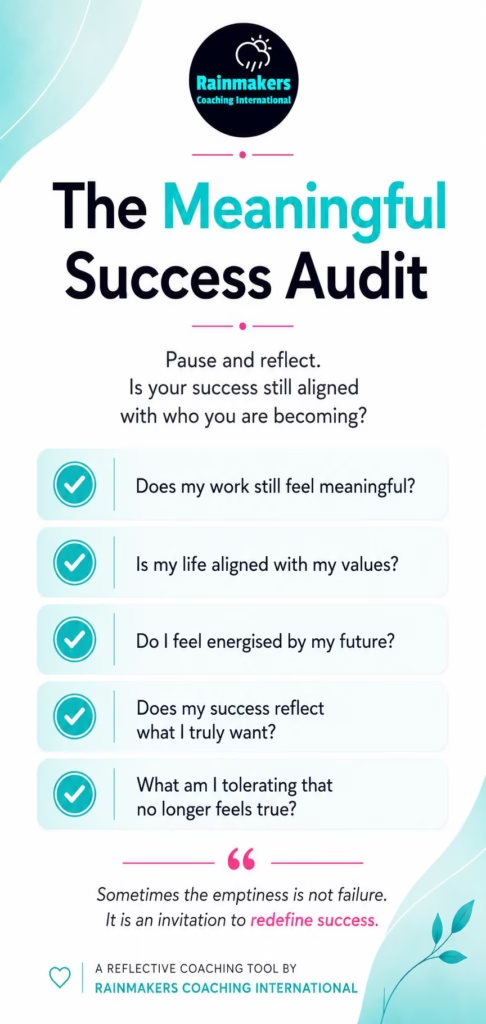
Here is a simple coaching exercise you can do. I call it the Meaningful Success Audit.
Find a quiet space. Take a deep breath. Then rate yourself from 1 to 10 for each question.
1 means “not at all.”
10 means “deeply and strongly.”
1. How meaningful does my work feel right now?
This is not how impressive, how stable or how acceptable to others. It’s about how meaningful does it feel to you?
Do you still feel connected to the purpose of your work?
Do you still feel that your contribution matters?
Do you still feel proud of what you are building?
Or are you simply going through the motions because you are good at it?
2. How aligned is my current life with my values?
Your values are the inner compass of your life. They may include growth, freedom, contribution, family, faith, creativity, stability, impact, peace, learning, courage, or authenticity.
When your life is aligned with your personal values, you may still feel challenged, but you feel grounded.
When your life is disconnected from your values, even success can feel heavy.
Ask yourself:
“What are my top values in this season of life?”
“Does my current life honour them?”
“Which value have I been neglecting for too long?”
3. How much energy do I feel when I think about my future?
Notice your body as you answer this. When you imagine the next three to five years on your current path, do you feel expanded or contracted?
Do you feel alive or drained?
Do you feel hopeful or numb?
Your body often tells the truth before your mind is ready to admit it. If the future feels heavy, it may not mean everything is wrong. But it may mean something needs to be reimagined.
4. How much of my success reflects what I truly want?
This is a brave question. Because some of our success is built from genuine desire. And some of it may be built from approval, fear, family expectations, social comparison, or old survival patterns.
Ask yourself honestly:
“Did I choose this because I truly wanted it?”
“Or did I choose this because I thought it would make me safe, respected, loved, or enough?”
There is no need to judge your answer. At different stages of life, we choose from the awareness we had then. But now that you know more, you can choose again.
5. What am I tolerating that I no longer want to normalise?
This question often reveals a lot.
Maybe you have been tolerating constant exhaustion.
Maybe you have been tolerating a role that no longer grows you.
Maybe you have been tolerating a toxic environment.
Maybe you have been tolerating emotional loneliness.
Maybe you have been tolerating self-doubt.
Maybe you have been tolerating a life that looks successful but does not feel alive.
Write it down.
Be truthful to yourself. Because what you tolerate repeatedly becomes the life you live.And what you finally acknowledge becomes the doorway to change.
Now look at your answers
Which area has the lowest score?
That is not a failure.
That is information.
That low score may be pointing you to the area of your life that needs care, honesty, or courageous action.
Then ask yourself:
“What is one small step I can take this week to honour this truth?”
Not a dramatic step. Not a perfect step. Just one honest step.
Maybe it is journaling for 20 minutes.
Maybe it is having a conversation.
Maybe it is updating your resume.
Maybe it is taking a day to rest.
Maybe it is exploring coaching.
Maybe it is admitting, for the first time, that you want something different.
Small steps matter.
Because meaningful success is not created only through big life decisions. It is created through repeated moments of self-honesty.
One choice at a time.
One boundary at a time.
One aligned action at a time.
One courageous conversation at a time.
One return to yourself at a time.
Reflection:
Looking at your Meaningful Success Audit, what is the one truth you can no longer ignore?
Frequently Asked Questions About Life Coaching and Meaningful Success
1) Why do I feel unfulfilled even though I am successful?
2) Is it normal for high achievers to feel stuck despite success?
3) Can life coaching help with career clarity?
4) What is the difference between life coaching and career coaching?
5) Is life coaching only for people who are struggling?
6) How do I know if I need a life coach?
7) Do I need to change my career to feel meaningful again?
8) Can life coaching help me find my purpose?
Final Thoughts: Maybe You Are Not Lost. Maybe You Are Being Invited to Redefine Success.
When success no longer feels meaningful, it can feel frightening. Especially when you have spent years building the life you have now.
You may wonder if something is wrong with you.
You may wonder if you are being ungrateful.
You may wonder if it is too late to change.
You may wonder if you should just continue and hope the feeling goes away.
But I’d like to to offer you another perspective.
Maybe you are not lost.
Maybe you are becoming more honest.
Maybe the life that once gave you pride is now asking to become more aligned.
Maybe the goals that once motivated you are no longer big enough for the person you are becoming.
Maybe your restlessness is not a problem to fix.
Maybe it is wisdom rising.
The wisdom that says,
“I am grateful for what I have built, and I am ready for something deeper.”
“I do not want to keep achieving at the cost of abandoning myself.”
“I want a life that feels meaningful, not just impressive.”
“I want success that includes peace, purpose, confidence, love, faith, joy, and truth.”
And if that is where you are, please know this:
You do not need to have all the answers today.
You do not need to change everything immediately.
You do not need to prove that your dissatisfaction is valid.
You only need to begin with honesty.
Honesty about what no longer fits.
Honesty about what you secretly desire.
Honesty about what you are tired of carrying.
Honesty about what kind of life you want to create from here.
Because meaningful success is not something you accidentally fall into. It is something you consciously create.
With clarity. Courage. Support. Self-trust. Aligned action. And sometimes, the most powerful beginning is simply saying:
“I am ready to come home to myself.”
Final Reflection:
What if the emptiness you feel is not a sign that you have failed, but a quiet invitation to redefine success on your own terms?
Ready to Redefine Success on Your Own Terms?
If you have been feeling successful on the outside, but quietly unfulfilled on the inside, you do not have to figure it out alone.
You do not need to wait until you burn out.
You do not need to have the perfect answer before asking for support.
You do not need to keep carrying the question, “What is next for me?” by yourself.
Sometimes, one honest conversation can help you hear yourself more clearly.
In a complimentary 90-minute Breakthrough Call, we will explore where you are now, what has been keeping you stuck, and what a more meaningful version of success could look like for you.
It is a safe and thoughtful space to pause, reflect, and begin reconnecting with your clarity, confidence, and direction.
Together, we may explore what no longer feels aligned in your current life or career, why your success may no longer feel meaningful, what you truly want in this next season, what beliefs, fears, or patterns may be holding you back, and what your next honest step could look like.
If your heart has been quietly saying, “There must be more than this,” perhaps this is your invitation to listen.
You are welcome to book a complimentary 90-minute Breakthrough Call with Rainy and begin creating a version of success that feels meaningful, aligned, and truly yours.
Book your complimentary 90-minute Breakthrough Call HERE

What’s Next?
Find out if your confidence level is undermining your success here.
Wondering if you are ready for coaching? Take this coaching readiness questionnaire
For more insights on personal growth and coaching, explore our blog articles.
