
You’ve chaired the meetings, hit the targets, and earned the title. From the outside, you are the picture of a successful leader. So why does it feel like you’re one misstep away from being found out? Why does the praise from your board or your team feel temporary, like a loan that could be recalled at any moment?
If you’re exhausted by the constant second-guessing and the fear that your success is a fluke, you are not alone. This experience is the high-achiever’s paradox: the more you accomplish, the more intense the pressure to prove you deserved it. The constant internal chatter isn’t a sign of weakness; it’s a sign that a part of you is working overtime to keep you safe.
But what if that self-doubt isn’t a flaw to be fixed? What if it’s an overused protective strategy, an invisible barrier you constructed long ago that is now keeping you from leading with the grounded confidence you’ve already earned? This isn’t about fighting your inner critic. It’s about understanding its purpose so you can finally release the need for it and reconnect with the truth of who you are.
Myth #1: Strong Leaders Never Experience Self-Doubt
In the corporate culture of Singapore and across Asia, the archetype of the stoic, unshakable leader is pervasive. We’re taught that decisiveness requires absolute certainty and that vulnerability is a liability. This creates immense pressure to project an image of flawless confidence, even when our internal reality filled with doubts and uncertainty.
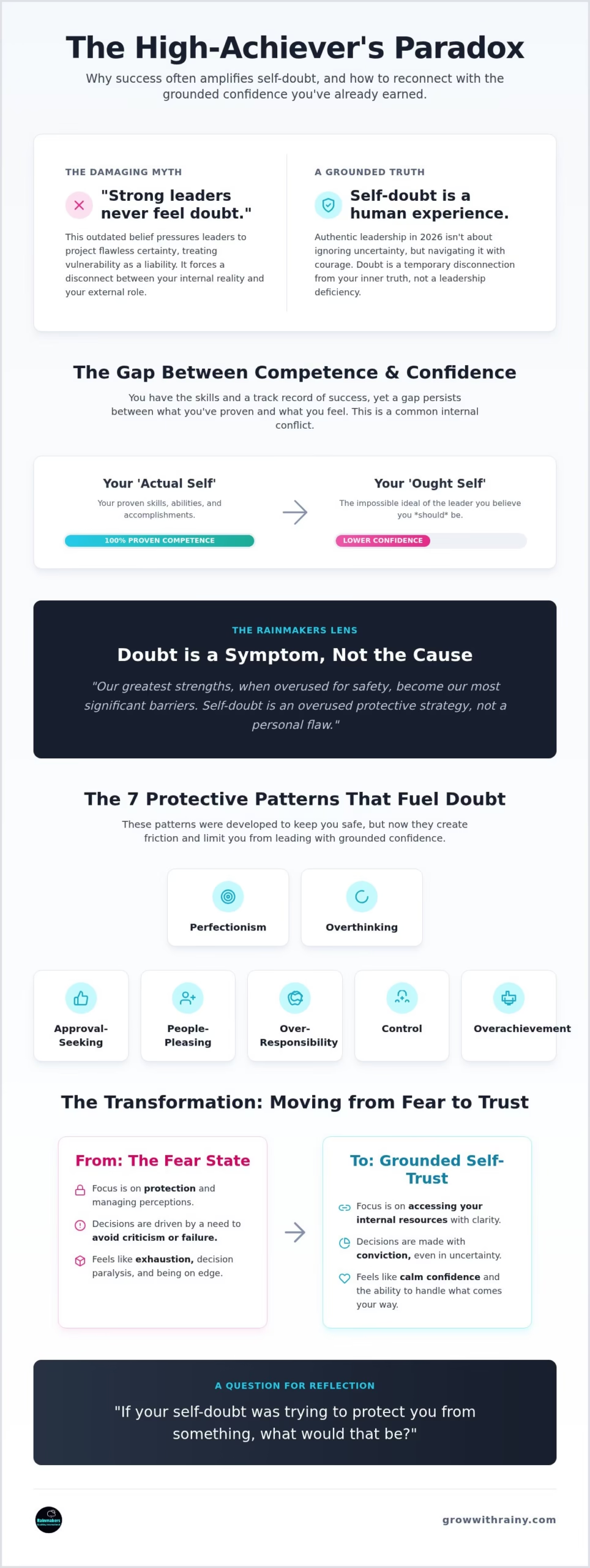
This is the first and most damaging myth we must bust. Self-doubt is not a leadership deficiency. It’s a human experience.
- Challenge the archetype: The belief that powerful leaders are immune to doubt is a holdover from an outdated, command-and-control style of management. True leadership in 2026 requires authenticity and the courage to navigate uncertainty, not pretend it doesn’t exist.
- Redefine self-doubt: It is not a reflection of your ability. It is a temporary disconnection from your inner truth, often triggered by high-stakes situations, new responsibilities, or the fear of failure.
- Introduce the High-Achiever’s Paradox: For many driven professionals, success doesn’t quiet the inner critic – it gives it a bigger stage. Each promotion or achievement raises the stakes, creating a new, higher level from which to fall. This is why you can have a track record of success and still feel like an imposter.
Your doubt isn’t random noise. It has a function. It’s a misguided attempt to protect you from perceived threats: criticism, failure, or being seen as “not enough.”
Reflective question: If your doubt was trying to protect you from something, what would that be?
The Difference Between Competence and Confidence
You have the skills. You have the experience. Yet, in the boardroom, a gap persists between your proven competence and your felt confidence. This is a common internal conflict explained by self-discrepancy theory in psychology. It highlights the tension between your ‘actual self’ (your skills, accomplishments, and abilities) and your ‘ought self’ (the leader you believe you should be).
When your inner critic insists you ‘ought’ to be more strategic, more eloquent, or more visionary, it creates a painful gap. You’re no longer operating from your grounded reality; you’re judging yourself against an impossible ideal. Competence doesn’t automatically cure doubt because doubt isn’t a problem of skill; it’s a problem of identity and perception.
Normalizing the Inner Critic
I once worked with a senior executive who had just been promoted to a regional role. He was celebrated by his peers, yet he confessed, “I feel like I fooled them all. I’m just waiting for the moment they realize they promoted the wrong person.” This feeling is incredibly common, a classic sign of what many call imposter syndrome in senior leaders.
His story illustrates a universal truth: self-doubt thrives in isolation. The moment we acknowledge that these feelings are a shared part of the human journey, even at the C-suite level, their power begins to diminish. You are not broken for feeling this way. You are simply human.
The Rainmakers Lens: Understanding Doubt as a Protective Strategy
Most advice on overcoming self-doubt as a leader tells you to ignore the voice, silence it, or fight it with positive affirmations. This is like trying to fix a rattling engine by turning up the radio. It doesn’t address the root cause, and the noise always returns when the music stops.
The Rainmakers Lens offers a different perspective. It’s based on a core principle: our greatest strengths, when overused for safety, become our most significant barriers.
Self-doubt is not the problem itself; it’s a symptom of a deeper, invisible protective strategy at play. For high-achievers, these strategies often manifest as patterns like Perfectionism or Overthinking. You developed these patterns because, at some point, they worked. Perfectionism helped you produce flawless work and avoid criticism. Overthinking helped you anticipate every possible outcome and feel a sense of control.
In uncertain, high-stakes leadership roles, these strategies go into overdrive. They create a false sense of security, but they come at a high cost: mental exhaustion, decision paralysis, and a constant feeling of being on edge. The goal, therefore, is not to fight the doubt. It’s to gently release the underlying need for protection that fuels it.
The Seven Protective Patterns
At Rainmakers Coaching International, we’ve identified seven common protective patterns in our Rainmakers Pattern Library that keep leaders stuck. Besides Perfectionism and Overthinking, they include:
- Approval-Seeking
- People-Pleasing
- Over-Responsibility
- Control
- Overachievement
These patterns are the invisible cages that hide what we call your “hidden treasures” – your innate wisdom, courage, purpose, and capacity for authentic connection. They create immense internal friction, the feeling of driving with the brakes on, which inevitably leads to burnout .
Moving from Fear to Self-Trust
The opposite of a fear-driven, protection-focused state is not fearlessness. It is grounded self-trust. Grounded self-trust is the ability to access your internal resources and act with clarity and conviction, even in the face of uncertainty. It’s the quiet confidence that you can handle whatever comes your way.
Leading from the ‘Fear State’ is about managing perceptions and preventing negative outcomes. Leading from the ‘Freedom State’ is about expressing your authentic self and creating positive impact. The first is draining; the second is generative.
Reflective prompt: Which protective pattern do you lean on most when the stakes are high?
Myth #2: Self-Criticism is the Secret to Your Edge
Perhaps the biggest objection high-achievers have to letting go of self-doubt is the belief that their inner critic is the source of their success. “If I’m not hard on myself,” the logic goes, “I’ll become complacent. My anxiety is the fuel that keeps me sharp.”
This is the second myth we need to dismantle. You didn’t achieve success because of your self-criticism; you achieved it despite the heavy weight of it.
Chronic self-doubt and the anxiety it produces don’t sharpen your thinking – they hijack it. Neurologically, the stress response triggered by intense self-criticism impairs the prefrontal cortex, the part of your brain responsible for strategic thinking, complex problem-solving, and emotional regulation. You’re trying to lead from a brain that is in a perpetual state of threat.
A more powerful, sustainable driver is what we call ‘Compassionate Insight’ – the ability to see your actions and their outcomes clearly, without the corrosive layer of self-judgment. It allows you to learn from mistakes, adapt, and grow, rather than being paralyzed by the fear of making them.
The Cognitive Cost of Second-Guessing
In Singapore’s dynamic and demanding market, leaders cannot afford to be drained by internal battles. The constant second-guessing fueled by the inner critic leads directly to decision fatigue. When your mental energy is spent re-litigating past choices and worrying about future ones, you have less capacity available for the creative, forward-thinking work your role requires.
Leading from a grounded space is more resilient and sustainable than leading from a place of pressure. It conserves your most valuable resource: your cognitive and emotional energy. This is a core component of building true mental toughness and resilience.
Redefining Excellence Without the Weight
Let’s be clear: releasing the inner critic is not about lowering your standards. It’s about uncoupling your desire for excellence from your fear of being found out. The first is a creative, expansive energy that pulls you forward. The second is a constrictive, fearful energy that holds you back.
When you release the need to be perfect, you create space for your natural strengths to emerge more fully. Your team doesn’t need a flawless leader; they need an authentic one. Research from institutions like Harvard Business School consistently shows that psychological safety – the belief that one can speak up without fear of punishment or humiliation is the single greatest predictor of high-performing teams.
Your self-acceptance is the first step in creating that culture.
Reconnecting with Your Truth: The 3R Transformation Process
So, how do you move from understanding this intellectually to embodying it in your leadership? You don’t need more “tips” or “hacks.” Writing down your accomplishments in a journal is a nice exercise, but it won’t rewire the deep-seated patterns that drive self-doubt.
Lasting change requires a structured process. At Rainmakers Coaching International, we guide leaders through our proprietary Rainmakers Transformation System™. This isn’t about adding more skills or knowledge. It’s about releasing what no longer serves you to uncover the powerful, resourceful leader you already are.
The framework is a simple, three-step path for your leadership journey in 2026:
- Release the Protective Strategy
- Reprogram the Inner Narrative
- Recondition for Grounded Leadership
Step 1: Release the Protective Strategy
The first step is to bring the unconscious pattern into conscious awareness. When you feel that familiar knot of anxiety or the urge to re-read an email for the tenth time, pause. Instead of getting swept away by the feeling, get curious about it. Identify the physical sensation of the doubt in your body. Then, name the pattern with non-judgmental awareness: “Hello, Perfectionism. I see you’re here trying to keep me safe.”
This simple act of naming creates a space between you and the pattern. It shifts you from being a prisoner of the strategy to being an observer of it. This is the starting point for letting go of these invisible barriers and building rock-solid confidence from the inside out.
Step 2: Reprogram the Inner Narrative
Once you’ve created space, you can begin to challenge and replace the old narrative. The ‘ought self’ – the voice telling you who you should be is loud, critical, and rooted in fear. Your work is to tune into a quieter, more powerful voice: the one connected to your innate ‘hidden treasures’ of wisdom, courage, and purpose.
Using the Rainmakers Lens, you learn to see yourself with the same compassion and belief that a great coach would. This is about identity-based change, not just behaviour-based tweaks. You stop trying to act more confident and start embodying the truth that you are already capable, worthy, and resourceful.
Step 3: Recondition for Grounded Leadership
This final stage is about practice. Building the muscle of self-trust is like building any other muscle – it requires consistent, intentional effort. Reconditioning involves daily practices that reinforce your new way of being. This could be a two-minute mindfulness exercise before a difficult conversation, a practice of celebrating small wins, or consciously choosing to trust your first instinct on a decision, etc.
Through this 3R Integration, the shifts become permanent. They move from being a conscious effort to your default way of operating. You no longer have to manage your doubt, because your new foundation is built on grounded self-trust.
Reflective question: What would you do today if you weren’t trying to protect your image?
Leading with Grounded Confidence in 2026
Overcoming self-doubt as a leader isn’t about reaching a mythical state of perfection where you never feel uncertain again. It’s about changing your relationship with uncertainty. It’s about building a deep, unwavering trust in your ability to navigate challenges from a place of inner alignment.
The ‘Grounded Leader’ is not the loudest person in the room. They are calm, decisive, and deeply authentic. They listen more than they speak. They inspire trust not through force of will, but through the integrity of their presence. And they know that their greatest treasures – their wisdom, courage, and purpose are, and always have been, within them.
The Impact of Authentic Leadership
When you shift your internal state from protection to freedom, the change doesn’t stop with you. It creates a ripple effect throughout your organization. A leader who trusts themselves creates a culture of trust. A leader who is compassionate with themselves fosters psychological safety. Your personal transformation becomes a powerful catalyst for team and organizational transformation.
This journey is guided by what we call the Rainmakers Principles of Human Transformation, which can become a roadmap for developing not just yourself, but your entire team. It’s a more human-centric approach to executive coaching in Singapore.
Your Journey to Self-Mastery
You have carried the weight of these protective patterns for a long time. The good news is, you don’t have to navigate the path to releasing them alone. This journey is not about becoming someone new. It’s about coming home to the leader you were always meant to be.
If you are ready to stop second-guessing and start leading from a place of grounded self-trust, the first step is a simple conversation.
Frequently Asked Questions
Is self-doubt the same as imposter syndrome for leaders?
They are closely related but not identical. Self-doubt is the feeling of uncertainty about your abilities or decisions. Imposter syndrome is a more pervasive psychological pattern where, despite external evidence of success, you have a persistent internal belief that you are a fraud and will be “found out.” Self-doubt is often a key symptom of imposter syndrome.
Can I ever truly get rid of my inner critic?
The goal isn’t to eliminate the inner critic entirely, as that part of your brain is also responsible for discernment and healthy self-assessment. The goal is to change your relationship with it. Through the 3R process, you can dial down its volume and strip it of its emotional charge, transforming it from a harsh judge into a neutral observer whose input you can choose to accept or dismiss.
How do I know if my self-doubt is a protective strategy or a genuine warning?
A genuine warning (your intuition or a rational assessment) feels calm, clear, and grounded. It often points toward a specific, actionable concern. Self-doubt rooted in a protective strategy feels anxious, repetitive, and emotionally charged. It’s often vague and personal, attacking your worthiness (“I’m not good enough”) rather than assessing the situation (“We may not have enough data for this decision yet”).
Will my team lose respect for me if I’m more ‘authentic’ and less ‘perfect’?
The opposite is almost always true. Projecting an image of perfection creates distance and can make you seem unapproachable. Authentic leadership, which includes acknowledging uncertainty and being open to learning, builds trust and psychological safety. Your team will respect your humanity and feel more empowered to bring their whole selves to work.
How long does it take to overcome deep-seated self-doubt in a leadership role?
There is no fixed timeline, as it depends on the individual’s patterns and commitment to the process. However, leaders often begin to experience significant shifts in perspective and a reduction in daily anxiety within the first few coaching sessions. The Rainmakers Transformation System™ is designed to create lasting, identity-level change, not just temporary relief, with most clients embedding these new ways of being within six months.
What is the first step I can take today to stop overthinking my decisions?
Practice the “one-and-done” rule for a small, low-stakes decision. Make the choice based on the information you have, and commit to not revisiting it. This begins to build the muscle of self-trust. When the urge to second-guess arises, simply notice it, name it (“That’s the Overthinking pattern”), and gently redirect your focus to your next task.
Is executive coaching in Singapore effective for dealing with imposter syndrome?
Yes, especially when the coaching approach goes beyond surface-level performance tips. An effective executive coach helps you identify and release the root protective strategies that fuel imposter syndrome. By focusing on rebuilding grounded self-trust and reconnecting you with your innate strengths, coaching provides a guided, supportive path to embodying your leadership authority authentically.

Article by
Rainy Rainmaker
Rainy Rainmaker is the founder of Rainmakers Coaching International and a transformational coach for confidence, self-trust, and authentic leadership. Based in Singapore, she helps high-achieving professionals, managers, and leaders who appear capable on the outside but feel quietly held back by self-doubt, overthinking, imposter feelings, burnout, or a loss of direction.
Through her signature Rainmaker Transformation Journey™: Release, Reprogram, Recondition – Rainy helps clients uncover the insights already within them and turn inner clarity into aligned action that creates lasting change in life, career, and leadership.
