

Understanding Limiting Beliefs as Protective Strategies
Have you ever found yourself on the brink of a major opportunity – a promotion, a high-stakes presentation, a bold new venture, only to be paralyzed by a voice that whispers, “You’re not ready for this”? You know you are capable. Your track record proves it. Yet, you hesitate, overthink, and hold back. This frustrating gap between your known ability and your in-the-moment actions is often governed by what we call limiting beliefs.
A limiting belief is an internal assumption you hold to be true about yourself, others, or the world, which constrains you in some way. It could be the conviction that “Asking for help is a sign of weakness,” the inherited rule that “You must always be the responsible one,” or the deep-seated feeling that “I’m just not a creative person.” These are not just negative thoughts; they are the invisible architecture of your reality, shaping your decisions, reactions, and ultimately, your future.
But here is the crucial shift in perspective that changes everything: limiting beliefs are not flaws you need to fix. At Rainmakers Coaching International, we see them as protective strategies. They are patterns you learned, often early in life, to keep yourself safe, loved, and accepted. You are not broken. You are, and have always been, whole. The goal of coaching for overcoming limiting beliefs is not to become someone else, but to release the outdated patterns that hide your inner treasure.
Imagine a brilliant, priceless gem covered in layers of dried mud. The gem’s value and light have never diminished, but they are obscured. Transformation is the gentle, deliberate process of washing away the mud – not to change the gem, but to allow its natural brilliance to emerge. This is how we approach your growth: by helping you reconnect with the truth of who you already are.
The Origin of Protective Patterns
These protective patterns are not random. They are carefully constructed from our earliest experiences with parents, teachers, and peers. A child praised only for perfect grades may develop a belief that their worth is tied to flawless performance. This isn’t a character flaw; it’s a logical strategy for securing love and approval in their environment.
As the Rainmakers Principle states: “Perfectionism is often a strategy for protecting love, acceptance, and worthiness.” It’s vital to understand that these are coaching constructs designed to explain learned behaviours. They are not clinical diagnoses. This distinction is empowering because what was learned can be unlearned and replaced with something that serves the adult you have become.
The Cost of Carrying Outdated Strategies
The very patterns that helped you survive and succeed early in your career often become the ones that limit your next stage of growth. The meticulous attention to detail that got you recognized as a junior analyst can morph into micromanagement that stifles your team. The desire to please that made you a beloved team player can prevent you from making the tough, necessary decisions of a leader.
This leads to what we call the “High-Achiever Self-Trust Gap” – a space where your external success is miles ahead of your internal sense of worthiness. It’s a place of inner struggle, impacting your leadership visibility, your willingness to take creative risks, and your overall sense of fulfilment.
Consider the story of a client, a newly promoted director at a tech firm. We can call her Sandy. The promotion was a validation of years of hard work, yet she felt like a fraud. Her limiting belief “I can’t make mistakes, or they’ll find out I don’t belong here” had taken root.
This belief, once a driver for high-quality work, was now a source of intense anxiety. She worked 16-hour days, double-checking every email and re-doing her team’s work. She avoided strategic meetings where she might be challenged.
The cost was immense: her health was deteriorating, her team was demoralised, and she was on the verge of burning out from a job she had desperately wanted. Her protective strategy was no longer protecting her; it was costing her everything.
If this gap between your ambition and your self-trust feels familiar, you are not alone. It’s a common experience for leaders who are ready for a new level of impact. Learn more in our Rock Solid Confidence: Guide for High-Achieving Leaders.
The 7 Hidden Patterns Holding High Achievers Back
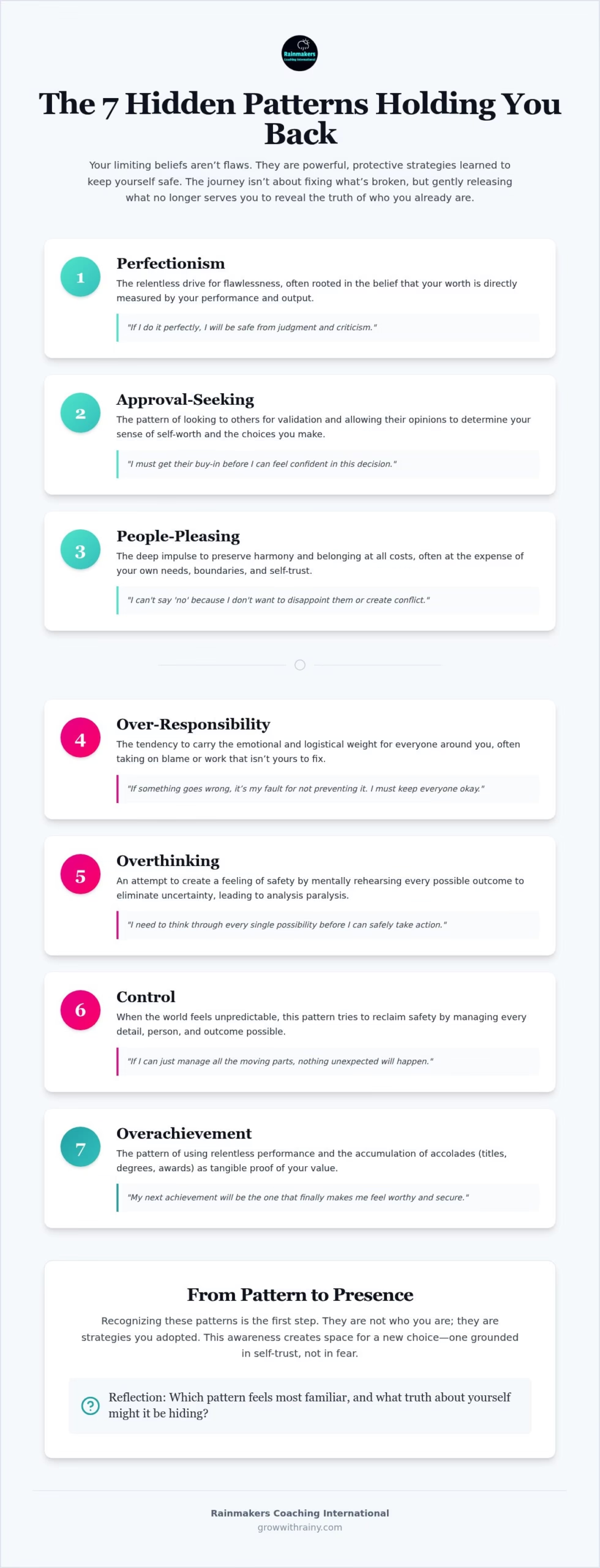
While limiting beliefs can take countless forms, our work with high-achieving leaders for more than a decade has revealed seven distinct protective patterns that frequently appear. As you read through them, notice if any resonate with a quiet “that’s me.” Remember, these are learned behaviours, not inherent flaws. Your capability isn’t the problem; the pattern underneath may be.
Perfectionism, Approval-Seeking, and People-Pleasing
- Perfectionism : This is the relentless drive for flawlessness, often rooted in the belief that your worth is measured by your performance. It’s the voice that says, “If I do it perfectly, I will be safe from judgment and criticism.”
- Approval-Seeking: This pattern involves looking to others for validation and allowing their opinions to determine your worth. You might hold back a valuable idea in a meeting, waiting to see which way the consensus is shifting.
- People-Pleasing: This is the impulse to preserve harmony and belonging at all costs, even at the expense of your own needs and self-trust. It’s saying “yes” to another project when your plate is already overflowing because you fear disappointing someone.
Over-Responsibility, Overthinking, and Control
- Over-Responsibility: This is the tendency to carry the emotional and logistical weight for everyone around you. You feel a deep-seated need to keep everyone “okay,” often taking on blame or work that isn’t yours.
- Overthinking: This pattern is an attempt to create a feeling of safety by mentally rehearsing every possible outcome and eliminating all uncertainty. It leads to analysis paralysis and prevents you from taking decisive action.
- Control: When the world feels unpredictable, the control pattern tries to reclaim a sense of safety by managing every detail, person, and outcome. It can create friction and stifle collaboration when your need for control overrides another’s autonomy.
The Overachievement Trap
- Overachievement: This is the pattern of using relentless performance and accumulation of accolades as proof of your value. As the Rainmakers Principle explains: “Overachievement often begins when a person learns to use performance as proof of their value.” The problem is that the validation from each win is fleeting, leading to a never-ending cycle of striving that results in burnout and a profound lack of fulfilment, even after achieving major goals.
Why Insight Alone Does Not Create Lasting Transformation
Many high achievers who seek coaching for overcoming limiting beliefs are incredibly self-aware. They’ve read the books, listened to the podcasts, and can articulate their patterns perfectly. They might say, “I know I’m a people-pleaser, but I just can’t stop myself from saying yes.” This is one of our core Rainmakers Points-of-View: “Insight is not the same as transformation.”
Knowing you have a pattern is like knowing you have a rock in your shoe. It’s useful information, but it doesn’t remove the rock. You can analyze the rock, understand its geology, and know precisely why it’s causing you pain, but until you take off your shoe and remove it, you will continue to limp. Lasting change requires a grounded approach that goes beyond intellectual understanding.
The Science of Belief and Behavioural Change
Your beliefs are not just abstract thoughts; they are physically wired into your brain. Decades of research in neuroplasticity show that the brain changes in response to experience. When you repeatedly think a thought or engage in a behaviour, you strengthen the neural pathways associated with it. As Canadian psychologist Donald Hebb famously postulated, “neurons that fire together, wire together.”
A limiting belief like “I’m not good enough” is not just a fleeting idea. It’s a well-traveled neural highway in your brain. When you’re faced with a high-stakes situation, your brain, seeking efficiency, will default to this familiar path. This is why you can “know” you are capable but still* “feel”* like an imposter. True transformation involves consciously and consistently building new neural pathways – creating a new road for your brain to travel down until it becomes the default.
The 3-R Framework for Reconnecting with Your Truth
To create this lasting change, we use the proprietary Rainmaker Transformation System™. It’s a grounded, three-stage process designed to move you from insight to integration.
- Release: This first stage is about gently letting go of the protective strategies that no longer serve you. It involves acknowledging the original purpose of the belief – to keep you safe and then consciously deciding that you no longer need that specific form of protection.
- Reprogram: Here, we work to shift the internal narrative from one of self-doubt to one of grounded self-trust. This isn’t about empty affirmations, but about installing new, more empowering beliefs that are aligned with the truth of who you are today.
- Recondition: The final stage is about practice. It’s where you actively build those new neural pathways by applying new habits of thought and action, especially in the high-stakes environments where old patterns used to take over.
Practical Strategies for Reconnecting with Your Truth
While deep transformation often benefits from a guide, you can begin the process of reconnecting with your truth today. The key is to shift your focus from generic “confidence” to a more profound and stronger self-trust. Start by trusting the evidence you already have about your capabilities.
The Practice of Self-Observation
You cannot release a pattern you cannot see. The first step is to become a curious, non-judgmental observer of your own thoughts and behaviours. This week, try these small practices:
- Identify Your Active Pattern: Look at the 7 patterns listed above. Which one feels most active in your professional life right now? Give it a name without judgment.
- Ask a Deeper Question: When you feel that pattern arise – eg. the urge to over-prepare, the fear of speaking up, or the impulse to take on too much – pause and ask yourself: “What am I trying to protect right now?” The answer might be your sense of worthiness, belonging, or safety. This shifts you from self-criticism to self-compassion.
- Run a Small Experiment: Choose one low-stakes meeting this week and practice simply being yourself. Don’t perform, don’t manage perceptions. Just show up and trust that who you are is enough.
Reframing the Inner Critic
Your inner critic often masquerades as “the truth.” It sounds authoritative, logical, and even helpful, warning you of potential dangers. A powerful practice is to challenge its authority. When it speaks, instead of accepting its verdict, ask: “Is that 100% true?” You will often find it is an exaggeration rooted in an old fear, not a fact based on current reality.
Remember this Rainmakers POV: “Confidence is not about becoming louder; it’s about being yourself.” True self-trust isn’t about silencing the inner critic with force; it’s about recognizing it as just one voice among many and choosing to listen to the wiser voice within you. For more on this, explore our guide on how to trust yourself again.
Navigating the Journey from Pattern to Presence
The journey of overcoming limiting beliefs is not about adding more skills or becoming a “better” version of yourself. It is a journey of subtraction – of gently removing the layers of protection that hide the capable, resourceful, and whole person you already are. It’s about allowing your hidden treasures to emerge.
The goal isn’t simply more success; it’s to become more fully yourself, so you can lead and live with a sense of authenticity and ease. It’s about closing the gap between the leader you are on paper and the one you feel like on the inside.
When Deeper Support is Essential
Self-observation is a powerful start, but integrating these changes into your life – especially when the pressure is on, is where coaching becomes essential. A coach provides the dedicated space and expert guidance to move through the 3-R Integration needed for lasting results.
They help you see the blind spots, hold you accountable to your new intentions, provide feedback and the grounded support to practice new behaviours until they become second nature.
A professional problem, like feeling like an imposter at work, rarely stays at work. It affects your relationships , your health, and your ability to be present in your own life. If you’re ready to move beyond insight and create real, lasting transformation, we invite you to explore our approach to Transformation Life Coaching.
A Final Reflection
As you consider your own journey, leave yourself with this question. It’s one we often explore with our clients to open up new possibilities.
If you stopped trying to fix yourself today, who would you have the space to become?
To gain deeper clarity on where you stand, take the first step by completing our confidential Self-Confidence Survey.

Article by
Rainy Rainmaker
Rainy Rainmaker is the founder of Rainmakers Coaching International and a transformational coach for confidence, self-trust, and authentic leadership.
Based in Singapore, she helps high-achieving professionals, managers, and leaders who appear capable on the outside but feel quietly held back by self-doubt, overthinking, imposter feelings, burnout, or a loss of direction. Through her signature Rainmaker Transformation Journey™: Release, Reprogram, Recondition – Rainy helps clients uncover the insights already within them and turn inner clarity into aligned action that creates lasting change in life, career, and leadership.
