
Why does the view from the top often feel so precarious? You have the title, the office, and a track record of wins, yet you still find yourself waiting for someone to notice you’re just winging it. If you’re exhausted by the constant need for external validation or find yourself paralyzed by second-guessing before every high-stakes decision, you’re experiencing a common disconnect. Building self-esteem for career success isn’t about collecting more trophies or perfecting your performance. It’s about something much deeper than your resume.
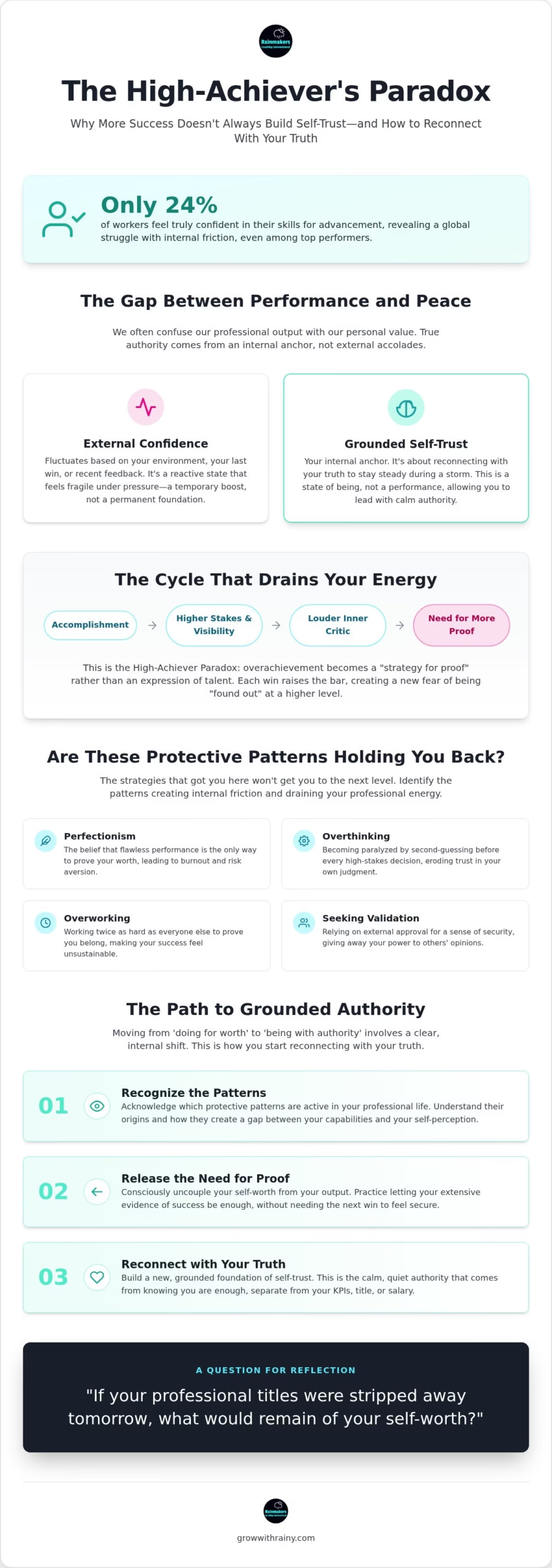
A 2025 global study revealed that only 24% of workers feel truly confident in their skills for advancement, proving that even high-performers struggle with internal friction. If you feel like your confidence is a fragile mask, it’s time to shift your focus. We’ll explore how to release the protective patterns that hold you back and help you start reconnecting with your truth. By the end of this guide, you’ll understand how to cultivate a grounded sense of self trust that brings calm authority to your meetings and clarity to your professional path. It’s time to move beyond the hustle and find a way to lead that feels as solid on the inside as it looks on the outside.
Key Takeaways
- Shift your focus from external accolades to internal worth by understanding why high achievement often fuels imposter syndrome rather than curing it.
- Discover how building self-esteem for career success involves releasing the need for constant performance to serve as proof of your value.
- Identify which of the 7 Protective Patterns, such as perfectionism or overthinking, are creating internal friction and draining your professional energy.
- Learn to use the Rainmakers Transformation System™ to begin reconnecting with your truth and leading with a calm, grounded authority.
What is Self-Esteem in a Professional Context?
Have you ever walked into a boardroom feeling like you’re wearing a costume? On paper, your credentials are impeccable. In reality, you’re waiting for the moment someone realizes you don’t belong there. This gap exists because we often confuse our professional output with our personal value.
What is Self-Esteem at its core? It is the internal evaluation of your own worth, separate from your KPIs, your salary, or your latest promotion. It’s the innate realisation that you are enough, even when the spreadsheets say otherwise.
Building self-esteem for career success isn’t about becoming the loudest person in the room. We’ve all seen “loud confidence,” that performative energy that feels fragile under pressure. Grounded self-trust is different. It’s a state of being rather than a performance.
At Rainmakers, we believe you don’t always need more evidence that you’re capable. You likely have a mountain of evidence already. What you need is to trust the evidence you have. A June 2026 study confirmed that self-esteem has a positive and significant influence on career adaptability, meaning your internal worth directly dictates how well you navigate change.
The Difference Between Confidence and Self-Trust
Confidence is often reactive. It fluctuates based on your environment, your last win, or the feedback you received this morning. If the environment changes, that confidence can vanish. Self-trust is your internal anchor. It’s about reconnecting with your truth so you can stay steady during a storm.
When you possess this grounded self-trust, you can navigate high-stakes leadership or career transitions without losing your sense of self. It’s the difference between a temporary boost and a permanent foundation.
Why High Achievers Often Struggle with Low Self-Worth
There’s a specific phenomenon I call the High-Achiever Self-Trust Gap. It’s the reason your internal feeling doesn’t match your external resume. For many, performance has become a “strategy for proof” rather than an expression of talent. You work harder to prove you’re worthy, but the worthiness never sticks.
You might think “fixing” your skills or getting another certification will solve the problem. It won’t. True growth comes from addressing imposter syndrome by shifting your identity, not just your skill set.
If your professional titles were stripped away tomorrow, what would remain of your self-worth?
The High-Achiever Paradox: Why Success Does Not Always Build Esteem
If you’ve ever felt that a promotion was like a threat rather than a reward, you’re not alone. Many senior leaders find that as the stakes get higher, the inner critic gets louder. This is the High-Achiever Paradox: the more you accomplish, the more you feel like a fraud.
Building self-esteem for career success requires stepping off the treadmill of external validation. If your internal safety is tied to your latest win, you’re always one mistake away from a collapse in confidence.
At Rainmakers, we see a recurring pattern. Overachievement often begins when a person learns to use performance as proof of their value. You treat your career like a series of trials where you must defend your right to be in the room.
The problem is that “just one more win” never provides the security you seek. It only raises the bar, creating a new fear of being “found out” at a higher level. This cycle drains your energy and prevents you from leading with a grounded presence.
When Success Triggers Imposter Syndrome
A promotion can feel like a threat because it places you in a new, unproven territory. I once coached a leader who reached a VP role after years of relentless effort. Instead of celebrating, she spent every meeting paralyzed by the thought that she’d finally reached her level of incompetence.
The high stakes amplified her inner critic, making her feel like she was winging it despite her obvious expertise. Research on Career Self-Efficacy from the University of Minnesota suggests that while we can believe in our skills, that belief remains fragile if it isn’t anchored in a deep sense of self-worth. Without that anchor, every new responsibility feels like a potential exposure of your perceived flaws.
The Pattern That Limits Your Next Stage of Growth
The patterns that helped you succeed at one stage can often limit you in the next. Relying on external approval or working twice as hard as everyone else might have worked in mid-management, but it stops working in executive leadership.
True authority comes when you can move from “doing” for worth to “being” with authority. When you stop using your output as a shield, you can finally start conquering imposter syndrome from the inside out.
If you’re ready to explore what’s driving your need for constant proof, a 90-minute coaching conversation can help you identify these hidden blocks.
Which part of your success are you still using as proof that you’re “enough”?
Identifying the 7 Protective Patterns That Dim Your Light
Think of your innate worth as a diamond. Over the years, high-pressure environments and early life experiences have caked that diamond in layers of mud. This mud isn’t a sign that you’re broken. It’s actually a collection of “protective strategies” you learned to survive and succeed.
Building self-esteem for career success isn’t about fixing the diamond; it’s about clearing away the mud so you can start reconnecting with your truth. In my coaching practice, I’ve identified 7 Protective Patterns that could dim your professional light:
- Perfectionism: Using flawless performance as a shield against criticism.
- Approval-Seeking: Letting others’ opinions dictate your internal weather.
- People-Pleasing: Sacrificing your own needs to maintain harmony.
- Over-Responsibility: Carrying the emotional weight of the entire team.
- Overthinking: Mentally rehearsing every scenario to avoid uncertainty.
- Control: Micro-managing outcomes to feel a sense of safety.
- Overachievement: Using constant “doing” to prove you are “enough.”
It’s vital to remember these are coaching constructs, not clinical diagnoses. They are simply learned behaviours. When you view them as strategies rather than fixed personality traits, you gain the agency to release them and build a more grounded professional presence.
Approval-Seeking and Perfectionism at Work
Approval becomes dangerous when we allow other people’s responses to determine our worth. If your sense of value depends on a nod from the CEO, you’ve handed over your power.
Similarly, perfectionism is often a strategy for protecting love and worthiness. We believe that if we never make a mistake, we can stay safe from judgment. These patterns create immense internal friction, draining the professional energy you need for creative problem-solving. You aren’t just leading; you’re performing for survival.
The Weight of Over-Responsibility and Overthinking
Overthinking is often an attempt to create safety by eliminating uncertainty. You replay every word of a conversation because you’re trying to predict and prevent future conflict. This often goes hand-in-hand with over-responsibility, which begins when we feel we must keep everyone else “okay” for us to feel okay. This grounded burden can paralyze your decision-making.
Research on Achieving Career Self-Efficacy shows that believing in your ability to manage your career path is essential for success. However, that belief is hard to maintain when you’re constantly second-guessing your judgment. Releasing these patterns allows you to lead from a place of calm authority rather than frantic management.
Which of these 7 patterns feels like the heaviest weight you’re carrying into your meetings right now?
Reconnecting with Your Truth: The 3-R Path to Grounded Success
Building self-esteem for career success isn’t a matter of adding new skills to an already overflowing list. It’s actually a journey of subtraction. True transformation happens when we shed the layers of “mud” we’ve accumulated and start reconnecting with your truth.
At Rainmakers, we facilitate this through the Rainmakers Transformation System™, which follows a proprietary 3-R methodology: Release, Reprogram, and Recondition. We don’t measure progress by what you know; we measure it by who you become when the pressure is on.
Stage 1 & 2: Release and Reprogram
The first step is to identify the invisible protective strategies that have been running your professional life. You might have spent years believing that you are a perfectionist or that you are an overthinker. We need to challenge that assumption immediately.
You aren’t your patterns; you’re the one who learned them to survive. In the Release stage, we let go of these outdated shields. This makes space to Reprogram your internal dialogue. Instead of a critic looking for flaws, you develop a grounded narrative that acknowledges your existing evidence of capability without needing to “prove” it to anyone else.
Stage 3: Recondition and Integrate
Knowledge alone won’t change your executive presence. You have to live it. The Recondition stage involves practicing new behaviours in low-stakes environments to build genuine self trust. This is where you bring your hidden treasures – those innate qualities like intuition and empathy into your daily interactions.
If you hit a setback, a grounded sense of self allows you to see it as data rather than a verdict on your worth. You learn to handle the friction of leadership without letting it crush your spirit.
The science backs this up. A study published in the Journal of Applied Psychology found that core self-evaluations, which include self-esteem and self-efficacy, are among the strongest predictors of job performance and career satisfaction.
When you improve your internal evaluation, your external results naturally follow. Try this “Release” exercise today: when you feel the urge to check an email for the fifth time, pause. Acknowledge the pattern of Perfectionism. Say to yourself, “I see this pattern trying to keep me safe, but I trust that I’ve done enough now.”
Book a 90-minute coaching conversation
What would your workday look like if you no longer needed to prove your worth in every single conversation?
Executive Presence Vs Authentic Presence for Career Success
Does executive presence require a louder voice or a more aggressive stance in the boardroom? Many professionals believe so. They spend years trying to mimic the “loud confidence” of others, only to find themselves more exhausted and less effective.
Authentic presence is actually a quiet strength. It is the natural byproduct of building self-esteem for career success by being yourself even when the stakes are high. When you stop performing, you finally start leading. This transition becomes possible only when you prioritize reconnecting with your truth over polishing your professional mask.
Leading with Impact from the Inside Out
Managing perceptions is an exhausting full-time job that offers zero long-term fulfilment. If you’re constantly editing your words to fit what you think others want to hear, you’re not leading; you’re following. Leading with impact from the inside out means trusting your judgment enough to be transparent.
This grounded self trust changes the frequency of your leadership. You stop motivating through pressure and start inspiring through alignment. When your team sees that you are steady in your own worth, they feel safer to do the same.
For more on this, read our Rock Solid Confidence Guide for High-Achieving Leaders.
Taking the Next Step Toward Self-Mastery
A July 2025 survey revealed that 44% of workers feel stuck in a “work situationship,” characterized by uncertainty and a lack of commitment to their employer. This often happens when your career is no longer aligned with your personal mission.
Building self-esteem for career success isn’t just about feeling better at your current desk. It’s about ensuring your growth feels meaningful rather than just like another trophy on the shelf. If the internal friction has become too loud to ignore, Transformation Life Coaching offers a path toward self-mastery.
This process isn’t about “fixing” you. It is about clearing the mud so your innate treasures can emerge. You can begin this shift today by taking our Self-Confidence Quiz to identify exactly which protective patterns are holding you back.
True success is the ability to walk into any room and feel at home in your own skin. It’s the calm authority that comes when you no longer have anything to prove and nothing to hide.
If you didn’t need anyone’s approval today, what would be your next bold move?
Step Into Your Grounded Authority
The office is quiet, the laptop is closed, but is your mind still auditioning for a role you’ve already won? Building self-esteem for career success isn’t about adding performance layers. It’s about stripping away the mud of perfectionism and overthinking to reveal the diamond underneath.
By releasing the 7 Protective Patterns through the Rainmakers Transformation System™, you stop managing perceptions and start leading with a presence that is steady and transparent. This shift creates a grounded sense of self trust that no boardroom pressure can shake.
Transformation doesn’t require you to become someone else; it requires you to trust the person you already are. With over a decade of experience coaching leaders, I’ve seen that the most powerful shift happens inside.
You don’t need to fix yourself. You simply need to reclaim the truth of your own value. Your next stage of growth is found in the quiet confidence of your own skin – when you’re ready to lead from wholeness.
What would change in your leadership if you finally believed you were already enough?
Frequently Asked Questions
How does self-esteem directly affect career progression?
Self-esteem dictates the risks you take and the boundaries you set in your professional life. High self-worth allows you to negotiate for what you deserve and handle high-stakes decisions without paralyzing second-guessing. A 2026 study found that self-esteem significantly influences career adaptability. Without it, you might stay in roles that don’t challenge you because you don’t trust your ability to succeed. Building self-esteem for career success ensures your growth is both sustainable and deeply meaningful.
Can you be successful even with low self-esteem?
Yes, many high achievers reach senior roles while struggling with low self-worth. They often use Overachievement as a learned strategy to prove their value to the world. However, this success often feels fragile and exhausting because it’s built on external validation rather than internal self trust. You might have the title and the salary, but without grounded self-esteem, you’ll likely feel like an imposter who is just one mistake away from being found out.
What is the fastest way to build self-confidence at work?
The most effective way is to start trusting the evidence of capability you already have rather than seeking more proof. Instead of waiting for a perfect presentation to feel confident, practice taking small steps to overcome minor workplace challenges. Small wins, acknowledged internally without needing a boss’s nod, build a foundation of self trust. This moves you from a performative state to one of calm, authentic presence where you no longer need to audition for your role.
Is imposter syndrome a sign of low self-esteem?
Imposter syndrome is often a symptom of a High-Achiever Self-Trust Gap. It happens when your internal evaluation doesn’t match your external resume. While it’s closely linked to self-esteem, it specifically targets your belief in your professional belonging. If you feel like a fraud despite your promotions, it’s a sign that you’re using performance as proof of value rather than reconnecting with your truth as a capable and experienced leader who has already earned their seat.
How do I stop seeking approval from my boss or peers?
Recognize that Approval-Seeking is a learned protective pattern, not a character flaw. It becomes dangerous when you allow other people’s responses to determine your worth. Start by setting small internal boundaries. Validate your own work before sending it out. When you notice the urge to ask “was that okay?”, pause and remind yourself of your expertise. Shifting this focus helps you lead with authority rather than constantly seeking permission to occupy your space.
What is the Rainmakers Transformation System™?
It is our proprietary three-stage methodology designed for deep, lasting change. The process involves three steps: Release, Reprogram, and Recondition. First, you release the invisible protective strategies that hide your innate value. Then, you reprogram your internal beliefs to reflect your true capabilities. Finally, you recondition your behaviours through 3R Integration. This system focuses on who you become during the process, ensuring your transformation is grounded and authentic rather than just a collection of new knowledge.
How can coaching help with career-related self-doubt?
Coaching provides a compassionate, non-judgmental framework to examine the patterns underneath your achievement. We don’t focus on “fixing people” because you aren’t broken. Instead, we help you clear the “mud” of self-doubt to reveal your hidden treasures. Through Career Coaching or Executive Coaching , you gain the tools to identify hidden blocks and build a professional life that feels as solid on the inside as it looks on the outside. Building self-esteem for career success starts here.
How do I know if my perfectionism is a protective pattern?
If your need for a flawless outcome is driven by a fear of judgment or rejection, it’s likely a protective pattern. Rainmakers Principle: Perfectionism is often a strategy for protecting love, acceptance, and worthiness. It creates internal friction and drains your professional energy. If you feel that one mistake will crumble your entire sense of value, you’re likely using perfectionism as a shield rather than a standard of excellence. Recognizing this is the first step toward change.

Article by
Rainy Rainmaker
Rainy Rainmaker is the founder of Rainmakers Coaching International and a transformational coach for confidence, self-trust, and authentic leadership.
Based in Singapore, she helps high-achieving professionals, managers, and leaders who appear capable on the outside but feel quietly held back by self-doubt, overthinking, imposter feelings, burnout, or a loss of direction. Through her signature Rainmaker Transformation Journey™: Release, Reprogram, Recondition – Rainy helps clients uncover the insights already within them and turn inner clarity into aligned action that creates lasting change in life, career, and leadership.
