
You’ve earned this seat, yet you likely feel a quiet anxiety about being found out or an overwhelming urge to prove your value through relentless overwork. It’s a common trap to believe that the hands-on tasks that led to your previous success are still your primary responsibility.
We often assume that more effort equals more impact, but for a leader, the opposite is often true. Engaging in coaching for new role success allows you to stop the exhausting performance of leadership and start reconnecting with your truth. Research from the Center for Creative Leadership shows that nearly 40 percent of new executives fail within their first 18 months; this is often because they struggle to adapt to the new culture or fail to build the right relationships.
In this article, we’ll explore how to release the protective patterns that limit your growth and find a grounded sense of authority. We’ll look at shifting from external validation to internal self trust. Are you leading from a place of genuine clarity, or are you still trying to win a race that’s already over?
Key Takeaways
- Identify the “High-Achiever Self-Trust Gap” to understand why your internal sense of safety hasn’t yet caught up with your external level of responsibility.
- Recognize how the 7 Protective Patterns, such as perfectionism, serve as safety strategies that may have helped you rise but now limit your leadership growth.
- Understand why transformational coaching for new role success focuses on releasing internal friction rather than just adding more tactical management skills.
- Apply a grounded framework for your first 90 days that prioritizes the “Release” phase, letting go of the hands-on habits that no longer serve your senior position.
- Learn how to choose a coach who embodies heart-centered authority to help you bridge the gap between professional excellence and genuine self trust.
The High-Achiever Self-Trust Gap in New Role Success
Imagine the heavy silence in the boardroom just before a high-stakes meeting begins. You’ve prepared the slides, you know the data, and your track record is impeccable. Yet, as you look around the table at your new peers, a cold realization settles in.
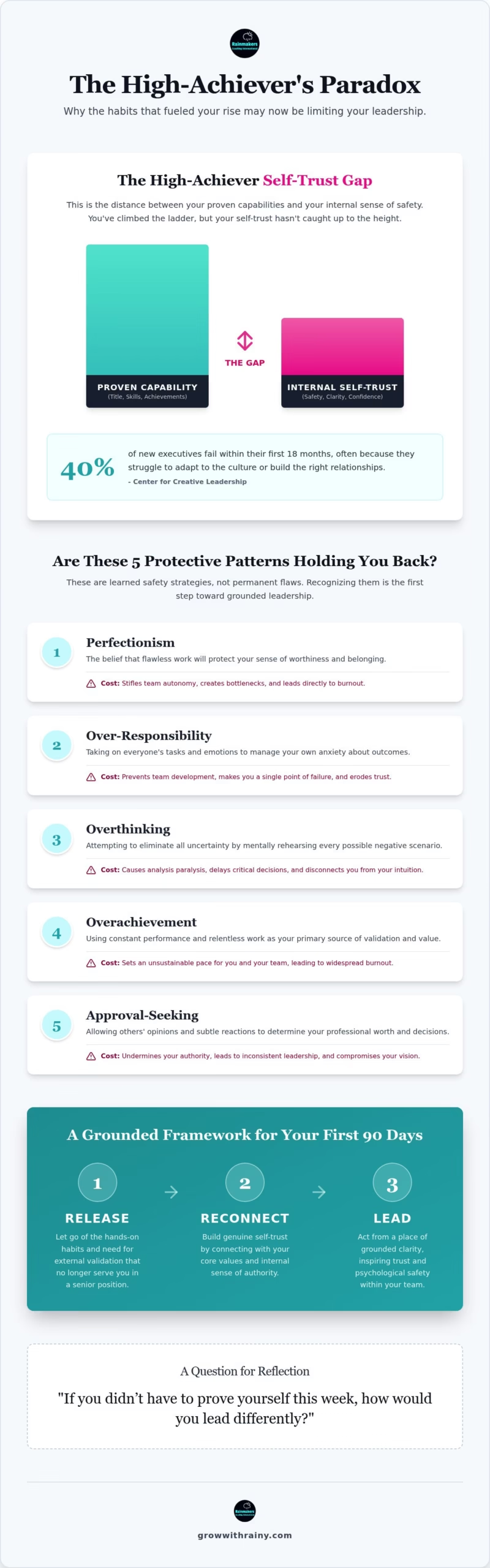
You feel like an outsider who somehow managed to slip through the door unnoticed. This is the High-Achiever Self-Trust Gap. It’s the distance between your proven capability, the things you’ve actually achieved, and your internal sense of safety. You’ve climbed the ladder, but your internal foundation hasn’t caught up with the height.
Many leaders believe that if they just land one more big win or get one more year of experience, this precarious feeling will vanish. It won’t. Anxiety doesn’t bow to evidence. If you don’t address the gap, you’ll keep performing success rather than actually living it.
Rainmakers coaching for new role success starts with a different premise: you don’t need more evidence that you’re capable; you need to trust the evidence you already have. Success in a senior position isn’t about acquiring a new personality. It’s about finding the courage to be the leader you already are.
Why Capability Isn’t the Problem
Your skills are the reason you’re in the room. You have the technical expertise and the strategic vision. The problem is that a new environment often triggers old protective patterns. When you feel exposed, you might revert to micromanaging or overworking to feel safe again. This often manifests as imposter syndrome in senior leaders, where the fear of being found out overrides your professional history. You aren’t failing because you lack talent; you’re struggling because you’re using old tools to navigate a new landscape.
Reconnecting With Your Truth
Reconnecting with your truth is the foundation for navigating any transition. It means looking past the new title and the high-stakes expectations to find the steady core of who you are. When you lead from this grounded place, you stop reacting to external pressure and start acting from internal clarity. You no longer need the environment to tell you that you’re doing a good job because your self trust is already established.
To begin this shift, try this practical exercise: Identify one professional truth about your capability that is entirely independent of your new title. Perhaps it’s your ability to simplify complex problems or your knack for building consensus among diverse teams. Write it down. This is your anchor. According to research by the Harvard Business Review, leaders who demonstrate high levels of self-awareness and internal alignment are far more likely to successfully navigate the first 18 months of a new role.
Reflection Question: If you didn’t have to prove yourself this week, how would you lead differently?
Identifying the 7 Protective Patterns Sabotaging Your Transition
When you step into a senior role, the pressure to perform doesn’t just come from your KPIs; it comes from within. You might find yourself leaning on what I call the 7 Protective Patterns. These aren’t clinical diagnoses or permanent flaws. They’re learned strategies you developed long ago to feel safe. By recognizing them, you can begin to shift from a place of defense to a place of grounded leadership.
Take Perfectionism . It’s rarely about the work being flawless; it’s often a strategy for protecting love, acceptance, and your sense of worthiness. Then there’s Over-Responsibility. This is the new manager who tries to do everyone’s job just to keep things "okay." It feels like being helpful, but it’s actually a way to manage your own anxiety.
Similarly, Overthinking is an attempt to create safety by trying to eliminate every possible uncertainty. If you can just think through every scenario, you believe you can’t be blindsided.
The Cost of Overachievement and Approval-Seeking
Overachievement and Approval-Seeking often go hand-in-hand. Overachievement uses constant performance as proof of value. It’s a fast track to burnout within your first 90 days because you’re running a marathon at a sprinter’s pace.
Approval-Seeking is equally draining. It allows other people’s subtle responses to determine your worth in the new office. If you’re struggling to find your footing, building rock solid confidence starts with recognizing these patterns before they deplete your energy.
The Pattern That Got You Here May Limit Your Next Stage
The strategy that helped you succeed as an individual contributor, whether it was Control or Perfectionism, now limits your growth as a leader. This is what researchers call the "transition trap." Under pressure, leaders often revert to their most practiced habits, even when those behaviors are counterproductive to their new environment.
A study published in the Journal of Applied Psychology found that stress significantly increases the likelihood of leaders returning to old, task-oriented habits rather than delegating effectively.
This is why coaching for new role success is so vital. It helps you see the armour you’re wearing so you can finally choose to take it off. If you’re ready to explore these patterns deeper, consider a coaching conversation to identify your specific blocks.
Reflection Question: Which of these seven patterns feels like your heaviest armor right now?
Why Standard Career Transition Coaching Services Often Fall Short
Most career transition coaching services treat your professional growth like a tactical checklist. They focus on external polishing: your executive presence, your communication style, or your networking strategy.
While these have their place, they rarely address the internal friction that makes a new role feel so heavy. This is the difference between tactical coaching, which tries to fix perceived flaws, and transformational coaching, which focuses on releasing the patterns that hold you back.
Real coaching for new role success doesn’t ask you to become a "new and improved" version of yourself. In fact, that’s often part of the problem. When you’re constantly trying to perform a version of success that feels alien, you lose your grounded sense of authority.
Transformation isn’t about adding more layers; it’s about removing what prevents you from becoming more fully yourself. Insight alone isn’t enough to change your behaviour. You need a grounded methodology to release those old ways of being and reprogram your response to pressure.
The Myth of "Fixing" People
Many traditional approaches treat leaders like a bonsai tree that needs to be trimmed and shaped to fit a specific corporate mold. At Rainmakers, we see you as a gem. You don’t need to be cut or altered; you simply need the layers of protective patterns and external expectations to be cleared away so your natural brilliance can show. Reconnecting with your truth is much more effective than trying to memorize a new set of leadership "hacks."
If you’re looking for a coach, pay attention to their language. Are they offering to "fix" your weaknesses, or are they inviting you to explore the source of your hesitation? A coach who helps you build self trust will prioritize your internal alignment over your external performance. You can read more about these distinctions in this guide on understanding life coaching misconceptions.
Evidence-Based Authority on Transition Failure
The stakes for senior transitions are incredibly high. Research from the Center for Creative Leadership suggests that nearly 40 percent of new executives fail within their first 18 months. When we look closer at why this happens, it’s rarely a lack of technical talent or industry knowledge. Instead, it’s a failure to adapt the inner landscape to the new environment.
Failure in a new role is often just the result of a leader trying to use old survival strategies in a space that requires a new level of presence. It’s about how you navigate the shift from doing to leading. Without a way to address the underlying patterns, even the most talented professional can find themselves stuck in a cycle of overwork and exhaustion.
Reflection Question: Are you seeking a coach to help you perform better, or to help you lead more authentically ?
A Grounded Framework for Your First 90 Days
The first 90 days of a new leadership role are often treated as a frantic sprint to prove your worth. You feel the weight of every decision, every email, and every meeting. Most people assume that "hitting the ground running" means working longer hours and making a loud, immediate impact. However, coaching for new role success suggests a different path. Real success isn’t about how fast you run; it’s about the groundedness of the foundation you’re standing on.
The Rainmakers Transformation System™ provides a three step framework to navigate this transition without losing yourself in the process. It begins with Release. This is where you identify and let go of the invisible protective strategies, like the 7 Protective Patterns, that no longer serve your senior position.
Next is Reprogram. You shift your internal narrative from a frantic "I must prove my value" to a steady "I am present and capable." Finally, you Recondition. This involves building new habits of self trust that hold firm even in high stakes moments.
Navigating the 3R Integration
True transformation is measured by who we become, not just what we know or what we’ve checked off a list. To integrate these shifts, try a "Daily Content Review" for your own leadership. At the end of each day, reflect on moments where you defaulted to an old pattern, like over-responsibility or overthinking.
Don’t judge the behaviour; simply observe it. This awareness is what allows you to return to a state of reconnecting with your truth during the next challenge.
Building Professional Resilience through Self-Trust
Resilience is often misunderstood as "toughing it out" or enduring high levels of stress without breaking. In a senior role, true resilience is the ability to stay connected to your truth under pressure. It’s about maintaining your internal alignment when the environment feels chaotic.
A practical strategy for your first 30 days is to set one firm boundary that protects your clarity of thought. This might be a "no meetings" block in the morning or a commitment to not checking emails after 7 PM. This isn’t about working less; it’s about protecting the mental space required for high level leadership.
According to a study published in the Academy of Management Executive, leaders who prioritize relational depth and internal alignment during transitions are significantly more likely to achieve long term success than those who focus solely on short term technical wins. When you lead from a place of self trust, you stop performing success and start embodying it.
Reflection Question: What would the most grounded version of you do in your next meeting?
Selecting the Right Career Transition Coach for Your Journey
Choosing a coach for new role success is a deeply personal professional decision. It’s not about finding someone to give you more work; it’s about finding someone who helps you do the internal work that matters. You need a coach who recognizes the High-Achiever Self-Trust Gap.
This is the friction that occurs when your external title grows faster than your internal sense of safety. If you feel like you’re "performing" leadership rather than living it, the right coach will help you close that gap.
Look for Heart-Centered Authority. You want a partner who possesses the professional credibility to understand your high-stakes environment, yet offers the empathetic warmth required for genuine transformation.
The goal isn’t simply to achieve more. It’s to become more fully yourself in the role you’ve worked so hard to earn. A grounded coach won’t try to change who you are; they will help you remove the patterns that prevent you from being who you are.
Questions to Ask a Potential Coach
When you’re interviewing a coach, listen for how they talk about growth. If they focus solely on tactical goals, they might just be adding more weight to your already heavy shoulders. Instead, ask questions that target the internal shifts:
- How do you help leaders identify the protective patterns that limit their growth?
- What is your process for building internal self trust rather than just external confidence?
- How does your framework address the "inside-out" transformation during a transition?
A chemistry call shouldn’t feel like a job interview. It should feel like a sanctuary where you can begin to reveal your hidden gems. If you don’t feel a sense of psychological safety from the first conversation, they aren’t the right guide for your journey. You can find more tips on this process in this guide on how to find the right life coach that suits your needs.
The Rainmakers Difference
With more than a decade of experience coaching senior leaders in Singapore and beyond, Rainy understands that leadership is a grounded experience. The signature Rainmakers Transformation System™ was built to help you navigate transitions by addressing the roots of your hesitation rather than just the symptoms.
Reflection Question: Are you ready to stop fixing your flaws and start releasing what is hidden?
Stepping Into Your Grounded Authority
You’ve navigated the climb; now it’s time to find your footing. We’ve explored how the very patterns that fuelled your rise can become the heavy armour that limits your growth in a senior position.
Real transformation happens when you stop trying to fix your perceived flaws and start releasing the protective strategies that create internal friction. By bridging the High-Achiever Self-Trust Gap, you move from performing success to embodying a quiet, steady authority.
Engaging in coaching for new role success offers more than just tactical advice for your first 90 days. It provides a grounded space to apply the proprietary 3R Transformation Methodology, focusing on long term self trust rather than short term fixes. With more than a decade of experience guiding senior leaders, I’m here to help you reconnect with your truth so you can lead with genuine clarity and presence.
You don’t have to carry the pressure of this transition alone.
Are you ready to stop performing your success and start living it from the inside out?
Frequently Asked Questions
How is career transition coaching different from standard career coaching?
Standard career coaching often focuses on tactical outcomes like resume writing or job search advice. Career transition coaching, particularly at Rainmakers, is an inside-out process. It addresses the internal shifts required to navigate a new role effectively. Instead of just helping you find a job, it focuses on the emotional and behavioural adaptation needed to thrive once you are there. This approach prioritizes reconnecting with your truth over simply checking off professional milestones.
What are the 7 protective patterns mentioned in the Rainmaker Transformation System™?
The 7 Protective Patterns are learned strategies for safety developed over time. These include:
- Perfectionism
- Approval-Seeking
- People-Pleasing
- Over-Responsibility
- Overthinking
- Control
- Overachievement
These patterns are coaching constructs, not clinical diagnoses. They often begin as ways to protect your worthiness or belonging but can become the very things that limit your growth in a more senior position.
How long does it typically take to see results from transition coaching?
Results often begin with a shift in perspective during the very first session. While the first 90 days are a critical window for coaching for new role success, the timeline for deeper transformation varies. You might notice immediate relief as you identify your protective patterns. However, building lasting self trust and reconditioning your responses to high-stakes pressure is a steady, methodical process that unfolds over several months of consistent practice and reflection.
Can career transition coaching help if I already feel like I’m failing in my new role?
Yes, it’s actually one of the most effective times to begin. Feeling like you’re failing often stems from the High-Achiever Self-Trust Gap rather than a lack of capability. When you feel precarious, you tend to lean harder on old patterns that don’t fit your new environment. Coaching helps you pause the frantic cycle of "proving" and allows you to start leading from a more grounded and authentic place.
Do I need to be in a senior leadership position to benefit from these services?
While our work often focuses on senior managers, directors, and executives, any professional navigating a significant transition can benefit. The core challenges of a new role, such as overthinking or the urge to prove your value through overwork, aren’t exclusive to the C-suite. If you’re moving into a position with higher stakes and more ambiguity, these tools will help you maintain your clarity and lead with a sense of internal safety.
How does the 3R methodology (Release, Reprogram, Recondition) work in practice?
The 3R methodology is a grounded framework for internal change. First, you Release the invisible protective strategies that create internal friction. Then, you Reprogram your internal narrative, shifting from a need for external validation to a reliance on self trust. Finally, you Recondition your behaviour by building new habits that support your leadership. It’s a move from insight to action, ensuring your transformation is reflected in how you show up every day.
Is career transition coaching confidential, especially regarding my employer?
Absolute confidentiality is the foundation of our coaching relationship. Whether you’re engaging in executive coaching or career development coaching, your sessions are a private space for honest reflection. We prioritize your psychological safety so you can explore your patterns without fear of judgment or professional exposure. This privacy allows you to be fully yourself; it’s the only way to achieve genuine, long-term transformation in your career.
What is the "High-Achiever Self-Trust Gap" and how do I know if I have it?
This gap is the distance between your proven professional capability and your internal sense of safety. You might have it if you feel like an outsider despite your achievements or if you have an overwhelming urge to prove your value through overwork. It often shows up as a quiet anxiety that you’ll be "found out." Recognizing this gap is the first step toward reconnecting with your truth and leading with grounded confidence.

Article by
Rainy Rainmaker
Rainy Rainmaker is the founder of Rainmakers Coaching International and a transformational coach for confidence, self-trust, and authentic leadership.
Based in Singapore, she helps high-achieving professionals, managers, and leaders who appear capable on the outside but feel quietly held back by self-doubt, overthinking, imposter feelings, burnout, or a loss of direction. Through her signature Rainmaker Transformation Journey™: Release, Reprogram, Recondition – Rainy helps clients uncover the insights already within them and turn inner clarity into aligned action that creates lasting change in life, career, and leadership.
