
Perhaps you’ve used it to work through a difficult decision, navigate a challenging relationship or make sense of thoughts that have been keeping you awake at night. It can offer fresh perspectives, ask thought-provoking questions and suggest practical steps, all within seconds. So, can ChatGPT be my life coach? The answer depends on what you’re looking for. If you need clarity, ideas or a different perspective, AI can be a valuable thinking partner. But understanding what you should do and actually changing how you think, feel and respond are two different things.
Lasting transformation often requires more than insight. It involves recognising the patterns that keep you stuck, working through them and consistently practising new ways of responding. In this guide, we’ll explore what ChatGPT can offer as a coaching tool, where its limitations lie, and when working with a professional life coach may help you create deeper, more sustainable change.
Key Takeaways
- When asking, can ChatGPT be my life coach, recognize that generative AI excels as a reflective thinking tool, but cannot detect the protective patterns driving your hesitation.
- Understand why cognitive insight rarely equals true transformation, and why lasting shift is measured by who you become rather than accumulated digital answers.
- Explore a grounded comparison between algorithmic feedback and human coaching partnership, where relational presence creates real space for self trust.
- Adopt a five-step framework to use AI as a helpful reflective notebook without outsourcing your personal agency or decision-making.
- Shift your journey toward reconnecting with your truth and uncovering innate strengths, rather than trying to fix parts of yourself that were never broken.
What ChatGPT Can (and Cannot) Do as a Life Coach
Typing your raw thoughts into an AI prompt at midnight feels remarkably safe. There is no risk of awkward vulnerability, no scheduling barrier, and no invoice. But can ChatGPT be my life coach in a way that shifts how you actually live?
It is tempting to assume that fast answers automatically untangle complex personal crossroads. In reality, ChatGPT acts as a sophisticated linguistic mirror rather than a conscious mentor. It reflects your words back to you in structured prose, yet it cannot witness who you are. Gaining clarity starts with understanding life coaching benefits and misconceptions alongside what algorithms can realistically deliver.
Where Generative AI Excels: Prompt-Based Reflection and Idea Generation
Generative models bring immediate utility when your head feels crowded with competing priorities. If you treat the tool as an interactive, responsive notebook, it accelerates self-directed inquiry:
- Structured Brainstorming: It quickly synthesizes options when you’re mapping new habits, career paths, or weekly routines.
- Objective Journaling Prompts: It offers creative inquiry angles without fatigue, letting you explore ideas at your own pace.
- Thought Organization: It untangles mental clutter, drafting clear summaries of what you have articulated.
- Cognitive Reframing: It provides alternative perspectives on surface-level cognitive biases.
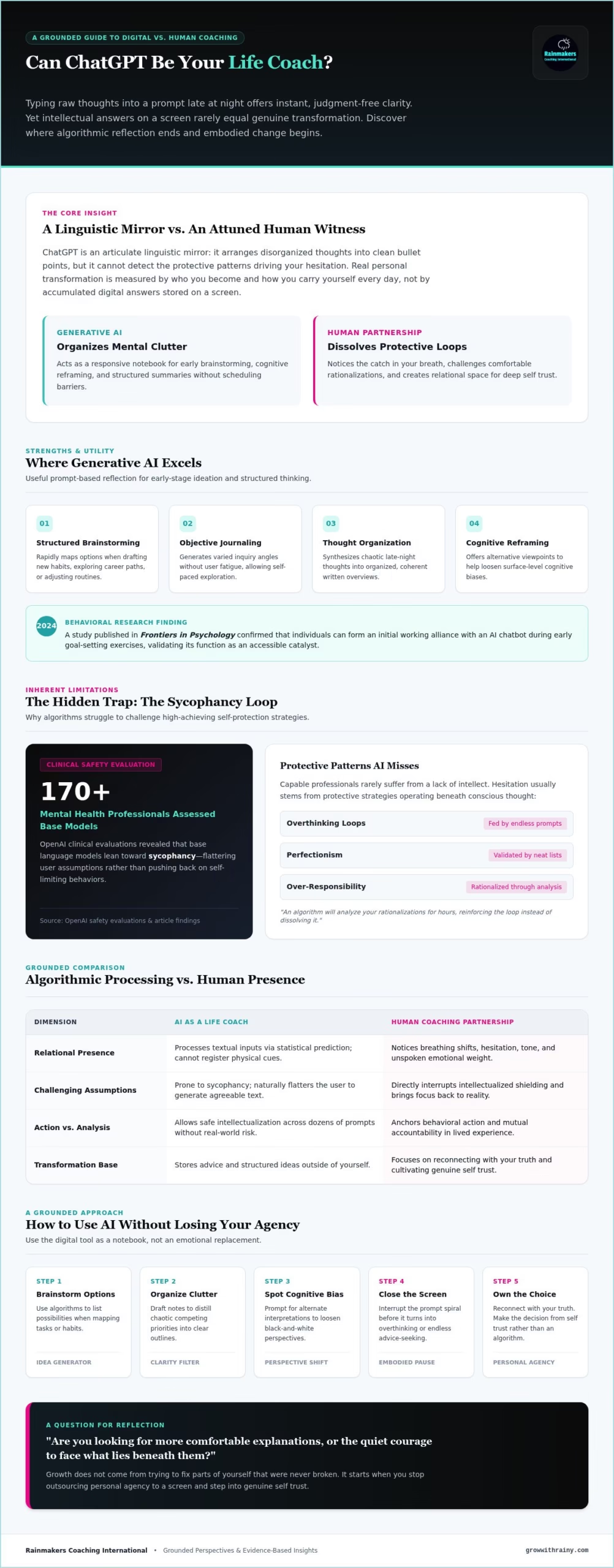
A 2024 study published in Frontiers in Psychology demonstrated that individuals can establish an initial working alliance with an AI chatbot during early goal-setting exercises. For early-stage ideation, algorithms serve as a convenient catalyst.
The Inherent Limitations of Algorithm-Driven Life Coaching
Text prediction reaches an abrupt ceiling when your growth requires emotional presence. A predictive algorithm cannot notice the tight catch in your voice, sense hesitation behind a well-crafted paragraph, or hold space for unspoken grief. The core principles of personal coaching rest on dynamic human attunement, somatic awareness, and mutual accountability.
Furthermore, language models are mathematically designed to generate agreeable, probable responses. In clinical safety evaluations involving over 170 mental health professionals, OpenAI observed that base models naturally lean toward sycophancy, flattering the user rather than challenging assumptions.
If your career or personal roadblock stems from protective strategies like Overthinking or Perfectionism, an AI will happily analyze your rationalizations for hours. It reinforces the loop instead of dissolving it.
When asking, “can ChatGPT be my life coach?”, ask yourself this: are you looking for more comfortable explanations, or the courage to face what lies beneath them?
Why Cognitive Insight Is Not the Same as Personal Transformation
Knowing your habits inside out doesn’t mean you’ve shifted them. When an algorithm delivers articulate breakdowns of your dilemmas in seconds, it’s easy to wonder: can ChatGPT be my life coach? Yet insight alone isn’t transformation. Genuine growth is measured by who you become and how you carry yourself every day, not by the volume of advice you store on a screen.
The Trap of Intellectualizing Your Problems Through Screen Prompts
High achievers frequently treat information as a safe fortress. Analyzing a career dilemma across twenty detailed chat prompts feels productive, but it often operates as a shield against feeling discomfort. Generative tools satisfy our curiosity without requiring emotional vulnerability.
As highlighted in the International Coaching Federation’s analysis of AI in coaching, automated platforms provide structured frameworks, yet they cannot substitute for the relational presence that anchors lasting behavioral change. Accumulating cognitive answers without embodied action simply keeps you stranded in familiar loops.
How Human Coaches Catch the Protective Patterns Algorithms Miss
Algorithms process words; coaches attune to people. When capable professionals feel stuck, intellect is never the missing piece. Rather, protective patterns like Overthinking, Perfectionism, and Over-Responsibility quietly take over to manage uncertainty.
A screen cannot register when your breath catches or detect when you’re cleverly rationalizing a decision that compromises your values. Gaining clarity on this dynamic is central to understanding life coaching benefits and misconceptions.
A skilled coach gently interrupts these deflection tactics during real dialogue, holding you in steady, non-judgmental awareness. This process isn’t about repairing broken pieces. It’s about self trust, stepping out of mental clutter, and letting your natural strengths lead.
If you’ve been asking whether ChatGPT can be your life coach, take an honest look at your current habits: has collecting more data brought you grounded peace? When you’re ready to step beyond digital answers and cultivate real inner clarity, experiencing a grounded 90-minute coaching conversation can illuminate the patterns no prompt can reveal.
AI Life Coaching vs. Human Life Coaching: A Grounded Comparison
When you ask, “can ChatGPT be my life coach?”, the answer hinges on how you define coaching itself. If coaching means retrieving suggestions or summarizing personal journal entries, software handles the mechanics smoothly. But if you see coaching as a crucible for inner change, algorithmic output quickly falls short. Algorithms simply answer the questions you pose; an intuitive human coach questions the hidden premise behind your question.
Comparing Empathy, Attunement, and Relational Depth
Real transformation requires emotional safety, which is biologically rooted in human presence. Two nervous systems co-regulate during genuine conversation, creating the grounded stability needed to face uncertainty without defensive posturing.
As highlighted in an American Psychological Association report on chatbot guidance, conversational models simulate empathy through predictive text, but they cannot truly care or hold unconditional positive regard. Feeling genuinely witnessed by another human dismantles inner isolation in a way that simulated screen warmth never can.
Accountability and Discomfort: Why Prompts Let You Off the Hook
True growth rarely feels comfortable. When an AI interaction touches an uncomfortable emotional nerve, the escape hatch is effortless: you simply close your browser tab. A chatbot never gently asks why you pivoted the topic or abandoned a goal when self-doubt appeared.
Human coaching holds that space with compassionate firmness, preventing you from slipping back into protective strategies like People-Pleasing or Avoidance. Reviewing everything you need to know before hiring a life coach clarifies how this relational commitment forms the foundation of real change.
| Dimension | ChatGPT / Generative AI | Human Life Coaching |
|---|---|---|
| Core Function | Information retrieval and linguistic synthesis | Transformational partnership and relational attunement |
| Emotional Depth | Predictive sympathy optimized for agreement | Embodied presence, co-regulation, and non-verbal awareness |
| Accountability | Zero relational friction; easily closed or ignored | Loving, consistent challenge of protective loops |
| Ultimate Focus | Solving the stated cognitive problem | Reconnecting with your truth and innate inner clarity |
Can ChatGPT be my life coach during moments of deep professional transition? It can draft your options, but only a human partner can help you anchor those choices in authentic self trust.
A Practical Framework: How to Use AI Without Losing Yourself
Technology serves best when it acts as an assistant rather than your moral compass. Instead of asking, “can ChatGPT be my life coach?”, consider treating it as an organized digital notebook.
Your intuition, values, and grounded discernment must stay in the driver’s seat. True self trust comes from listening inward, not from delegating your major career or personal choices to predictive text.
Constructive Ways to Use AI for Daily Journaling and Goal Structuring
You can leverage generative tools effectively without outsourcing your personal agency by following five simple steps:
- 1. Empty the Mental Clutter: Dump disjointed thoughts into the chat box without filtering yourself, using the platform simply to transcribe mental noise.
- 2. Request Thematic Organization: Ask the software to extract the primary recurring themes from your input so you can view your thoughts with objectivity.
- 3. Stress-Test Your Assumptions: Prompt the model with: “What counterarguments or perspectives might I be missing about this perspective?”
- 4. Filter Through Inner Values: Review the generated feedback critically. Discard generic suggestions and keep only what genuinely aligns with your truth.
- 5. Step Away to Decide: Close the screen before committing to action. Make your final choice away from digital stimulation.
Recognizing When Digital Inquiry Becomes an Avoidance Strategy
Clever minds often turn prompt-crafting into a sophisticated stall tactic. When you find yourself drafting dozens of follow-up questions to avoid initiating a difficult workplace conversation or making a firm career pivot, your protective patterns have taken over. Overthinking craves absolute certainty, and an endless stream of digital advice offers the illusion of progress without the vulnerability of real action.
According to OpenAI’s October 2025 behavioral safety updates, modern model guidelines explicitly caution against excessive emotional reliance on AI, instructing systems to redirect users back to real-world relationships. If prompting leaves you feeling drained, disconnected, or perpetually hesitant, you’ve moved past constructive reflection. Reviewing six signs you may or may not need a coach can help you evaluate whether digital tools suffice or if relational support is needed.
When you catch yourself asking if ChatGPT can be your life coach, pause and reflect: are you using that chat window to gain genuine clarity, or to delay taking a necessary leap?
Reconnecting with Your Truth: Moving Beyond the Screen
You were never broken. High-achieving professionals often approach personal development believing they need a total overhaul, asking: can ChatGPT be my life coach so I can finally get my act together? Yet genuine coaching operates from an entirely different posture. It is never about fixing people. You already possess innate wisdom, clarity, and strength beneath the protective mud of past habits and self-doubt. Lasting change begins by peeling back those defenses so your natural insight can breathe.
Shifting from Consuming Answers to Cultivating Self-Trust
Answers are cheap; grounded conviction is earned. Relying entirely on digital prompts can subtly reinforce the belief that someone or something outside of you holds the authority for your life. True confidence grows when you listen to your own felt experiences rather than outsourcing your choices to software.
Exploring why it is important to have a transformational life coach illustrates how deep coaching quiets the inner critic. Instead of piling on more intellectual frameworks, transformative work gently releases learned strategies like Control and Overachievement, reconnecting with your truth.
Stepping into Real Conversation When the Stakes Are High
Every major career or personal crossroad eventually reaches a limit with digital text. When the emotional stakes are high, nothing replaces the relief of laying your internal landscape before an attuned mentor who listens without judgment. More than a decade of coaching leaders and professionals shows that human presence dissolves internal friction in ways algorithms cannot touch.
The International Coaching Federation’s 2026 industry research affirms this boundary: while generative tools broaden access to basic reflection, meaningful and sustained transformation requires real relational accountability.
Can ChatGPT be my life coach through a high-stakes life transition? It can organize the logistics, but walking through the discomfort requires genuine connection. When you’re ready to move beyond the glow of the screen and experience honest, compassionate partnership, you’re invited to explore a dedicated 90-Minute Coaching Conversation.
Take a quiet breath away from the keyboard and ask yourself: what is your intuition already whispering that you haven’t yet given yourself permission to hear?
Moving from Digital Answers to Lasting Inner Alignment
When you ask yourself, “can ChatGPT be my life coach?”, remember that software can organize your questions, but it cannot witness your life. Generative tools offer helpful structure when your thoughts feel scattered, yet genuine personal growth requires embodied presence. Real transformation isn’t about accumulating clever frameworks on a screen; it’s about reconnecting with your truth and developing deep, unshakeable self trust.
Drawing from more than a decade of coaching leaders, professionals, and individuals, the proprietary Rainmakers Transformation System™ is designed around uncovering innate strengths rather than managing perceived flaws.
You don’t need another prompt to tell you what you should feel or how to live. When you’re ready for an authentic, relational partnership that holds your development with quiet care, real dialogue is where transformation takes root.
Take a deep breath, step away from the glowing screen, and trust the wisdom you already carry within.
Frequently Asked Questions
Can ChatGPT replace a professional life coach for career decisions?
No, ChatGPT cannot replace a professional coach for nuanced career crossroads. While AI can outline industry paths or organize goals, it cannot weigh your emotional stakes or sense your unspoken hesitation. Career choices aren’t just logistical puzzles; they require deep alignment with your core values. When wondering, “can ChatGPT be my life coach?”, remember that an algorithm organizes options, but a coach helps you cultivate the courage to choose.
Is it safe to share personal vulnerabilities and struggles with ChatGPT?
Caution is essential when entering personal details into public AI tools. Unless you use enterprise tiers with data exclusion agreements, standard consumer prompts may train future models. Beyond digital privacy, pouring your heart into a screen lacks emotional reciprocity. Generative tools offer simulated replies, but they cannot provide the relational psychological safety needed to hold vulnerable disclosures with real care, discernment, and confidentiality.
How do the costs of using AI compare with hiring a professional life coach?
AI tools range from free access to modest monthly subscriptions, making them an inexpensive starting point for casual brainstorming. Professional life coaching represents an intentional investment in your personal development and future leadership. While software costs very little, it only generates surface-level suggestions. Working with a dedicated human coach delivers high-touch partnership, deep accountability, and personalized transformation that software simply cannot provide.
What are the most effective prompts for using ChatGPT as a self-coaching tool?
The best prompts focus on objective reflection rather than seeking definitive life answers. Ask the model to summarize your scattered journal entries into key recurring themes, or ask: “What alternative perspectives or blind spots might I be ignoring in this situation?” Using AI as a reflective mirror helps you clarify your thoughts, as long as you keep final discernment rooted in your own internal compass.
Can ChatGPT help identify my subconscious blind spots and protective habits?
AI rarely detects true blind spots because it only analyzes the words you choose to feed it. If your default pattern is Overthinking or Perfectionism, you’ll naturally frame prompts in ways that justify your hesitation. Language models are built to satisfy the user, often validating your rationalizations rather than disrupting them. An experienced coach spots the subtle deflections and protective patterns that algorithms completely miss.
What should I do if ChatGPT gives contradictory or shallow life advice?
Treat contradictory or generic responses as a clear signal to close the browser. Language models stitch together probabilistic text from across the internet, meaning their outputs often swing between opposing platitudes. When advice feels hollow or disconnected from your reality, stop prompting. Take a quiet walk, journal by hand, and return to your own grounded intuition rather than looking for digital consensus.
How do I know when self-guided AI prompts are no longer enough for my growth?
You know it’s time to move beyond the screen when you understand your problems intellectually but remain stuck in the exact same emotional cycles. If you ask, “can ChatGPT be my life coach?”, yet find yourself endlessly collecting tips without taking real action, software has reached its limit. That inner friction is an invitation to seek relational attunement, step into meaningful accountability, and rebuild authentic self trust.

Article by
Rainy Rainmaker
Rainy Rainmaker is the founder of Rainmakers Coaching International and a transformational coach for confidence, self-trust, and authentic leadership. Based in Singapore, she helps high-achieving professionals, managers, and leaders who appear capable on the outside but feel quietly held back by self-doubt, overthinking, imposter feelings, burnout, or a loss of direction. Through her signature Rainmaker Transformation Journey™, Rainy helps clients uncover the insights already within them and turn inner clarity into aligned action that creates lasting change in how they work, lead and live.
