
What if the reason you’re exhausted isn’t actually your calendar, but the way you’ve trained yourself to carry everyone else’s weight? You likely feel like the only one who truly cares about the quality of the output. When you try to log off, the guilt follows you home like a shadow. You’ve probably looked for advice on how to prevent manager burnout and tried every productivity hack available, yet that heavy, physical exhaustion remains. Sleep doesn’t seem to fix it because the drain isn’t just physical; it’s the weight of a pattern you’ve carried for years.
I want to share a different perspective. Traditional workload management often fails because it ignores the internal patterns that drive you to over-function. This is about why your Over-Responsibility pattern is the real culprit behind your fatigue. By addressing these deep-seated habits, you can stop using force to get results and start leading with a sense of ease. We’ll look at how to bridge the High-Achiever Self-Trust Gap and begin reconnecting with your truth. This shift allows you to develop a grounded leadership style and reclaim your personal time without the constant mental noise of the office.
Key Takeaways
- Learn how to prevent manager burnout by looking beyond your workload and addressing the internal strategy of Over-Responsibility that causes chronic exhaustion.
- Understand why traditional self-care fails to provide relief when it doesn’t involve reconnecting with your truth and addressing the root of your fatigue.
- Apply the 3-R methodology to distinguish between your actual professional duties and the emotional labor that belongs to your team.
- Cultivate a grounded leadership style that allows you to lead with a sense of quiet strength and clarity rather than through constant force.
The Myth of the “Unmanageable Workload” in Leadership
Do you feel like you are the only one holding the grounded foundation of your team together? It’s a heavy weight to carry. You might believe that if you let go for even a second, the quality of work will plummet. This is the central myth of leadership: that your value is tied to your constant vigilance. If workload were the only cause of exhaustion, every manager with a full inbox would be suffering. Yet, we see some leaders navigate high-pressure environments with a sense of quiet strength while others crumble under the same volume.
The World Health Organization identifies Occupational burnout as a work-related phenomenon resulting from chronic workplace stress. It involves energy depletion, mental distance from your job, and a sense of ineffectiveness. But at Rainmakers, we look deeper. We see burnout as internal friction. It’s the tension between your true self and the protective patterns you’ve built to stay safe. Learning how to prevent manager burnout requires looking at these patterns rather than just your to-do list.
Distinguishing Stress from Pattern-Based Exhaustion
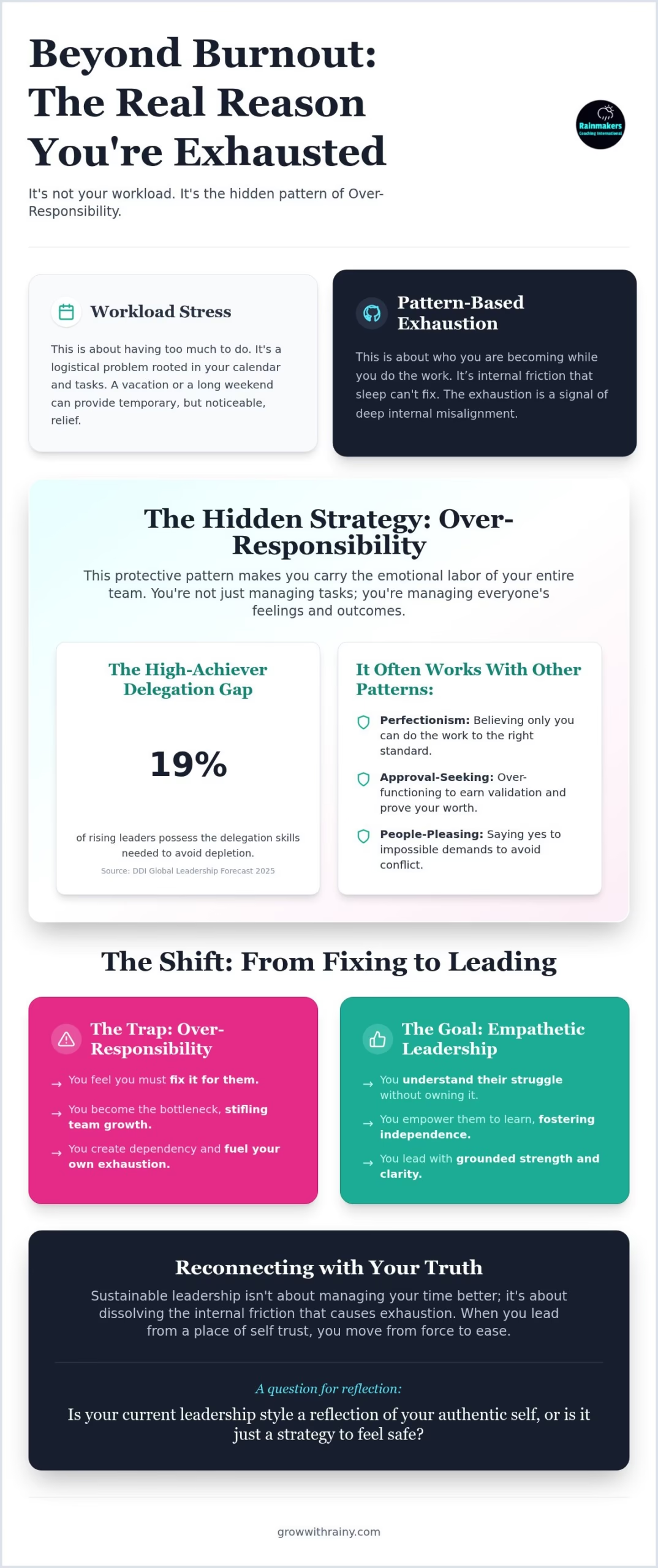
Stress is usually about having too much to do. Burnout is about who you are becoming while you do it. If a vacation only provides temporary relief, the problem isn’t the workload. It’s the internal “mud” that hasn’t been cleared. You don’t need to be fixed, because you aren’t broken. You simply need a path for reconnecting with your truth. When you lead from a place of self trust, the friction that causes exhaustion begins to dissolve. Understanding how to prevent manager burnout involves recognising when your exhaustion is a signal of this internal misalignment.
The High-Achiever Paradox: Success via Exhaustion
Many leaders reached their positions through a pattern of Overachievement. You learned that being the best was the only way to be safe. Now, that same strategy is your biggest hurdle. According to the Gallup 2026 State of the Global Workplace report, manager engagement fell from 27% in 2024 to just 22% in 2025.
This isn’t just a workload issue. It’s a sign that the old ways of succeeding are no longer sustainable. You might be protecting your worth through performance rather than leading with impact . This often ties into broader high-achiever mental health challenges that go unaddressed.
Is your current leadership style a reflection of your authentic self, or is it just a strategy to feel safe?
Recognizing Over-Responsibility: The Hidden Strategy Behind Burnout
Over-responsibility often begins when a child learns that they must keep everything and everyone okay. This is a core Rainmakers Principle. It’s a protective pattern born out of a need for safety. In the boardroom, this translates to you carrying the emotional labor of your entire department.
You aren’t just managing tasks; you’re managing everyone’s feelings and outcomes. This creates the High-Achiever Self-Trust Gap. It’s a state where you don’t trust your team to succeed without your constant, heavy-handed intervention. This erodes your self trust and makes it impossible to lead with ease.
Research supports this link between internal control and exhaustion. The DDI Global Leadership Forecast 2025 found that only 19% of rising leaders possess the delegation skills needed to avoid depletion.
When you can’t delegate, you micromanage. This isn’t just bad for the team; it’s a primary reason why learning how to prevent manager burnout is so difficult. You’re working against your own internal wiring. This pattern creates a grounded weight that keeps you stuck in the weeds of daily operations.
The 7 Protective Patterns and Your Energy
While we focus on seven specific patterns at Rainmakers, Over-Responsibility is often the loudest. It works in tandem with others like Perfectionism and Approval-Seeking. If you find yourself People-Pleasing, you likely say yes to impossible deadlines just to avoid conflict. This is often followed by Overthinking, which creates a massive amount of mental fatigue before the work even starts. These patterns are like heavy weights you’ve forgotten you’re carrying. Understanding these is key to finding strategies to prevent and cure manager burnout.
Is it Empathy or Over-Responsibility?
There is a vital difference between being an empathetic leader and carrying the team’s burdens. Empathy allows you to understand a team member’s struggle. Over-responsibility makes you feel like you must fix it for them.
When you step in to “save” the situation, you actually prevent your team’s growth. You become the bottleneck. This cycle fuels your exhaustion and keeps your team in a state of dependency. Reaching your professional milestones requires a different approach. You can see this in the 10 signs you’ll achieve your goals this year.
If you’re ready to look at the patterns beneath the surface, we can explore this together in a coaching conversation. We focus on the internal shifts that lead to external results.
What would happen if you trusted your team to handle their own challenges today?
Why Traditional Self-Care Fails High-Achieving Managers
Have you noticed that vacations don’t seem to work anymore? You spend the first three days winding down and the last three days dreading the return. Traditional self-care like bubble baths or yoga can’t fix a deep-seated Over-Responsibility pattern. These are surface-level fixes for a grounded problem.
If you haven’t addressed the internal friction, you’re just a burnt-out manager in a bathtub. Learning how to prevent manager burnout requires more than just “checking out” for a few days. It requires a fundamental shift in how you relate to your work.
Setting boundaries often feels like a threat to your safety. If you’ve spent your life being the one who “gets it done,” saying no feels like you’re failing your team or your reputation. It may even make you feel like a bad manager. This is why you must focus on reconnecting with your truth. Without that internal alignment, a boundary is just a rule you’re waiting to break.
Transformation isn’t about how many hours you work. It’s about who you become in the process. Building this foundation is essential for any leader, as we explore in our guide on Rock Solid Confidence: Guide for High-Achieving Leaders.
External Fixes vs. Internal Transformation
We often look for external solutions to internal problems. A “clear inbox” is an external fix, but releasing the need for control is an internal transformation. You can attend all the delegation training in the world, but if you don’t have self trust, you’ll just end up redoing the work anyway.
Gallup research on burnout highlights that unmanageable workloads are a primary driver of exhaustion. However, for the high-achiever, the workload is often made unmanageable by the internal refusal to let go.
This is where the Rainmakers Transformation System™ becomes vital. Insight alone doesn’t change behaviour. You need a methodical process to release the old patterns and recondition your response to pressure.
The Cost of the “Approval-Seeking” Manager
Then there is the Approval-Seeking pattern. This makes you a “yes-man” to senior leadership, even when you know your team is already at capacity. The Rainmakers Principle states that “approval becomes dangerous when we allow other people’s responses to determine our worth.”
If your value is tied to being the “reliable one” who never pushes back, you’ll never truly learn how to prevent manager burnout. You are essentially trading your well-being for a temporary sense of validation. This pattern creates a cycle of resentment and fatigue that no amount of “time management” can solve.
When you say “yes” to a project you don’t have capacity for, whose approval are you actually trying to win?
Grounded Strategies to Reclaim Your Energy
Most advice on how to prevent manager burnout tells you to manage your time better. But time isn’t your primary leak; it’s the internal friction of over-functioning. To truly reclaim your energy, you must shift from leading through force to leading through ease. This requires a grounded approach to your internal world. By using the 3-R methodology, we can begin to clear the “mud” of old habits and start reconnecting with your truth.
The first step is Release.
This starts with identifying the “recognised problem.” When you feel a surge of stress, ask yourself: Is the problem the meeting itself, or is it my need to control the outcome? Often, we grip tighter when we feel uncertain.
Then ask yourself, “What am I afraid will happen if I don’t handle this personally?”
This brings the hidden strategy of Over-Responsibility into the light.
Step two is Reprogramming.
You must challenge the assumption that your worth is tied to your output. Consider adopting a more grounded belief such as: “I am valuable even when I am not performing.”
Reconditioning Your Daily Leadership Habits
Once you’ve identified the patterns, you can begin reconditioning your daily leadership habits. This isn’t about adding more tasks. It’s about changing the quality of your presence. Use grounded communication to set clear expectations with your team.
Instead of stepping in to fix things, try a five-minute “Self-Trust” check-in before every major decision. Ask yourself if you’re acting out of a genuine need or a protective pattern. This simple pause helps bridge the High-Achiever Self-Trust Gap, allowing you to lead with quiet strength rather than reactive urgency.
Evidence-Based Resilience
Psychological research on “Cognitive Appraisal” shows that how we perceive a situation determines our stress response. A study by Lazarus and Folkman found that leaders who view workplace challenges as “growth opportunities” rather than “threats to safety” have significantly lower rates of burnout.
For a high-achiever, a threat often looks like a potential failure or a loss of approval. By shifting your appraisal, you can maintain your energy even during high-stakes projects. You can explore more about these internal shifts in our guide on Mastering Mental Toughness: Resilience and Growth.
Book a 90-minute coaching conversation
If you stopped carrying the emotional weight of your team’s results, what would you do with all that extra energy?
Reconnecting with Your Truth: The Path to Sustainable Leadership
Transformation is a process of becoming. It’s about clearing away the protective patterns that have obscured your innate treasures for years and becoming who you are meant to be. The Rainmakers Transformation System™ provides a clear path for this journey, moving you through the Release, Reprogram, and Recondition stages.
This isn’t just about professional development. It’s about reconnecting with your truth so you can lead from a place of quiet strength. By addressing the root causes of your exhaustion, you discover how to prevent manager burnout for the long term. The goal isn’t just to achieve more success; it’s to lead and live authentically .
Moving Beyond the High-Achiever Self-Trust Gap
You likely have more than a decade of evidence showing your capability, yet you might still feel like you’re one mistake away from being found out. This is the High-Achiever Self-Trust Gap. You don’t need more proof of your worth. You need to trust the proof you already have.
Coaching isn’t about adding new skills to a system that feels broken. It’s about helping you find the wisdom and courage that are already within you. When you close this gap, you stop leading through force and start leading through ease.
If you’re ready to explore this further, our work in Executive Coaching Singapore: A Guide to Releasing Your Hidden Leadership Treasures offers a deeper look at this transition.
Your Next Step Toward Grounded Leadership
Burnout doesn’t respect the boundary between your office and your home. The mental noise of work follows you into your evenings and weekends, draining the joy from your personal life.
Finding a grounded path forward requires identifying exactly which protective patterns are running the show. I invite you to take our Self-Confidence Quiz to begin this discovery. This tool helps you see the internal friction points that contribute to your fatigue.
Remember that your value is innate. Transformation is simply the act of removing the mud so the diamond can shine. You’ve always been enough; you’ve just been working too hard to prove it.
If you didn’t have to prove your worth today, how would you lead your team?
Leading with Grounded Ease
Burnout is rarely a failure of your talent or your dedication. It’s often the natural result of an Over-Responsibility pattern that has reached its limit. You’ve spent years believing that your worth is tied to your constant performance and vigilance.
Realising that you are the primary driver of your own exhaustion is the first step toward freedom. You now have a clearer understanding of how to prevent manager burnout by looking inward rather than just at your calendar.
With more than a decade of experience coaching high-achieving leaders, I’ve seen how the proprietary 3-R methodology facilitates lasting change. It’s about removing the internal friction and reconnecting with your truth.
This grounded, empathetic approach allows senior executives to lead with a sense of quiet strength. You don’t need to be fixed. You simply need to clear the mud that prevents your innate treasures from shining.
Your team doesn’t need a manager who carries their weight. They need a leader who is fully present and grounded in their own value. Trust that the wisdom you need is already within you.
Frequently Asked Questions
How do I know if I am burnt out or just stressed?
Stress is about the volume of tasks. Burnout is a chronic state where you feel mentally distant from your role and physically drained in a way that sleep cannot fix. If your exhaustion feels like a heavy, grounded weight that follows you home, it’s likely burnout. It’s less about how much you do and more about the internal friction you experience. Reconnecting with your truth helps you distinguish between external pressure and internal depletion.
Can I prevent manager burnout without changing my job?
You can learn how to prevent manager burnout without resigning. The exhaustion usually stems from your internal protective patterns rather than the job description itself. When you shift from leading through force to leading through ease, the same environment feels entirely different. By addressing the Over-Responsibility pattern, you reclaim your personal time and mental space. The goal is to change your internal strategy so you can lead with a sense of quiet strength and clarity.
Why do I feel guilty when I try to delegate tasks?
Guilt is often a symptom of the Over-Responsibility pattern. You’ve likely trained yourself to believe that keeping everyone okay is your primary duty. When you delegate, you feel like you are dropping a ball that only you can carry. This stems from a lack of self trust in your team’s capability. Releasing this guilt requires you to acknowledge that your worth isn’t tied to being the sole provider of quality or solutions for every problem.
Is manager burnout a sign that I am not cut out for leadership?
Burnout is a sign that your current leadership strategy is unsustainable, not that you lack the talent to lead. High-performers often rely on Overachievement to feel safe, which eventually leads to energy depletion. This is a common hurdle for senior executives. It indicates a need for a grounded shift in perspective rather than a career change. Reclaiming your energy is about removing the mud of these old habits to let your innate leadership treasures shine through.
How does the “Over-Responsibility” pattern specifically cause burnout?
This pattern causes you to take on the emotional labor of your entire team. You feel responsible for their moods, mistakes, and successes. This constant vigilance creates a High-Achiever Self-Trust Gap, where you don’t trust the outcome unless you are personally involved. Understanding how to prevent manager burnout requires you to recognise when you are carrying burdens that don’t belong to you. This internal friction is the primary driver of your energy depletion.
What is the first step to take when I feel the onset of burnout?
The first step is to identify the problem. When you feel overwhelmed, pause and ask if the stress comes from the task or your need to control the outcome. Bringing this pattern into your awareness is the beginning of the Release stage. It allows you to see the internal friction for what it is. This simple act of reflection creates the space needed to begin reconnecting with your truth and leading with a sense of ease.
How long does it take to recover from leadership burnout through coaching?
While every journey is unique, many leaders feel a significant shift in their energy within the first few weeks of coaching. Using the proprietary 3-R methodology allows for a focused approach to underlying patterns. Recovery isn’t about fixing flaws; it’s about removing what prevents you from being yourself. This process helps you build a grounded foundation of self trust. This makes sustainable leadership possible and helps you maintain your well-being in the long term.
Can “People-Pleasing” really lead to physical exhaustion?
Yes, because the mental effort required to manage other people’s perceptions is immense. People-pleasing forces you to say yes to impossible deadlines and avoid necessary conflicts. This constant state of high alert keeps your nervous system in a fight-or-flight response. Over time, this mental noise translates into physical exhaustion that sleep cannot fix. Reclaiming your energy requires you to stop trading your well-being for external approval and start leading with a grounded sense of authenticity.

Article by
Rainy Rainmaker
Rainy Rainmaker is the founder of Rainmakers Coaching International and a transformational coach for confidence, self-trust, and authentic leadership.
Based in Singapore, she helps high-achieving professionals, managers, and leaders who appear capable on the outside but feel quietly held back by self-doubt, overthinking, imposter feelings, burnout, or a loss of direction. Through her signature Rainmaker Transformation Journey™: Release, Reprogram, Recondition – Rainy helps clients uncover the insights already within them and turn inner clarity into aligned action that creates lasting change in life, career, and leadership.
