
You may know you need support, but not know what kind of support you need.
Maybe you feel stuck in your career.
Maybe you have lost confidence after stepping into a bigger role.
Maybe you are performing well on the outside, but privately feel misaligned, tired, or unsure what is next.
So you begin wondering:
Do I need a life coach?
A career coach?
An executive coach?
A leadership coach?
It can feel confusing because life, career, confidence, and leadership are rarely separate.
For many high-achieving professionals, the issue does not always fit neatly into one box. What looks like a career problem may also involve self-doubt. What looks like a leadership problem may be related to self-trust. What looks like a life direction problem may also be connected to years of making choices based on expectation instead of alignment.
So the real question is not only, “What type of coach do I need?”
The deeper question is:
Where do I need the most support right now?
This guide will help you understand the difference between a life coach, career coach, executive coach, and leadership coach, so you can choose the right kind of support for your current season of growth.
Quick Answer: What Type of Coach Do I Need?
You may need a life coach if your main challenge is confidence, fulfilment, self-worth, emotional patterns, or life direction.
You may need a career coach if you want clarity on your career path, job direction, career transition, or your next professional move.
You may need an executive coach if you are a senior leader working on executive presence, strategic influence, decision-making, communication under pressure, or leadership effectiveness.
You may need a leadership coach if you want to communicate better, lead people more effectively, set healthier boundaries, build team trust, and become more confident in managing others.
The right coach is not necessarily the one with the most impressive title.
The right coach is the one who can help you work on the real blockage, not just the surface symptom.
For example, you may think you need a career coach because you feel stuck at work. But after deeper reflection, you may realise the real issue is not your job title. It is that you have lost confidence in your own voice, values, and direction.
Or you may think you need an executive coach because you want stronger leadership presence. But the deeper work may involve learning to trust yourself in visible, high-stakes moments without over-preparing, shrinking, or faking confidence.
This is why choosing the right coach begins with self-honesty.
With a thoughtful pause to ask:
What kind of support would help me move forward with more clarity, confidence, and alignment?
Why It Is Not Always Obvious Which Coach You Need
Choosing the right coach is not always straightforward because real life is rarely separated into neat categories.
You may search for a career coach because you feel stuck at work.
But underneath that career confusion, there may be a deeper question:
“Do I still believe in myself?”
You may search for an executive coach because you want to become more visible in senior meetings.
But underneath that leadership goal, there may be a deeper fear:
“What if I speak up and people realise I am not as capable as they think?”
You may search for a life coach because you feel unfulfilled, even though life looks good on the outside.
But underneath that dissatisfaction, there may be years of choosing what was responsible, impressive, or expected instead of what feels honest and aligned.
This is why many high-achieving professionals feel confused when choosing a coach.
The surface problem may sound practical.
“I need to make a career decision.”
“I need to become more confident.”
“I need to improve my leadership presence.”
“I need to find my next direction.”
And this quiet disconnection is more common than many people realise.
Gallup’s 2026 State of the Global Workplace report found that only 20% of employees globally were engaged in 2025, while 64% were not engaged and 16% were actively disengaged.(Gallup)
In other words, many people are still showing up to work, but may not feel psychologically connected to their work, team, or organisation.
So if you feel unclear, disconnected, or quietly misaligned, it does not always mean something is “wrong” with you.
It may mean something in your work, leadership, identity, or life direction is asking for deeper attention.
But the deeper work may involve identity, self-trust, emotional patterns, boundaries, values, and courage.
That does not mean every problem is complicated.
It means the right coach should be able to help you see clearly.
Not just what you want to change, but why the same pattern keeps repeating.
Sometimes what looks like a career problem is actually a confidence problem.
Sometimes what looks like a leadership problem is actually a self-trust problem.
Sometimes what looks like a life problem is your deeper self asking for a more aligned path.
So before you choose between a life coach, career coach, executive coach, or leadership coach, it helps to pause and ask:
Am I looking for a new strategy, or am I ready to become a more honest, confident, and aligned version of myself?
Because the best coaching does not only help you move forward.
It helps you understand yourself more deeply, so the next step you take is not just impressive on the outside, but true on the inside.
What Is a Life Coach?
A life coach helps you create greater clarity, confidence, and alignment in your life.
This may include your personal goals, mindset, emotional patterns, self-worth, values, motivation, identity, relationships, fulfilment, and life direction.
A life coach is not there to tell you how to live your life. A good life coach helps you hear yourself more clearly. Because sometimes, the answers are not absent. They are buried underneath fear, self-doubt, old expectations, emotional clutter, or the pressure to keep being who everyone expects you to be.
For many high-achieving professionals, life coaching becomes helpful when life looks “fine” on the outside, but something inside feels unsettled.
You may have the title.
You may have the income.
You may have the responsibilities, achievements, and respect.
But deep down, you may still wonder:
“Why do I not feel as fulfilled as I thought I would?”
That is often where life coaching begins – with honesty.
A Life Coach Helps With Confidence, Fulfilment, Self-Worth, and Life Direction
A life coach may support you with questions such as:
“Who am I becoming?”
“What do I really want at this stage of life?”
“Why do I keep doubting myself?”
“What does meaningful success look like for me now?”
“How do I stop living from fear, guilt, or expectation?”
“How do I rebuild confidence after a difficult season?”
“How do I make choices that feel aligned with my values?”
Life coaching often works at the level of inner clarity. It helps you understand the patterns behind your decisions, behaviours, and emotional responses.
For example, you may realise that you keep saying yes because you are afraid of disappointing people.
You may realise that you keep chasing the next achievement because resting makes you feel guilty.
You may realise that you have built a successful life around what others expected from you, but not necessarily around what feels deeply true for you now.
This kind of awareness matters because sustainable change rarely comes from forcing yourself harder. It often begins with understanding yourself more honestly and choosing a different response.

You May Need a Life Coach If You Feel Stuck in Life
You may benefit from working with a life coach if:
You feel successful but unfulfilled.
You keep doubting yourself despite your achievements.
You feel emotionally stuck or directionless.
You want to rebuild confidence.
You are questioning what meaningful success looks like now.
You feel tired of living by other people’s expectations.
You want to understand yourself more deeply before making your next move.
You are ready to grow, but you are not sure where to begin.
A life coach can be especially helpful when you do not only want a quick answer.
You want deeper clarity.
You want to understand why the same pattern keeps repeating.
You want to feel more at home in yourself, not just more productive in your schedule.
Life Coach Singapore: When Local Context Matters
If you are searching for the best life coach in Singapore or within the APAC region, context matters.
Many professionals here carry a constant pressure to succeed, provide, perform, and keep going.
The culture can reward achievement, resilience, and responsibility but it may not always create enough space for emotional honesty, self-reflection, or personal alignment.
You may be used to asking:
“What should I do next?”
“What is the practical step?”
“What is the responsible choice?”
“What will others think?”
But life coaching invites a different kind of question:
“What is the honest choice?”
That does not mean abandoning responsibility. It means learning to make decisions from a place of clarity rather than fear. Because a meaningful life is not built only by achieving more. It is built by becoming more aligned with who you truly are, what you value, and how you want to lead, love, work, and live.

What Is a Career Coach?
A career coach helps you create clarity around your professional direction.
This may include your career path, strengths, job transition, promotion readiness, job search strategy, interview preparation, career goals, or next professional move.
A career coach is especially helpful when your question is not only:
“Can I do this job?”
But:
“Is this still the right path for me?”
Many professionals reach a point where their career looks stable from the outside, but internally, they feel uncertain. They may still be performing well, be respected and earning well. But something feels missing.
The work that once felt exciting may now feel heavy. The role that once felt like growth may now feel limiting. The path that once made sense may no longer feel aligned.
That is often when career coaching becomes valuable. Not because you need someone to tell you what job to take. But because you need space to understand what you truly want next and what may be holding you back from choosing it.
A Career Coach Helps With Career Clarity, Direction, and Transitions
A career coach may support you with questions such as:
“Should I stay in my current role or move on?”
“What career path fits my strengths and values now?”
“Why have I lost motivation at work?”
“Am I ready for a career change?”
“What kind of role would feel more meaningful?”
“How do I prepare for my next promotion or transition?”
“What is my next professional chapter?”
Career coaching is often practical, but it should not be shallow.
A good career coach does not only look at your resume, job title, or LinkedIn profile.
They help you understand the patterns behind your career decisions.
For example, you may realise that you have been choosing roles based on approval rather than alignment.
You may realise that you keep staying too long because you are afraid of disappointing others.
You may realise that you are not actually lacking ambition, you are lacking a direction that feels meaningful enough to pull you forward.
Career clarity is not only about finding the next job. It is about creating a professional path that fits who you are now, not only who you were ten years ago.
You May Need a Career Coach If You Feel Stuck in Your Career
You may benefit from working with a career coach if:
You feel stuck in your career.
You are considering a career change.
You are unsure whether to stay or leave your job.
You have lost motivation at work.
You want a clearer career roadmap.
You are at a career crossroads.
You want to understand your strengths and how to use them better.
You are preparing for a promotion, transition, or new professional chapter.
You want your next step to feel more aligned, not just more impressive.
This is important because many high achievers are good at moving forward, but not always good at pausing to ask whether the direction still feels right.
They keep climbing because they know how to climb.
But at some point, the question becomes:
“Is this still the wall I want to climb?”
A career coach helps you step back, look honestly at where you are – understanding your strengths, values, motivations, and desired future – and decide your next move with greater clarity and courage.
Career Coach Singapore: When Career Direction Feels Personal
If you are an expat searching for a career coach in Singapore or within the APAC region, you may be navigating more than a career decision.
You may be balancing ambition, family expectations, financial responsibilities, cultural pressure, leadership visibility, and the desire for meaningful work.
In high-performance environments, it can be easy to keep choosing what looks secure, prestigious, or sensible, even when something inside feels disconnected.
A career coach can help you separate external pressure from internal clarity. Because the right career decision is not always the one that looks best on paper. Sometimes, the right career decision is the one that allows you to grow without losing yourself.
A helpful question to begin with is:
If I stopped choosing from fear, obligation, or comparison, what career direction would I finally allow myself to explore?

What Is an Executive Coach?
An executive coach helps senior professionals strengthen how they think, decide, influence, communicate, and lead when the stakes are higher.
Executive coaches typically work with Senior Managers, Directors, Heads of Department, Regional Heads, VPs, General Managers, C-suite leaders, business owners, and high-potential leaders preparing for bigger leadership responsibilities.
At this level, coaching is less about basic management skills.
It is more about how you lead through complexity.
You may now be expected to:
Lead across teams, functions, markets, or cultures.
Influence stakeholders who do not report to you.
Communicate with senior leadership, regional teams, board members, or business owners.
Make decisions with incomplete information.
Represent your function in high-stakes meetings.
Navigate organisational politics without losing yourself.
Hold pressure from above while supporting people below.
On the outside, people may see you as capable and experienced.
But internally, you may feel the weight of a bigger leadership seat.
You may find yourself wondering:
“How do I influence senior stakeholders without sounding defensive?”
“How do I speak up when the regional leadership team is in the room?”
“How do I stay steady when I am challenged by someone more senior?”
“How do I stop over-preparing before important presentations?”
“How do I lead across countries when every stakeholder has different expectations?”
“How do I make confident decisions when there is no perfect certainty?”
This is where executive coaching can help.
Not by turning you into someone louder, colder, or more performative.
But by helping you lead with greater clarity, steadiness, influence, and trust in yourself.
An Executive Coach Helps With Presence, Influence, and Decision-Making
An executive coach may support you with questions such as:
“How do I build stronger executive presence?”
“How do I influence senior stakeholders more effectively?”
“How do I communicate clearly under pressure?”
“How do I make decisions when there is no perfect certainty?”
“How do I handle visibility without overthinking?”
“How do I lead through complexity without losing myself?”
“How do I become more trusted at the senior level?”
At senior levels, technical competence is rarely enough.
You may already be hardworking.
You may already be capable.
You may already be respected.
You may already know how to deliver results.
But the next level of leadership often asks for something different.
More self-trust.
More clarity.
More emotional steadiness.
More strategic influence.
More courage to be visible.
Because executive presence is not about dominating the room.
It is about becoming easier to trust in the room.
You May Need an Executive Coach If You Are Stepping Into a Bigger Leadership Role
You may benefit from working with an executive coach if:
You have recently been promoted into a Senior Manager, Director, Head of Department, VP, or Regional Head role.
You are now influencing across departments, markets, or senior stakeholder groups.
You need to present ideas to regional leadership, C-suite leaders, board members, or business owners.
You feel pressure to prove that you deserve your seat at the table.
You struggle to speak up when people in the room are more senior, more vocal, or more politically skilled.
You overthink before giving your point of view in important meetings.
You want stronger executive presence without becoming loud, aggressive, or performative.
You are managing complexity, conflict, restructuring, change, or high-pressure business decisions.
You want to lead with more calm authority while staying true to who you are.
At senior levels, working harder is not always the answer.
You may already be giving a lot.
But the next level may not require you to push harder.
It may require you to lead with more grounded confidence, clearer judgement, and deeper self-trust.
An executive coach can help you grow into that next level without abandoning who you are.

Executive Coach Singapore: When Leadership Pressure Becomes Personal
If you are searching for an executive coach in Singapore or within the APAC region, you may be navigating a unique mix of leadership expectations.
You may be working across cultures, managing regional stakeholders, leading high-performing teams, or operating in environments where competence, speed, and composure are expected.
In these spaces, many leaders learn to look calm even when they feel stretched.
They learn to deliver, decide, and perform – even when they are privately questioning themselves.
But leadership growth is not only about doing more.
It is also about becoming more grounded in how you lead.
A helpful question to begin with is:
What kind of leader do I want people to experience when the pressure rises?
What Is a Leadership Coach?
A leadership coach helps managers and leaders become more effective in how they lead themselves and others.
This may include communication, team trust, delegation, difficult conversations, boundaries, emotional regulation, feedback, conflict management, and confidence as a people leader.
A leadership coach may work with new managers, team leads, senior managers, department heads, and professionals who are moving from individual contribution into people leadership.
At this stage, your success is no longer measured only by how well you perform.
It is also measured by how well you help others perform, grow, communicate, and work together.
That can feel like a very different kind of responsibility.
You may be asking yourself:
“How do I give feedback without damaging the relationship?”
“How do I set boundaries without feeling guilty?”
“How do I handle conflict without avoiding it or overreacting?”
“How do I lead people who have different personalities, motivations, and expectations?”
“How do I become respected without becoming harsh?”
This is where leadership coaching can help.
Not by giving you a fixed script for every situation.
But by helping you become more self-aware, steady, and intentional in the way you lead.
A Leadership Coach Helps You Lead Yourself and Others Better
A leadership coach may support you with questions such as:
“How do I communicate more clearly?”
“How do I build trust with my team?”
“How do I delegate without feeling like I am losing control?”
“How do I manage difficult conversations?”
“How do I stop taking responsibility for everyone’s emotions?”
“How do I lead with both kindness and authority?”
“How do I become more confident as a manager?”
Leadership begins with self-leadership.
Before you can lead others with steadiness, you need to understand what happens inside you under pressure.
Do you become overly accommodating?
Do you avoid conflict?
Do you over-explain yourself?
Do you become reactive?
Do you take on too much because you do not want to disappoint others?
These patterns matter because your team does not only respond to what you say.
They also respond to how grounded, clear, and consistent you are.
A leadership coach helps you notice your patterns, strengthen your communication, and lead in a way that builds trust without losing yourself.
You May Need a Leadership Coach If You Want to Become a Better People Leader
You may benefit from working with a leadership coach if:
You are a new manager.
You are leading a team for the first time.
You avoid difficult conversations.
You struggle to set boundaries.
You feel responsible for everyone’s emotions.
You find it hard to delegate.
You want to communicate more clearly.
You want to build trust with your team.
You want to give feedback with more confidence.
You want to lead without becoming harsh, reactive, or performative.
You want to be respected without losing your warmth.
Many thoughtful leaders struggle here because they care deeply.
They do not want to hurt people.
They do not want to disappoint their team.
They do not want to become the kind of leader they once disliked.
But avoiding discomfort does not always create safety.
Sometimes, it creates confusion.
Clear leadership can still be kind.
Boundaries can still be respectful.
Feedback can still be caring.
And authority does not need to be cold.
A leadership coach can help you develop the confidence to lead people with both compassion and clarity.
Leadership Coach Singapore: When People Leadership Feels Complex
If you are searching for a leadership coach in Singapore or within the APAC region, you may be leading in a fast-moving, multicultural, high-expectation environment.
You may be managing different communication styles, seniority expectations, regional team dynamics, hybrid work challenges, and the pressure to deliver results while keeping people engaged.
In these environments, leadership is not only about giving instructions.
It is about building trust across difference.
It is about staying steady when people are emotional, resistant, unclear, or under pressure.
It is about knowing when to listen, when to guide, when to challenge, and when to hold the line.
A helpful question to begin with is:
How can I lead in a way that helps people feel both supported and accountable?
Life Coach vs Career Coach vs Executive Coach vs Leadership Coach: Key Differences
By now, you may notice that these coaching categories can overlap.
That is normal.
Your life, career, confidence, and leadership do not exist in separate boxes.
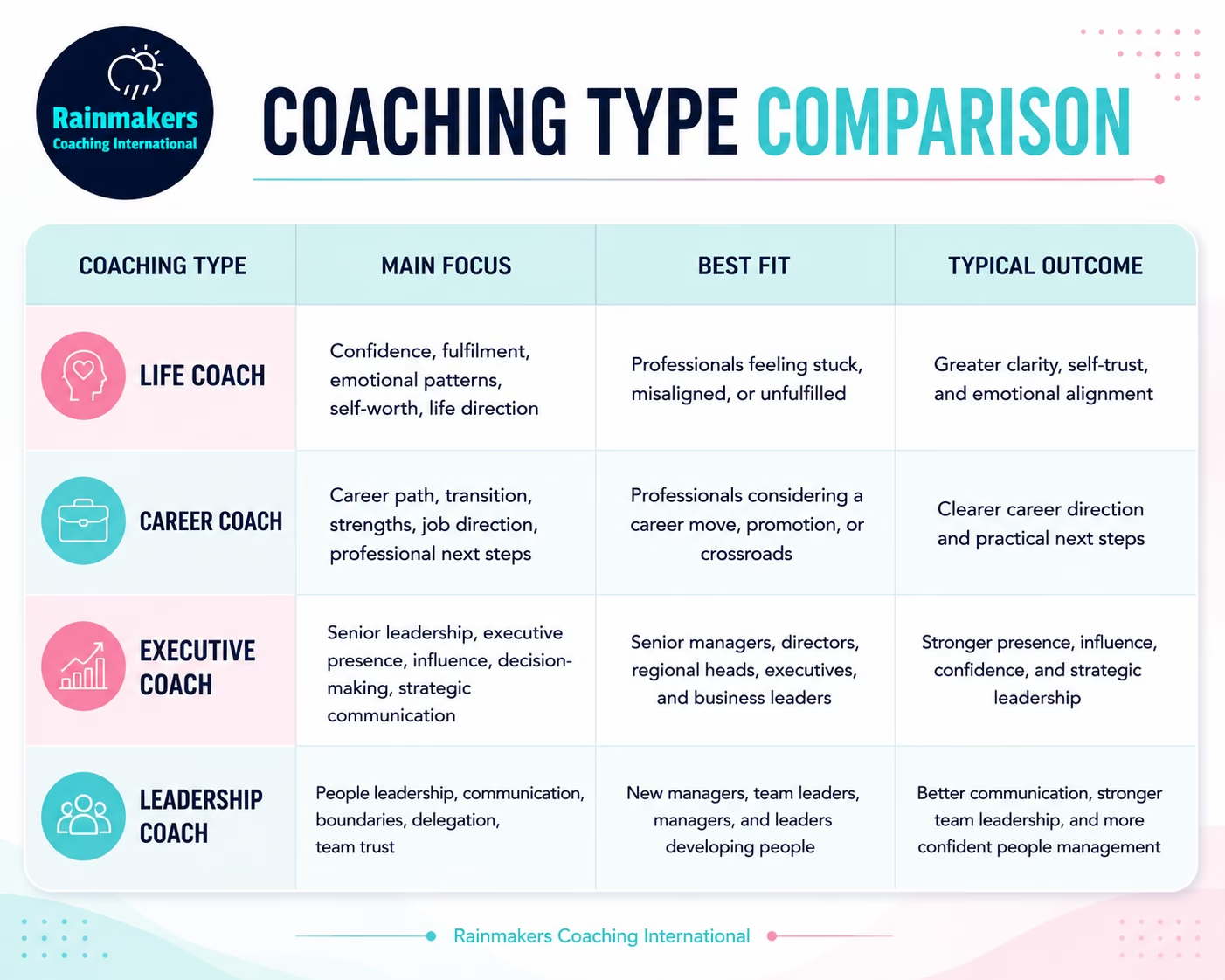
Still, each type of coach has a different primary focus.
Here is a simple comparison:
The deeper question is not:
“Which coach has the most impressive title?”
The better question is:
“Where do I need the most support right now – my life, my career, my leadership, or my self-trust?”
Life Coach vs Career Coach
A life coach focuses on broader personal growth, confidence, fulfilment, emotional patterns, identity, and life direction.
A career coach focuses more specifically on career clarity, job direction, professional transitions, strengths, and next career steps.
You may need a life coach if your deeper question is:
“Who am I becoming?”
You may need a career coach if your deeper question is:
“What is my next professional move?”
Executive Coach vs Leadership Coach: Similarities and Key Differences
An executive coach and a leadership coach can overlap because both help leaders become more effective in how they communicate, influence, make decisions, manage pressure, and build trust with others.
Both may support you with:
Communication under pressure.
Confidence in leadership situations.
Difficult conversations.
Stakeholder influence.
Self-awareness.
Emotional regulation.
Executive or leadership presence.
Leading with greater clarity and steadiness.
The key difference is usually the level, scope, and complexity of the leadership challenge.
A leadership coach often supports managers, team leads, new leaders, and growing leaders who want to become more effective at leading people. The focus is usually on communication, delegation, feedback, team trust, boundaries, conflict conversations, and day-to-day people leadership.
An executive coach usually works with more senior leaders such as Senior Managers, Directors, Heads of Department, Regional Heads, VPs, General Managers, C-suite leaders, or business owners. The focus is often on strategic influence, executive presence, senior stakeholder management, decision-making under ambiguity, organisational complexity, visibility, and leading across functions, markets, or cultures.
A simple way to see the difference is this:
A leadership coach helps you become a stronger people leader.
An executive coach helps you become a stronger senior leader.
One is not better than the other.
It depends on the leadership seat you are in, the complexity you are carrying, and the kind of growth you need next.
Career Coach vs Executive Coach
A career coach helps you clarify your professional direction.
An executive coach helps you lead more effectively in your current senior role or prepare for a higher level of leadership responsibility.
You may need a career coach if you are asking:
“Where should I go next?”
You may need an executive coach if you are asking:
“How do I lead better where I am, or at the next level I am stepping into?”
In real life, these questions can be connected. You may be considering a career move because your current leadership role no longer feels aligned.
You may be stepping into a promotion and realising that your confidence, presence, and self-trust need to grow with the role.
This is why choosing a coach is not only about the category. It is about the real work you are ready to do.
How to Know What Type of Coach You Need
By this point, you may have a clearer understanding of the different coaching categories.
Now the question becomes more personal:
Which type of support fits the real issue I am facing now?
Use these five questions as a self-coaching guide.
Ask Yourself These 5 Questions Before Choosing a Coach
1. Is my biggest struggle personal, professional, or leadership-related?
If the struggle is mostly about confidence, self-worth, fulfilment, identity, or life direction, you may need a life coach.
If the struggle is mostly about career decisions, job direction, or your next professional move, you may need a career coach.
If the struggle is mostly about senior leadership, executive presence, influence, or decision-making under pressure, you may need an executive coach.
If the struggle is mostly about managing people, communication, boundaries, delegation, or team trust, you may need a leadership coach.
2. Do I need clarity, confidence, strategy, emotional support, or all of them?
Some people need a clear plan.
Some people need confidence to follow through.
Some people need emotional support because they are carrying invisible pressure.
Some people need all three.
There is nothing wrong with needing deeper support. It simply means the issue may not be solved by another checklist or productivity hack.
Some Coaches Focus More on Strategy. Some Coaches Focus More on Inner Work.
Beyond choosing between a life coach, career coach, executive coach, or leadership coach, it is also important to understand the coach’s coaching approach.
Some coaches are excellent at strategy.
They may help you create a career plan, prepare for interviews, improve communication, structure your goals, build leadership habits, or make practical decisions.
Some coaches are stronger in the inner work.
They may help you understand your emotional patterns, rebuild confidence, shift limiting beliefs, strengthen self-trust, heal old identity blocks, and become more grounded in who you are.
Neither approach is better.
It depends on what you need most right now.
If you already feel clear and confident, but need a practical plan, a strategy-focused coach may be helpful.
But if you keep repeating the same patterns – overthinking, self-doubt, people-pleasing, fear of visibility, perfectionism, or emotional overwhelm, you may need a coach who can help you work at the deeper level.
So ask yourself:
Am I mainly looking for more strategies?
Or am I looking to develop myself so I can finally follow through on the strategies I already know?
Because many high achievers do not lack information.
They have read the books.
They have attended the courses.
They have saved the frameworks.
They may already know what they “should” do.
But knowing what to do is not always the same as being able to do it with confidence, steadiness, and self-trust.
That is where deeper coaching can make a difference.
3. Am I trying to make a decision, or become a different version of myself?
If you mainly need to make a specific decision, such as whether to stay, leave, change role, or pursue a promotion, career coaching may be helpful.
If you are being invited into a bigger version of yourself – more confident, visible, grounded, courageous, or self-trusting – you may need deeper coaching support that includes life, executive, or leadership coaching.
4. Is this issue affecting only my work, or many areas of my life?
Sometimes a work problem stays at work.
But sometimes it follows you home.
You may notice that the same self-doubt affects your leadership, relationships, parenting, communication, decisions, and personal confidence.
When the pattern shows up across different areas of life, the work may need to go deeper than career strategy alone.
5. Do I want short-term direction, or deeper transformation?
There is a difference between wanting a next step and wanting a new way of being.
Both are valid.
But it helps to be honest.
If you want short-term direction, you may need a coach who can help you clarify options and create a practical plan.
If you want deeper transformation, you may need a coach who can help you understand and shift the beliefs, emotional patterns, and identity blocks that keep you repeating the same cycle.
What Type of Coach Do I Need? A Simple Decision Guide
Choose a life coach if your deeper question is:
“Who am I becoming, and how do I live with more confidence and alignment?”
Choose a career coach if your deeper question is:
“What is my next professional direction?”
Choose an executive coach if your deeper question is:
“How do I lead, influence, and make decisions at a higher level?”
Choose a leadership coach if your deeper question is:
“How do I become a more confident and effective leader of people?”
The right coach should help you feel clearer, not more confused.
More grounded, not more pressured.
More honest with yourself, not more ashamed of where you are.
Because coaching is not about proving that something is wrong with you.
It is about creating the support, structure, and reflection you need to grow into the next version of yourself.
What If You Need More Than One Type of Coach?
Many high-achieving professionals do not fit neatly into one coaching category.
You may begin by searching for a career coach because you feel unclear about your next professional move.
But as you reflect more deeply, you may realise the real issue is not only career direction.
It may also be self-doubt.
Or fear of failure.
Or the pressure to choose the “right” path so you do not disappoint anyone.
You may begin by searching for an executive coach because you want stronger executive presence.
But underneath that goal, you may realise visibility makes you feel exposed.
You may over-prepare before meetings.
You may soften your opinions too quickly.
You may hold back because you do not want to sound too strong, too emotional, or too demanding.
You may begin by searching for a leadership coach because you want to lead your team better.
But as you look closer, you may realise the issue is not only communication.
It may be boundaries.
Self-trust.
People-pleasing.
Or the fear of being disliked when you have to make difficult decisions.
You may begin by searching for a life coach because you feel lost, unfulfilled, or disconnected from yourself.
But the deeper work may also touch your career, leadership identity, confidence, relationships, and the way you make choices.
This is why coaching is not always linear.
Sometimes you come in wanting a strategy.
But what you really need is to understand the pattern underneath the strategy.
Sometimes you come in wanting clarity.
But what you really need is the courage to act on the clarity you already have.
Sometimes you come in wanting confidence.
But what you really need is to release the old belief that taught you to doubt yourself in the first place.
At Rainmakers Coaching International, coaching often sits at the intersection of life, career, confidence, and leadership.
A Coaching Story: When Career Clarity Was Not Just About Career
One client came to coaching because she felt stuck in her career.
On the surface, it looked like a career direction issue.
She was capable, hardworking, and respected in her organisation. But she felt increasingly disconnected from her role. She wondered whether she should stay, leave, or look for something completely different.
At first, she thought she needed a clearer career strategy.
But as we worked together, it became clear that the issue was not only about her job.
She had spent years choosing what looked responsible, impressive, and acceptable to others.
She was good at meeting expectations.
But she had lost touch with what was truly aligned with her own strengths, values, and inner voice.
The deeper work was not only career coaching.
It was also confidence work.
It was life direction work.
It was leadership identity work.
She needed to trust that her gifts mattered.
She needed to stop dismissing what gave her energy.
She needed to find the courage to speak honestly about the kind of work that would allow her to grow.
Over time, she became clearer about who she was, what she valued, and how she wanted to contribute.
With that clarity, she was able to have more honest conversations at work.
Instead of forcing herself into a path that no longer fit, she began advocating for a role that allowed her to use her strengths more fully.
Eventually, a new role was created for her.
Not because she pushed harder.
But because she became clearer, more confident, and more able to communicate what was true for her.
That is the power of coaching at the intersection of life, career, confidence, and leadership.
Sometimes the question is not simply:
“What job should I choose?”
Sometimes the deeper question is:
“Who do I need to become so I can finally choose what is aligned with me?”
The work is not only about what you should do next.
It is also about who you are becoming as you take that next step.
This is where deeper transformation happens.
You begin to release what no longer serves you.
You begin to reprogram the beliefs and identity that support who you are becoming.
You begin to recondition new behaviours through aligned, strategic action.
So instead of asking only:
“Which type of coach do I need?”
You may also want to ask:
“What kind of growth am I truly ready for?”
Because the right coaching support should not force you into a box.
It should help you see yourself more clearly, move forward more honestly, and lead your life from a place of deeper self-trust.
Coaching vs Therapy vs Mentoring
When you are looking for support, it is also helpful to understand what coaching is and what coaching is not.
This matters because many people use these terms interchangeably.
They may say they need a coach when they actually need therapy.
They may look for a mentor when they want advice from someone who has walked a similar path.
They may look for a coach when what they truly need is not another answer, but a space to develop clarity, confidence, and self-trust.
None of these forms of support is better than the other.
They simply serve different purposes.
Coaching vs Therapy: Do I Need a Coach or Therapist?
Coaching is usually focused on growth, clarity, goals, mindset, behaviour, and future-oriented action.
A coach helps you understand where you are now, where you want to go, what may be getting in the way, and how to move forward with greater awareness and responsibility.
Therapy is usually more appropriate when you need support for mental health treatment, clinical concerns, trauma, severe emotional distress, diagnosis, or psychological symptoms that affect your daily functioning.
You may benefit from therapy if you are experiencing intense anxiety, suicidal thoughts, trauma symptoms, or difficulty functioning in daily life.
You may benefit from coaching if you are generally functioning, but want support with growth, confidence, direction, leadership, decision-making, or personal transformation.
A simple way to think about it is this:
Therapy often helps you heal and stabilise.
Coaching often helps you grow and move forward.
There can be overlap, especially when coaching involves emotional patterns or self-belief. But coaching should not replace professional mental health care when clinical support is needed.
If you are experiencing severe emotional distress, trauma symptoms, thoughts of self-harm, or symptoms that affect your safety or daily functioning, it is best to seek support from a licensed mental health professional.
Coaching vs Mentoring: What Is the Difference?
A mentor usually shares guidance based on their own experience.
They may say:
“This is what worked for me.”
“This is what I would do.”
“Here is what I learned in my own career or leadership journey.”
Mentoring can be very helpful when you want wisdom from someone who has walked a similar path.
Coaching is different.
A coach may share perspective, but the deeper work is not about copying someone else’s path.
It is about helping you understand yourself, your patterns, your values, your strengths, and your next aligned step.
A mentor may help you learn from their experience.
A coach helps you learn from your own inner wisdom.
Signs You Are Ready to Work With a Coach
You may not need to have everything figured out before working with a coach.
In fact, many people begin coaching because they do not have full clarity yet.
They only know that something needs to change and they have a strong desire to change.
Maybe you have been thinking about the same issue for months, or even years.
Maybe you keep telling yourself, “I should be able to figure this out on my own.”
Maybe you have read the books, listened to the podcasts, attended the courses, and still find yourself repeating the same patterns.
That does not mean you are failing.
It may simply mean you need a different kind of support.
Your mind may already be open because of all the knowledge you have collected. But now, you may need help applying that knowledge consistently in real life.
As learning expert Jim Kwik often teaches, knowledge alone is not power. It becomes powerful when we apply it.
That is often where coaching becomes valuable.
Not because you do not know enough.
But because you are ready to turn what you know into who you become.
You May Be Ready for Coaching If…
You are tired of thinking in circles or feeling stuck in your own mind-maze.
You keep returning to the same issue, but nothing really changes.
You want change, but you are not sure where to begin.
You feel successful on the outside, but privately unsettled or misaligned.
You are open to being challenged with care.
You want both emotional support and practical strategy.
You are ready to take responsibility for your growth.
You do not want another quick fix; you want deeper change.
You are willing to look honestly at your patterns, beliefs, and choices.
You want to become more confident, clear, and aligned in how you live, work, and lead.
Coaching Works Best When You Are Willing, Not Perfectly Ready
Many high achievers wait until they feel ready.
They want to be clearer first.
More confident first.
Less emotional first.
More prepared first.
But coaching does not require you to arrive perfectly sorted.
It requires willingness.
Willingness to reflect.
To be honest.
To take responsibility.
To see what you may not have wanted to see before.
To take small, aligned steps even when the full path is not clear yet.
You do not need to be fearless before you begin.
You only need to be willing to stop abandoning yourself in the same old ways.
That may be the beginning of meaningful change.
A Self-Coaching Question to Begin With
Before you decide whether coaching is right for you, ask yourself:
If nothing changes in the next six months, what pattern will I be most tired of repeating?
Your answer may show you where the real work is.
It may be confidence.
It may be career direction.
It may be leadership presence.
It may be boundaries.
It may be self-trust.
And sometimes, acknowledging the real pattern is already the first act of courage.
How to Choose the Right Coach for You
Once you have a clearer sense of the type of coach you may need, the next question is:
How do I choose the right coach for me?
This matters because coaching is personal.
You are not only choosing a service.
You are choosing a space where you can be honest about your doubts, decisions, fears, patterns, and growth.
The right coach should not make you feel rushed, pressured, or small.
The right coach should help you feel more honest, more grounded, and more able to take your next step.
Whether you are looking for a life coach in Singapore, career coach in Singapore, executive coach in Singapore, leadership coach in Singapore, or an online coach who works across regions, here are a few things to look for.
Look for a Coach Who Understands Your Context
A coach does not need to have lived your exact life to support you well.
But it helps when they understand the world you operate in.
For high-achieving professionals, senior managers, directors, regional heads, and executives, your challenges are rarely one-dimensional.
You may be managing ambition, pressure, leadership visibility, organisational politics, family expectations, cultural dynamics, financial responsibilities, and the quiet fear of falling behind.
On the outside, you may look capable.
But internally, you may be carrying more than people realise.
So look for a coach who can understand both sides of your world:
The outer performance.
And the inner pressure.
The goals you want to achieve.
And the emotional patterns that may be holding you back.
The strategy you need.
And the self-trust you may need to rebuild.
Look for a Coach Whose Method Matches the Transformation You Need
A good coach should be able to explain how they work.
Not in a rigid or mechanical way.
But in a way that helps you understand the journey.
Some top coaches are excellent at strategy.
They may help you create a plan, structure your goals, prepare for interviews, build leadership habits, improve communication, or map out practical next steps.
This can be useful when you already feel clear, confident, and ready to act.
But many high-achieving professionals do not struggle because they lack strategies.
They already know what they “should” do.
They know they should speak up.
They know they should set boundaries.
They know they should stop overthinking.
They know they should make the decision.
They know they should stop waiting until they feel perfectly ready.
The real challenge is often deeper.
They may not yet trust themselves enough to act.
They may still carry old beliefs about who they are allowed to be.
They may know the strategy, but their identity has not caught up with their next level of growth.
This is where inner work and identity development become powerful.
At Rainmakers Coaching International, the work goes beneath surface strategy.
It helps you understand the beliefs, emotional patterns, and identity blocks that keep you repeating the same cycle – so you can become the version of yourself who can act with more clarity, confidence, and self-trust.
Because strategy can show you the next step.
But identity determines whether you believe you are the kind of person who can take it.
This is why Rainmakers coaching is not only strategy-led.
It is identity-led.
Through the Rainmakers Transformation process of Release, Reprogram, and Recondition™️, you begin to release what no longer serves you, reprogram the beliefs and identity that support who you are becoming, and recondition new behaviours through aligned action.
That is how change becomes more than an idea.
It becomes something you begin to live.
Some coaching helps you build a better plan. Rainmakers coaching helps you become the person who can finally live that plan with confidence, alignment, and self-trust.
Look for Emotional Safety and Honest Challenge
The right coach should create a space where you feel safe enough to be honest, but not so comfortable that you stay the same.
This balance matters.
If a coach only comforts you, you may feel understood but unchanged.
If a coach only challenges you, you may feel judged, pressured, or unsafe.
Good coaching holds both.
Warmth and truth.
Compassion and accountability.
Emotional safety and honest challenge.
You want a coach who can listen deeply, but also reflect what you may not be seeing.
A coach who can support you, but not enable your avoidance.
A coach who can challenge your limiting beliefs without shaming you for having them.
Because growth often requires courage.
But courage grows better in a space where you feel respected, not criticised.
Look for Proof, Experience, and Alignment
Before choosing a coach, look at their experience, testimonials, client stories, qualifications, and body of work.
Do they work with people like you?
Do their articles, videos, posts, or talks make you feel understood?
Do they speak to the real issues you are facing?
Do they seem grounded and thoughtful, or do they promise instant transformation?
Do they have a coaching style that feels aligned with what you need?
Some people need a coach who is very strategic and structured.
Some people need a coach who is deeper, more reflective, and emotionally attuned.
Some people need both.
There is no one-size-fits-all answer.
The right fit is the coach who helps you feel safe enough to be honest, and strong enough to grow.
Choose a Coach Who Helps You Take Responsibility Without Shame
Coaching is not about blaming you for where you are.
It is also not about rescuing you from your own life.
Good coaching helps you take responsibility in a way that feels empowering, not shaming.
It helps you see:
What patterns are repeating.
What beliefs may be limiting you.
What choices are still available.
What support you need.
What aligned action you can take next.
This is especially important for high achievers.
Because many high achievers already blame themselves enough.
They do not need more self-criticism.
They need a space where they can see themselves honestly, rebuild trust with themselves, and move forward with clarity.
A helpful question to ask when choosing a coach is:
Do I feel more connected to myself after listening to this coach or more pressured to become someone I am not?
That answer matters.
Because the right coach should not pull you further away from yourself.
The right coach should help you come home to who you truly are, and grow from there.
Final Reflection: What Type of Coach Do You Really Need?
Before you decide what type of coach you need, pause and ask yourself:
Is my real blockage in my life direction, my career direction, my leadership growth, or my self-trust?
This question matters because the support you choose should match the transformation you are truly seeking.
Maybe you do not only need a new career strategy.
Maybe you need to trust your own direction again.
Maybe you do not only need stronger executive presence.
Maybe you need to feel safe being seen, heard, and challenged.
Maybe you do not only need better leadership skills.
Maybe you need the confidence to lead with both clarity and compassion.
Maybe you do not only need life direction.
Maybe you need to reconnect with the part of you that has been quietly waiting for permission to choose something more aligned.
You may not have the full answer yet.
That is okay.
Clarity often begins with one honest question.
What kind of support would help me become more confident, aligned, and true to myself in this season of life?
The right coach should not force you into a box.
The right coach should help you understand yourself more deeply, move forward more honestly, and grow into the version of yourself you are ready to become.
Because sometimes, the real question is not only:
“What type of coach do I need?”
Sometimes the deeper question is:
“Who am I ready to become?”
Still Unsure What Type of Coach You Need?
Most people do not come to coaching with a neat label.
They come with a question.
“Why do I feel stuck, even though I have achieved so much?”
“Why do I keep doubting myself when I know I am capable?”
“Why does my career look successful, but no longer feel aligned?”
“Why am I ready for more, but still holding myself back?”
The answer may not be obvious at first.
What looks like a career problem may be a confidence problem.
What looks like a leadership challenge may be a self-trust challenge.
What looks like a lack of direction may be a deeper need to reconnect with who you are becoming.
That is why the first step is not to choose the “perfect” type of coach.
The first step is to understand what is really going on.
If you are unsure whether you need life coaching, career coaching, executive coaching, or leadership coaching, you are welcome to apply for a complimentary 90-minute Coaching Call with Coach Rainy.
This is a focused, confidential conversation to explore where you are now, what feels unclear, what you want to change, and whether coaching is the right support for you.
You do not need to arrive with perfect clarity.
You only need honesty, openness, and a genuine desire to move forward.
Because each call is personalised and in-depth, availability is intentionally limited.
Apply for your complimentary 90-minute Coaching Call and take the first step toward greater clarity, confidence, and self-trust.
Schedule your call HERE
FAQ
What type of coach do I need?
What is the difference between a life coach and a career coach?
What is the difference between a life coach and an executive coach?
What is the difference between an executive coach and a leadership coach?
Do I need a coach or a therapist?
Can one coach help with life, career, confidence, and leadership?
How do I choose the right coach in Singapore or online?
What’s Next?
Find out if your confidence level is undermining your success here.
Wondering if you are ready for coaching? Take this coaching readiness questionnaire
