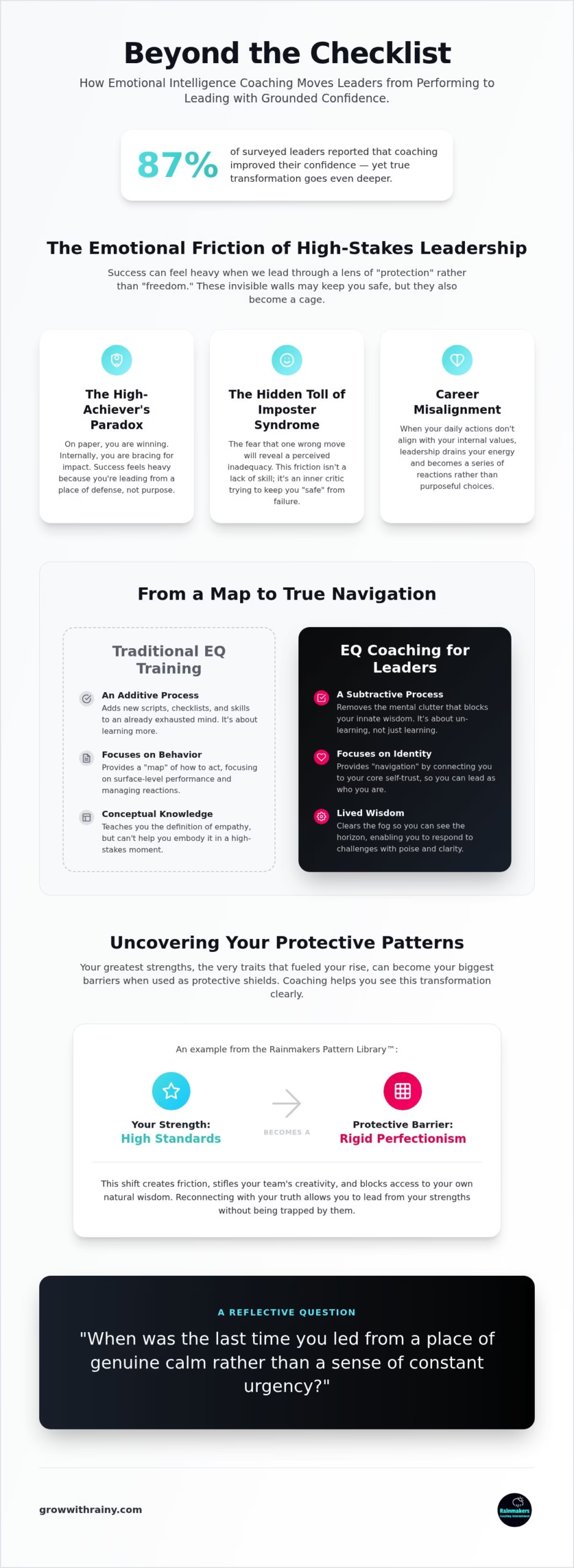
What if the professional mask you’ve spent years perfecting is actually the very thing holding your leadership back? You’ve likely mastered the corporate EQ checklists and the polite feedback loops, yet you might still feel like a fraud when the boardroom doors close. If you’re tired of the constant overthinking and the mental clutter that follows every high-stakes decision, you aren’t alone. A 2021 study found that 87% of surveyed leaders reported that coaching improved their confidence; however, true transformation requires more than just new skills. This is where emotional intelligence coaching for leaders shifts from a performance metric to a path for reconnecting with your truth.
We agree that leading a team shouldn’t feel like a heavy, exhausting performance. You deserve a sense of grounded confidence that doesn’t vanish the moment a crisis hits. In this article, you’ll discover how to identify the invisible protective patterns that hinder your natural wisdom and create unnecessary friction in your professional relationships. We’ll explore how moving beyond traditional training allows you to lead with a sense of clarity and purpose that feels genuinely meaningful.
Key Takeaways
- Understand why traditional EQ checklists often fail and how emotional intelligence coaching for leaders facilitates a deeper shift toward genuine self-trust.
- Identify the seven invisible protective strategies within the Rainmakers Pattern Library that create mental clutter and hinder your natural leadership wisdom.
- Explore the science of grounded leadership by connecting emotional regulation to your brain’s executive function for more decisive, clear-headed action.
- Learn how to use the Rainmaker’s Transformation System™ to release defensive habits and reclaim your innate treasures of courage and purpose.
The Emotional Friction of High-Stakes Leadership
“I hope no one asks me a question I can’t answer today.” That quiet thought often ripples through the minds of even the most seasoned executives. You’ve reached the summit, yet the view feels clouded by a persistent, heavy fog.
This is the High-Achiever’s Paradox. On paper, you are winning. Internally, you are bracing for impact. Success often feels heavy because many of us lead through a lens of “protection” rather than “freedom.” We build invisible walls to stay safe, but those same walls eventually become a cage.
Many leaders believe that if they just work harder or maintain stricter discipline, the exhaustion will fade. It won’t. This friction exists because you are likely leading from a place of defence. You’ve developed strategies to keep your reputation intact, but these patterns also block your access to your own natural wisdom.
This is why Emotional Intelligence is more than a corporate buzzword; it’s the foundation of how you relate to yourself and your team. When you feel this weight, emotional intelligence coaching for leaders offers a path back to your most grounded self. It isn’t about learning new tricks to manage people. It’s about releasing the internal friction that makes leadership feel like a burden.
When Success No Longer Feels Meaningful
It’s possible to have everything you worked for and still feel profoundly stuck. When your daily actions don’t align with your internal values, you experience career misalignment. This gap drains your energy and makes emotional regulation feel like an uphill battle.
When success no longer feels meaningful, your leadership becomes a series of urgent reactions rather than purposeful choices. Take a moment to reflect. When was the last time you led from a place of genuine calm rather than a sense of constant urgency?
The Hidden Toll of Imposter Syndrome
For many, imposter syndrome in senior leaders manifests as sudden emotional volatility or a compulsive need to over-control every outcome. High-performers are often the most susceptible because the stakes are undeniably high.
You feel the weight of every decision, fearing that one wrong move will reveal a perceived inadequacy. This mental friction isn’t a lack of skill; it’s your inner critic acting as a misguided protective mechanism trying to keep you safe from failure.
Through emotional intelligence coaching for leaders, we don’t just manage these feelings. We understand their source and reprogram the response. How much energy are you spending today just trying to prove you belong in the room?
Why EQ Coaching for Leaders is Different from Training
Most leadership training programs treat emotional intelligence like a software update. They give you new scripts to follow and checklists to manage your team’s reactions. But when you are in a high-stakes board meeting and your heart starts racing, a checklist is the last thing you can access.
Emotional intelligence coaching for leaders is different because it isn’t about adding new skills to an already exhausted mind. It’s about reconnecting with your truth. This is a subtractive process. We work to remove the mental clutter that keeps you from accessing the wisdom you already possess.
In my work with senior executives, I often see the Rainmakers Principle in action. Your greatest strengths, the very traits that fuelled your rise to the top, often become your biggest barriers when they are used as protective shields. For example, your high standards might have evolved into a rigid perfectionism that stifles your team’s creativity.
Coaching focuses on identity and self-trust rather than just surface-level behaviour. It’s a grounded approach that helps you lead from who you are, not just what you know. When you lead from your center, you don’t have to perform. You simply are.
From Conceptual Knowledge to Lived Wisdom
Knowing the definition of empathy is easy. Embodying it while you’re delivering difficult news is a different matter entirely. Training provides the map, but coaching is about the navigation.
Using the Rainmakers Lens, we look past the professional mask to see the innate treasures that have been buried under years of corporate expectations. It’s like clearing the fog from a ship’s bridge. You don’t need a new compass; you just need to be able to see the horizon clearly again. This clarity allows you to respond to challenges with poise instead of reacting with defensiveness.
The Role of Self-Trust in Decision Making
At the heart of this work is the ability to rely on your own internal signal. Learning how to trust yourself again is the foundation of genuine emotional intelligence. When you trust your own judgment, the desperate need for external validation or excessive control begins to dissolve.
You no longer need to over-analyze every email or second-guess every conversation. You become decisive because you are clear. Decision-making becomes a quiet, internal confirmation rather than an exhausting external debate.
If you’re ready to move from knowing EQ to embodying it, we can explore these patterns together in a complimentary 90-minute coaching conversation.
Reflection: Where are you currently seeking external safety instead of trusting your own internal clarity?
Releasing the Protective Patterns That Cloud Your Leadership
Many leaders view their habits as fixed personality traits. If you’re someone who meticulously checks every detail, you might call yourself a perfectionist. If you’re the one who carries the weight of the whole team’s emotions, you might think you’re just being supportive.
In the context of emotional intelligence coaching for leaders, we look deeper. We use the Rainmakers Pattern Library™️ to identify seven invisible protective strategies. These aren’t flaws to be fixed; they’re tools you once used to feel safe in high-pressure environments. By identifying these patterns, we move from a state of “protection” to a state of “freedom.”
These strategies often masquerade as high emotional intelligence. For example, being highly attuned to others’ needs or holding yourself to extreme standards can feel like empathy or excellence. In reality, they are often defensive uses of EQ. You’re using your awareness to prevent conflict or avoid criticism before it happens.
Another common pitfall for senior executives is Over-Responsibility. This is when you feel personally responsible for every team member’s happiness or every project’s minute success . This doesn’t just lead to burnout ; it prevents your team from developing their own resilience. Coaching helps you shift the focus from fixing these supposed flaws to simply releasing strategies that no longer serve your growth.
Perfectionism and Overthinking: The Efficiency Killers
In high-stakes environments, perfectionism and overthinking are frequently used to mask a deep-seated fear of uncertainty. Rainy’s Observation suggests that overthinking is actually a strategy to create a sense of safety through data. You believe that if you can just analyze enough variables, you can control the outcome and avoid failure. However, this mental clutter only leads to hesitation.
True leadership comes from a state of grounded self-mastery. This is where you can make decisive choices despite uncertainty, trusting your internal compass rather than a mountain of spreadsheets. When you stop trying to think your way into safety, you start leading from your truth.
Approval-Seeking vs. Authentic Connection
There’s a significant difference between genuine empathy and the need for people-pleasing. Authentic connection requires you to be honest, even when the truth is uncomfortable. If you’re constantly seeking approval, you’re leading from a place of lack.
You might fear that your value will disappear if you make a difficult, unpopular choice. But your worth as a leader is inherent; it doesn’t fluctuate with the latest office sentiment. When you release the need for constant validation, you can build professional relationships based on transparency rather than performance. You become a leader people can trust because they know where you stand.
As you consider your own daily interactions, which of these patterns currently feels like the loudest voice in your head?
Research-Backed Strategies for Grounded Leadership
Psychological research confirms that emotional intelligence is not just a personality trait; it is a neurological advantage. Studies show that emotional intelligence has a 58% influence on job performance, and 90% of top performers possess high levels of EQ.
When you experience a high-stakes trigger, your amygdala can take over, causing your prefrontal cortex, the seat of your executive function, to go offline. Emotional intelligence coaching for leaders works to keep this executive center active. It allows you to stay present and decisive even when the pressure is mounting. This shift moves you from a state of survival to a state of grounded authority.
At Rainmakers, we facilitate this shift through the signature Rainmakers Transformation System™. This process focuses on identity-level change rather than surface-level habit tracking. It involves three distinct phases: Release, Reprogram, and Recondition.
By addressing the root of your internal friction, you can access the “hidden treasures” of wisdom and courage that are often buried under corporate expectations. To begin grounding yourself in real-time, try these three strategies:
- Label the emotion: Simply naming what you feel (e.g., “I feel a sense of hesitation”) reduces amygdala activity.
- Physical grounding: Focus on the sensation of your feet on the floor to pull your attention out of a mental loop.
- The intentional pause: Take one full, conscious breath before responding to a challenging comment. This small gap allows your prefrontal cortex to re-engage.
The Release Phase: Identifying Triggers
You cannot release a protective strategy until you notice it in action. This usually starts with a physical sensation of friction. Do you feel a tightness in your chest before a meeting? Do your shoulders rise toward your ears when you receive a critical email? These are the physical signals of an invisible shield being deployed.
To help identify your baseline triggers and patterns, taking a self-confidence assessment can provide the clarity you need. In this system, Release is defined as the intentional act of letting go of the need for that invisible shield. You learn to trust that you are more effective without the armour.
Reprogramming the Leadership Monologue
Once the shield is released, you must shift the internal narrative that kept it in place. This isn’t about positive thinking; it’s about compassionate, non-judgmental insight. You might shift from “I must be perfect to keep my team’s respect” to “I am grounded in my truth.”
This internal shift changes how you show up in every interaction. You can also use a simple “If-Then” mental framework to navigate conflict. For example: “If a team member challenges my direction, then I will ask a curious question first, trusting that my authority is not threatened by their perspective.”
Book your complimentary 90-minute coaching conversation
What is one physical sensation you notice when you feel the need to protect your professional reputation?
The Rainmakers Path to Emotional Self-Mastery
Leadership in a global hub like Singapore often demands a level of performance that can feel unsustainable. You’re expected to be the anchor for your team while navigating complex, high-stakes dynamics. This is why executive coaching in Singapore through the Rainmakers lens is designed specifically for the senior professional who is ready to stop performing and start leading.
We don’t look for what is “broken” within you. Instead, we focus on the “hidden treasures”, the innate wisdom, courage, and purpose, that have always been there, waiting to be reclaimed. This is the core of emotional intelligence coaching for leaders. It’s about recovering the parts of yourself that were set aside in the name of professional survival.
Transformation isn’t just a theory; it’s a lived experience. You can see evidence of this shift in our breakthrough stories, where leaders just like you have moved from mental clutter to profound clarity. These are individuals who realized that their emotional intelligence was a tool for connection, not just a defensive strategy.
They stopped leading from a place of “protection” and started leading from a place of “freedom.” This shift doesn’t just improve your performance; it changes how you feel when you wake up in the morning. You begin to lead with inner strength that doesn’t require a mask. To further support this journey, Success369 offers specialized alignment frameworks and retreats designed to foster sustainable success for individuals and organizations.
Building Rock Solid Confidence
True authority doesn’t come from a title; it comes from a deep sense of self-trust. Learning how to build rock solid confidence is the ultimate outcome of this journey. Through our 3R Integration process, we ensure that the shifts you make aren’t just temporary fixes. We work to make self-trust a fundamental part of your identity.
When you move from a place of fear to a place of grounded self-trust, your leadership style changes. You become more decisive, more empathetic, and significantly more resilient. You no longer need to over-manage because you trust your team and, more importantly, you trust yourself.
Your Next Step Toward Clarity
If you’re looking for a structured path, the Building Rock Solid Confidence Program offers a clear roadmap to emotional self-mastery. It’s a space where you can lower your defenses and reconnect with your truth in a way that feels safe and professional. You don’t have to carry the weight of your leadership alone.
I invite you to reach out for a personalized conversation to see how we can uncover the treasures within your own leadership journey. This is the most direct way to experience the power of emotional intelligence coaching for leaders firsthand. It’s time to move toward a version of success that actually feels like you.
If you stopped protecting yourself today, who would you become as a leader?
Step Into Your Most Grounded Leadership
Leading a senior team shouldn’t feel like a heavy, daily performance. True effectiveness emerges when you stop managing your reputation and start reconnecting with your truth. We’ve explored how identifying invisible protective patterns and building self-trust allows you to shift from internal friction to natural, decisive wisdom.
By using the signature Rainmakers Transformation System™, you can finally move from reactive survival to a state of calm, grounded authority that inspires your team and protects your own well-being. For organizations that are ready to scale, Groundwork Growth Partners provides the senior-level guidance needed to ensure that this leadership evolution translates into sustainable business growth.
With over a decade of experience providing compassionate, non-judgmental insight to APAC executives, I’ve seen how emotional intelligence coaching for leaders acts as the ultimate catalyst for this identity-level change. It’s not about learning more skills; it’s about uncovering the treasures of innate strengths and purpose that are already within you.
You deserve to lead with a sense of peace that matches your professional achievements. If you’re ready to release the weight of overthinking and lead with authentic clarity, I’m here to guide that transition.
Reclaim your leadership clarity – Explore Executive Coaching in Singapore
You’ve already achieved so much. Now, it’s time to lead from a place of freedom and clarity that feels genuinely meaningful.
Frequently Asked Questions
What is the difference between emotional intelligence training and coaching?
Emotional intelligence training typically offers a generic curriculum focused on conceptual knowledge, while coaching is a bespoke journey of personal embodiment. Training teaches you what empathy is, but coaching addresses the internal friction preventing you from actually being empathetic under pressure. It is a shift from simply knowing a skill to reconnecting with your truth in every professional interaction.
How does emotional intelligence coaching help with imposter syndrome?
Coaching addresses the root cause of imposter syndrome by identifying the specific protective patterns you use to hide perceived inadequacies. Instead of just “faking it” until you feel successful, you learn to build genuine self-trust. This process reduces the mental clutter and emotional volatility that often follow a senior-level promotion or a high-stakes career move.
Can emotional intelligence really be developed in senior leaders?
Yes, research into neuroplasticity shows that the brain can develop new pathways for emotional regulation at any age. Emotional intelligence coaching for leaders leverages this ability to shift your brain’s response from reactive protection back to grounded executive function. It is less about learning new traits and more about uncovering the natural treasures of wisdom you already possess.
How long does it take to see results from EQ coaching?
You can often experience a significant shift in internal clarity after a single session. However, lasting transformation that changes your identity as a leader usually requires a commitment of six to twelve months. This timeframe allows you to release, reprogram, and recondition deep-seated habits so that your new sense of grounded authority becomes permanent.
Is emotional intelligence coaching suitable for high-performing introverts?
Absolutely, because EQ is about internal alignment and authentic connection rather than being loud or outgoing. High-performing introverts often thrive in the reflective, one-on-one nature of coaching. It helps them leverage their natural observation skills while releasing the exhausting pressure to “perform” a certain persona during social or high-stakes leadership settings.
What are the “protective strategies” mentioned in your coaching model?
Protective strategies are the seven invisible habits found in the Rainmakers Pattern Library™️, such as perfectionism, over-responsibility, and people-pleasing. These are strategies you developed earlier in your career to feel safe or successful in high-pressure environments. Coaching helps you release these shields so you can lead with freedom and clarity rather than staying stuck in a state of defense.
How do I know if I need an executive coach for emotional intelligence?
You might need a coach if your external success no longer matches your internal sense of peace. If you feel like a fraud despite your senior-level title, or if you struggle with constant overthinking and burnout, these are clear signals. Coaching provides the grounded support necessary to navigate high-stakes team dynamics without losing your sense of purpose or clarity.
Does EQ coaching involve clinical counseling or therapy?
No, emotional intelligence coaching for leaders is not clinical counseling, psychotherapy, or a job placement service. While the work is emotionally grounded and deeply personal, it is forward-looking and focused on professional mastery and personal growth. We facilitate a transformational journey toward self-trust rather than diagnosing or treating clinical mental health conditions.

Article by
Rainy Rainmaker
Rainy Rainmaker is the founder of Rainmakers Coaching International and a transformational coach for confidence, self-trust, and authentic leadership.
Based in Singapore, she helps high-achieving professionals, managers, and leaders who appear capable on the outside but feel quietly held back by self-doubt, overthinking, imposter feelings, burnout, or a loss of direction. Through her signature Rainmaker Transformation Journey™: Release, Reprogram, Recondition – Rainy helps clients uncover the insights already within them and turn inner clarity into aligned action that creates lasting change in life, career, and leadership.
